What should you compare?
Start with protein for the amount of milk you actually use, then compare milk type, nutrition and storage instructions.
| Priority |
What to check |
Your needs |
| Protein per portion |
Read protein per 100ml and calculate it for your usual portion. Tesco and Waitrose each list 3.4g per 100ml for filtered skimmed milk; Waitrose lists 7g per 100ml for SuperNutrio semi-skimmed milk. |
Will the milk itself make a substantial contribution to the amount of protein I intend to consume, or is it one ingredient among others? |
| Milk type and nutrition |
Check the skimmed or semi-skimmed description, then compare fat and energy on the same per-100ml basis. Tesco lists 0.1g fat and 35kcal per 100ml for its filtered skimmed milk; Waitrose lists 1.7g fat and 64kcal per 100ml for SuperNutrio. |
If I prefer skimmed milk, the higher protein figure on a semi-skimmed carton does not settle the choice on its own. |
| Storage after opening |
Separate unopened-life claims from post-opening instructions. Arla UK states up to three weeks unopened and seven days opened for Cravendale; Waitrose states up to one month unopened and seven days opened for its filtered skimmed milk. Follow the date and storage directions on your pack. |
I use small amounts at a time, so I need a carton size and post-opening period that suit how quickly I finish it. |
| Ingredients and allergens |
Check the current pack’s ingredients and allergen declaration. The Food Standards Agency identifies milk as an allergen risk; filtering or skimming does not make cow’s milk a milk-free product. |
If I need to avoid milk, I cannot choose a cow’s-milk product solely because it is filtered, skimmed or described as higher in protein. |
Which product lines are relevant?
These product lines illustrate different ways to balance skimmed milk, protein per portion and storage; a brand name alone does not establish the specification of every carton.
Cravendale
Arla UK’s Cravendale 2L filtered skimmed milk is a reference point for shoppers comparing nutrition with stated chilled life.
- Arla UK lists 3.6g protein per 100g and states up to three weeks unopened and seven days after opening.
- Its protein figure is stated per 100g, so check the units before comparing it with labels stated per 100ml.
Tesco
Tesco’s 2L own-label filtered skimmed milk offers a per-100ml nutrition label for comparing portions.
- Tesco lists 3.4g protein, 0.1g fat and 35kcal per 100ml, with a seven-day post-opening instruction.
- Check the current carton label when ordering, as product information can change.
Waitrose
Waitrose’s filtered British free-range skimmed milk is relevant when stated unopened and post-opening periods affect the choice.
- Waitrose lists 3.4g protein per 100ml and states up to one month unopened and seven days after opening.
- Use the purchased pack’s date and storage directions rather than treating those periods as a rule for all filtered milk.
M&S
M&S provides a plain skimmed-milk comparison, but its listed filtered milk is semi-skimmed rather than filtered skimmed.
- M&S lists 3.6g protein and 0.3g fat per 100g for its plain skimmed milk.
- Its filtered semi-skimmed listing gives 1.8g fat per 100g; check the milk type before comparing it as a skimmed option.
SuperNutrio
SuperNutrio is a protein-focused cow’s-milk alternative for shoppers willing to consider semi-skimmed milk.
- Waitrose lists 7g protein per 100ml for its SuperNutrio product.
- The same listing gives 1.7g fat per 100ml, and the product has a three-day post-opening instruction.
Skimmed milk options on Joybuy
These Morrisons UHT skimmed milk options provide an ordinary skimmed-milk comparison for this decision. If filtered milk is specifically what you want, check the carton’s product description for filtration; the stated three-day post-opening period should not be confused with the seven-day instructions on the filtered skimmed examples above.
 No image available
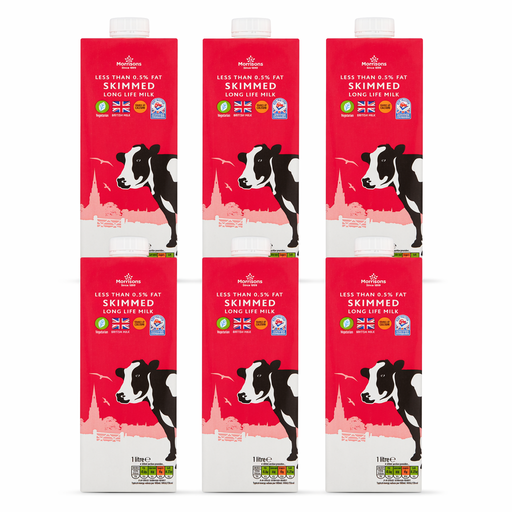
Morrisons British UHT Skimmed Milk, 1 litre (6 packs)
For drinks, cereal or cooking, the product information lists 3.5g protein, 0.1g fat and 33kcal per 100ml. This UHT milk can be stored in a cupboard before opening; refrigerate it after opening and use it within three days. Check the carton if you require filtered milk.
Joybuy
 No image available
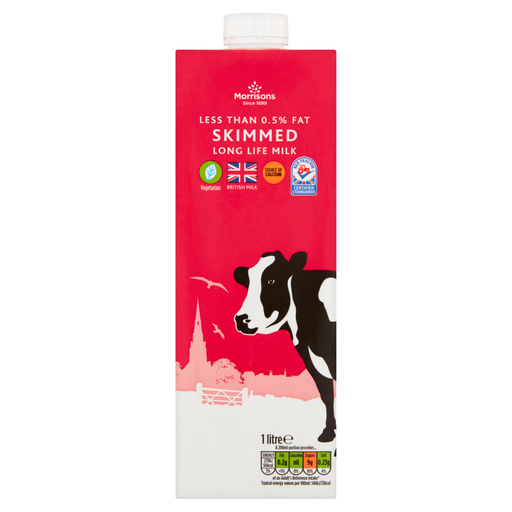
Morrisons British UHT Skimmed Milk, 1 litre
For a single carton of skimmed milk, the product information lists 3.5g protein, 0.1g fat and 33kcal per 100ml. It describes cupboard storage before opening, followed by refrigeration and use within three days once opened. Check the carton if filtration is part of your choice.
Joybuy
Common questions
Does filtering skimmed milk automatically increase its protein content?
No: filtering alone does not establish a higher protein figure. Tesco and Waitrose each list 3.4g per 100ml for their filtered skimmed milks, while M&S lists 3.6g per 100g for its ordinary skimmed milk. Check the units and protein figure on the specific carton rather than relying on “filtered”.
Should I choose filtered skimmed or protein-focused semi-skimmed milk?
Choose according to the amount of milk you use and whether skimmed milk is important to you. Tesco’s filtered skimmed milk lists 3.4g protein and 0.1g fat per 100ml; Waitrose lists 7g protein and 1.7g fat per 100ml for SuperNutrio semi-skimmed milk. The latter also has a shorter, three-day post-opening instruction.
How long does filtered skimmed milk keep after opening?
Follow the individual carton’s instructions. Arla UK states seven days after opening for Cravendale filtered skimmed milk, and Waitrose states seven days for its own-label filtered skimmed milk. Their unopened-life claims differ, so do not use those claims in place of the pack’s use-by date and storage directions.
Does filtering make cow’s milk suitable for someone with a milk allergy?
No. The Food Standards Agency identifies milk as an allergen risk; a cow’s-milk product does not become milk-free through filtering or skimming. Check the current carton’s ingredients and allergen declaration.
When should I ask about a high-protein diet?
Ask a relevant clinician if a health condition affects whether a high-protein diet is suitable for you. Berkshire Healthcare NHS Foundation Trust specifically advises people with CKD Stage 4 or higher to check with their GP, renal consultant or dietitian before following one.


