Who is this for?
The useful label checks depend on whether the drink is going into a pre-run breakfast, a post-run snack or a diet with specific allergen requirements.
Runners making breakfast with oat drink
If you add it to porridge, cereal or a smoothie, compare its carbohydrate per serving and any added vitamins and minerals alongside the rest of your meal. Check whether the carton needs refrigeration before opening if storage matters to your routine.
Runners planning post-run snacks
An oat drink can be part of a snack, but check its protein figure before relying on it alone. The UK Sports Institute advises including carbohydrate and protein in food after a run.
Buyers checking gluten and oat suitability
Look for an explicit gluten-free claim if gluten suitability matters, and read the current allergen declaration. The Food Standards Agency notes that oats remain an allergen even when a food is labelled gluten-free.
What should you check?
Start with the food or drink you will make, then compare the individual carton’s nutrition, fortification, allergen and storage information. “Filtered”, “barista” and “long-life” answer different questions and can appear on the same product.
| Priority | What to check | Your needs |
|---|
| Training meals |
Compare carbohydrate and protein per 100 ml, then consider the amount you actually use. Plan the other foods in a pre-run breakfast or post-run snack; try the combination during training. |
I’m adding oat drink to breakfast or a smoothie, not using the carton as my entire fuelling plan. After a run, I want the wider snack to contain both carbohydrate and protein, in line with UK Sports Institute guidance. |
| Fortification |
Read the individual label for added calcium, iodine and vitamins such as D and B12. The UK SACN and COT assessment says plant-drink nutrient content varies considerably and that UK organic plant drinks cannot be fortified. |
Oat drink regularly replaces dairy in my meals, so I want to know which nutrients this particular carton declares rather than assuming every variant is alike. |
| Storage |
Check for a long-life or UHT statement, instructions before opening and refrigeration instructions afterwards. Choose a pack size that fits how quickly you use it. |
Pantry storage before opening would help during a busy training week; I’ll still need to follow the opened-carton instructions. |
| Sugars and texture |
Compare sugars, total carbohydrate, energy and fat on the same per-100-ml basis where available. Treat a barista description as a clue about intended coffee use, not training performance. |
For everyday meals, I may prefer a no-sugars label; for coffee, texture may matter more. I’ll compare the actual nutrition panels before choosing between variants. |
| Filtering |
Identify exactly what the maker says is filtered, then read the nutrition panel and ingredients separately. ReRooted describes “Triple Filtered Water” in its Oat Whole product; that wording does not specify the drink’s fortification. |
I’m interested in a filtered product, but I still need its own carbohydrate, protein and ingredient information to decide whether it fits the meal. |
| Allergens |
Check the current pack for an explicit gluten-free claim and oat-allergen information. The Food Standards Agency defines gluten-free as no more than 20 mg/kg gluten in food as sold; oats must still be identified as an allergen. |
Gluten or oats affect which cartons I can consider, so I need the exact product’s label rather than a brand-wide assumption. |
Brand and retailer references
These examples show why the variant name and carton label matter more than a brand-wide assumption; they do not indicate which products a retailer currently stocks.
Oatly
Its UK oat-drink range includes different approaches to fortification and storage.
- Oatly says its Semi Oat Drink contains added vitamin D2, riboflavin, B12, calcium and iodine and can be stored at room temperature before opening.
- Do not transfer that nutrient profile to an organic variant: the UK SACN and COT assessment says organic plant drinks cannot be fortified in the UK.
Alpro
The UK range includes Original, No Sugars and Barista oat drinks.
- Alpro lists 6.4 g carbohydrate, 0 g sugars and 0.8 g protein per 100 ml for its Oat No Sugars drink, alongside added calcium and iodine.
- Check the protein in the portion you use rather than treating the drink alone as a post-run snack.
Minor Figures
Its Barista Oat is presented for coffee and everyday brewing.
- Minor Figures labels Barista Oat gluten-free and declares 13.2 g carbohydrate per 200 ml.
- It declares 0.7 g protein per 200 ml; check the other foods in a post-run snack.
Tesco
Its oat-drink category has listed own-label and other brands in long-life, organic and barista formats.
- The category offers a way to compare product formats and individual labels.
- A category listing does not establish the nutrient content of a particular carton; inspect that product’s details.
Sainsbury's
Its listing for Oatly Organic Oat Drink Long Life identifies that product as UHT.
- The listing illustrates a long-life option for shoppers comparing storage formats.
- Organic and UHT describe different attributes; neither establishes that the drink is fortified.
M&S
Its oat-drink variants illustrate substantial differences within one range.
- M&S lists added calcium, iodine and vitamins D and B12 for Plant Kitchen Whole Oat Drink.
- M&S says its separate Only 3 Ingredients Oat Drink is not fortified and is not suitable for coeliacs. Check the precise variant.
Joybuy oat-drink options
These long-life oat drinks offer choices for breakfasts, smoothies or coffee around training. Compare each carton’s declared nutrients and allergen information; a filtered process should be checked on the particular pack if it matters to you.
 No image available
Alpro Oat Original Long Life Drink, 8 × 1 L
For cereal or smoothies when you want a carton that can be stored before opening in a cool, dry place. The product information declares 6.3 g carbohydrate, 3.2 g sugars and 0.8 g protein per 100 ml, plus calcium, iodine and vitamins B2, B12 and D2. It identifies gluten-containing oats; check the pack if gluten or oat suitability matters.
View on Joybuy
 No image available
Oatly Barista Oat Drink Long Life, 6 × 1 L
A long-life barista variant listed for coffee, cereal and smoothies. Its product information declares 7.1 g carbohydrate, 3.4 g sugars and 1.1 g protein per 100 ml, with added calcium, iodine, vitamin D2, riboflavin and B12. Follow the carton’s refrigeration instructions after opening and check its oat-allergen declaration.
View on Joybuy
 No image available
Alpro Oat No Sugars Long Life Drink, 8 × 1 L
A long-life option listed for cereal, smoothies, tea and coffee. Its product information declares 6.4 g carbohydrate and 0.9 g protein per 100 ml, with calcium, iodine and vitamins B2, B12 and D2. The product text conflicts on naturally occurring sugars, so check the current carton before relying on the No Sugars description; it also identifies gluten-containing oats.
View on Joybuy
 No image available
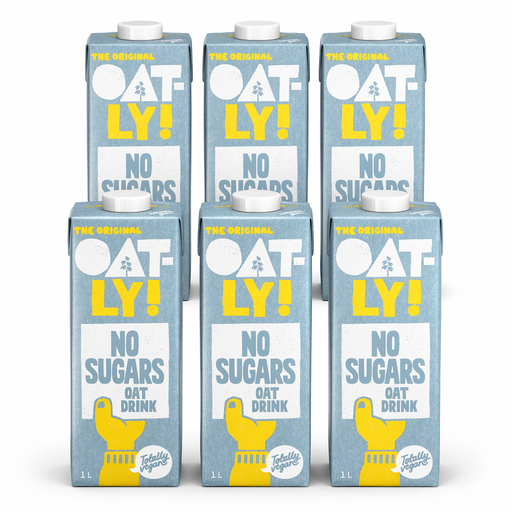
Oatly No Sugars Oat Drink, 6 × 1 L
This variant is described as suitable for ambient storage before opening. Its product information declares 6.3 g carbohydrate and 1 g protein per 100 ml, plus calcium, iodine, vitamin D2, riboflavin and B12. The product text conflicts on naturally occurring sugars: check the current carton before relying on the No Sugars description, and read its oat-allergen information.
View on Joybuy
 No image available
Alpro Barista Oat Long Life Drink, 8 × 1 L
A long-life variant with stated coffee uses if barista-style preparation matters alongside breakfast. Its product information declares 6.5 g carbohydrate, 3.0 g sugars and 0.8 g protein per 100 ml, with calcium and vitamins B2 and D. It identifies gluten-containing oats; check the allergen statement for the current pack.
View on Joybuy
Frequently asked questions
Is oat drink enough on its own before or after a training run?
Treat it as one part of a meal or snack, not a complete fuelling plan. Compare the carbohydrate and protein in your serving and the accompanying food; the UK Sports Institute advises including carbohydrate and protein in food after a run.
Does “filtered” tell me more about an oat drink’s nutrition?
A filtering description does not replace the product’s nutrition panel. For example, ReRooted names “Triple Filtered Water” in its Oat Whole ingredients; use that product’s own carbohydrate, protein, fortification and allergen information to assess the drink.
What if oat drink regularly replaces dairy in my meals?
Compare individual cartons for added calcium, iodine and vitamins rather than assuming they contain the same nutrients. The UK SACN and COT assessment reports considerable variation between plant drinks and says UK organic plant drinks cannot be fortified.
Is any oat drink suitable for someone avoiding gluten?
No brand-wide assumption is safe: check the exact pack for an explicit gluten-free claim and its allergen information. The Food Standards Agency defines gluten-free as no more than 20 mg/kg gluten in food as sold and notes that oats remain an allergen; Minor Figures labels its Barista Oat gluten-free, whereas M&S says its Only 3 Ingredients Oat Drink is not suitable for coeliacs.
Does a long-life oat drink replace water during a run?
Long-life describes storage before opening, not an on-run hydration plan. The NHS identifies water as an everyday drink and notes that lengthy physical activity can increase fluid needs; decide what to drink during a run separately from how you use oat drink in meals.


