Shared-kitchen batch cooks
If several colleagues cook rice, compare the amount of filtered water ready to use with the amount dispensed in one operation. A large feed tank alone does not tell you either figure.


For an office on a public mains supply in England or Wales, a purifier is not needed to make water suitable for cooking rice: the Drinking Water Inspectorate says suppliers must provide wholesome water suitable for cooking. Choose a countertop appliance if the team wants a different taste, less limescale or convenient dispensing, but check how much filtered water is ready for a saucepan, who will maintain the unit and, for reverse osmosis (RO), how its waste stream is handled. Investigate an unexplained change in the tap water before treating a filter as the solution.
If several colleagues cook rice, compare the amount of filtered water ready to use with the amount dispensed in one operation. A large feed tank alone does not tell you either figure.
For teams seeking a different taste or less limescale, the treatment method matters more than an advertised stage count. The Drinking Water Inspectorate says public mains water in England and Wales must already be suitable for cooking; a preference for filtered water is a separate reason to buy.
A refillable appliance needs someone to clean it, replace the correct cartridge and follow its operating instructions. The Drinking Water Inspectorate warns that neglected domestic water-treatment devices can accumulate deposits and bacteria.
Choose it when: The office has a public mains supply in England or Wales and has no particular taste or dispensing requirement.
Consider: If colour, particles, taste or odour change unexpectedly, ask the water company for advice and investigate a possible building-pipe problem rather than relying on a filter to fix its cause.
Choose it when: The team specifically wants an RO process and a refillable, non-plumbed unit; available models differ in their hot-water and batch-dispensing arrangements.
Consider: RO produces a treated stream and a concentrated waste stream, as the Drinking Water Inspectorate explains, so someone must manage the waste water.
Choose it when: Taste, limescale and hot water on demand are the priorities, without a requirement for RO.
Consider: A cartridge-based dispenser is not interchangeable with RO; its tank, dispensing capacity and cartridge upkeep still need to suit the kitchen.
| Concern | Buying check | Who this matters to |
|---|---|---|
| Water ready for a batch | Compare feed-tank capacity with purified-water capacity and the largest single dispense; check whether filtration takes time. | If I fill a saucepan while colleagues also use the kitchen, I want enough filtered water without repeated refills or long waits. Around 38% of consumers put batch capacity and dispensing first. |
| Reason for filtering | Decide whether the goal is taste or limescale reduction, or a particular RO process; for RO, check where the waste stream goes. | When taste or limescale is my main concern, I want a treatment method that addresses that preference rather than assuming tap water is unsafe. Roughly 31% of consumers prioritise the treatment choice. |
| Shared upkeep | Confirm the compatible cartridge and cleaning instructions, then assign responsibility for replacements and routine care. | If I am responsible for the shared kitchen, I need a unit that colleagues can keep clean and maintain consistently. Around 31% of consumers put manageable upkeep first. |
The Drinking Water Inspectorate says public mains water in England and Wales must be wholesome and suitable for cooking. A countertop filter does not resolve the cause of a persistent problem with building pipes or fittings.
Identify whether the aim is taste, limescale or a particular treatment process. For an unexplained change in the water, contact the water company and investigate the premises' plumbing where appropriate.
A feed reservoir, purified-water reservoir, removable pitcher and single dispense setting describe different quantities. Confusing them can leave cooks waiting or pressing the dispense control repeatedly to fill a pan.
Check each relevant capacity and any filtration time separately, then compare them with the saucepan and available counter space.
The Drinking Water Inspectorate explains that RO produces treated water alongside a relatively concentrated waste stream. In a shared kitchen, its collection and disposal need a clear owner.
Check the chosen model's waste-water arrangement and maintenance instructions before deciding where it will sit.
Emptying or managing the waste water adds a routine task for the team.
A reminder cannot clean a reservoir or fit a new cartridge. The Drinking Water Inspectorate warns that missed cleaning and cartridge changes can allow deposits and bacteria to build up.
Name a person responsible for cleaning and replacement, record the compatible filter model and follow the appliance's electrical and hot-water safety instructions.
The K19-H is a non-plumbed countertop RO example with instant-hot dispensing for teams considering smaller cooking batches.
The R9 Pro represents a countertop RO route for a kitchen used by several colleagues.
The Cube is a non-RO filtered instant-hot dispenser for teams focused on taste, limescale and hot water on demand.
The Classic is a countertop RO option for preparing filtered water ahead of cooking rather than dispensing hot water on demand.
This editorial ordering compares published capacities and dispensing arrangements for shared-office rice preparation; it is not a performance test. Feed tanks and purified-water pitchers measure different things, so compare the figures in each row on their own terms.
| Rank | Model | Main specifications | Reason | Platform |
|---|---|---|---|---|
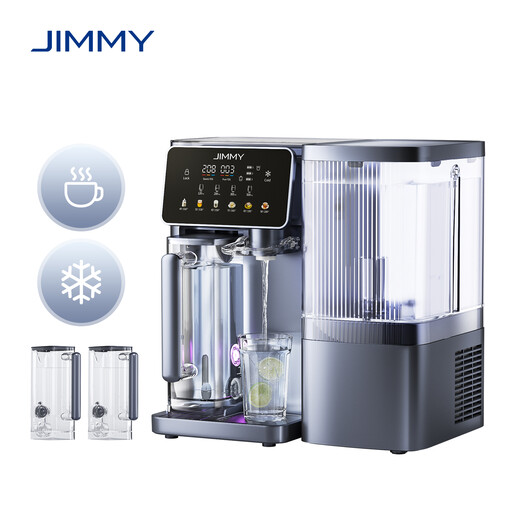
| 1 | JIMMY R9 Pro countertop RO purifier | Listed 5.5 L tank; two 1 L pitchers; hot, cold and ambient dispensing; 553 × 346 × 440 mm. | The Joybuy listing describes several ways to supply water in a shared kitchen. Check that the unit fits the counter and that its dispensing arrangement suits the saucepan; these specifications alone do not establish faster batch preparation. | Joybuy |
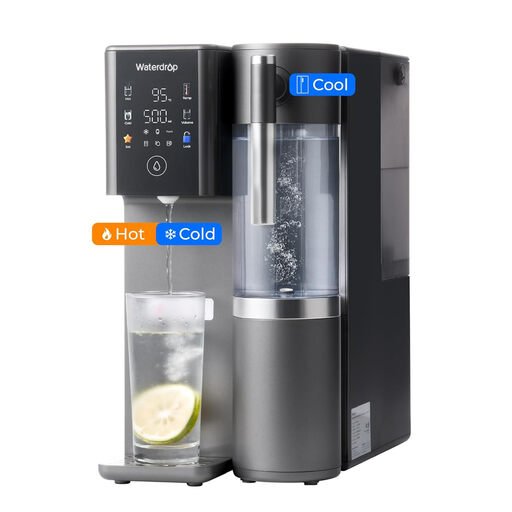
| 2 | Waterdrop K19-H countertop RO filter with instant hot water | Waterdrop states a 5 L feed tank, dispensing presets up to 600 mL and temperatures up to 95 °C. | The specified presets offer a way to dispense measured amounts, though filling a larger pan may require multiple cycles. Its 5 L figure describes the feed tank, not an amount of purified water ready at once. | Waterdrop UK |
| 3 | AquaTru Classic | AquaTru states a 4 L tap-water tank, a 2.7 L purified-water tank and a 10–15 minute filtration time. | The stated purified-water capacity makes planned batches easier to assess, provided the team can allow time to filter the water before cooking. | AquaTru UK |
These countertop RO models are options for teams that specifically want a refillable purifier. Compare their water-handling and maintenance details before choosing one for shared rice preparation.
 No image available
Consider this model if several colleagues want hot, cold and ambient water from a countertop unit without plumbing.
The Joybuy listing states a 5.5 L tank, two 1 L pitchers, seven-stage filtration and UV sterilisation; these are listing descriptions, not independent performance results.
Allow for its listed 553 × 346 × 440 mm dimensions. Check the single-dispense volume, RO waste-water arrangement and compatible replacement filter for the way the office will use it.
 No image available
Consider this model if the team wants a non-plumbed RO unit with a removable pitcher for preparing filtered water.
The product information describes a detachable 1.1 L purified-water pitcher and six temperature settings. Confirm hot-water dispensing for this exact variant, as the title and descriptions differ on that point.
Before relying on it for a saucepan, check the feed-tank size, amount available in one dispense, filtration time, RO waste-water arrangement and compatible replacement filter. The 1.1 L pitcher is not a stated total purified-water capacity.
Not as a routine health-protection measure for an office on a public mains supply in England or Wales. The Drinking Water Inspectorate says that supply must be wholesome and suitable for cooking; a private supply or suspected fault at the premises needs its own assessment.
Ask the water company for advice rather than buying a purifier solely to cover the change. The Drinking Water Inspectorate advises identifying and remedying a problem caused by building pipes or fittings, with a plumber where appropriate; a filter may only improve its noticeable effects temporarily.
No: an instant-hot setting describes the dispensed water, not a replacement for the rice-cooking process. Use the cooking method and instructions appropriate to the office kitchen after filling the pan or cooker.
Assign someone to clean the unit and change its exact compatible cartridge as its manufacturer instructs, and keep a record of changes. The Drinking Water Inspectorate warns that neglected cleaning and cartridge changes can allow deposits and bacterial growth.
No: the non-plumbed countertop examples discussed here are refillable appliances. If the office instead considers a device connected directly to the supply, check the applicable water-fittings requirements and installation guidance for its location; do not assume the same installation conditions apply.