
24/7 Customer Support

Free returns

Same-day & Next-day Delivery

Quality Guaranteed

Unlock Your Welcome Offers: FREE Delivery | Up to 80% OFF | Free 30-day JoyPlus trial
Download the APP
Fine tip pens can make notes neater, labels easier to read and creative work more controlled. However, choosing the right set is not simply a matter of picking the largest pack or the brightest colours. Students, office workers, artists and journal writers often discover that a pen which looks suitable on the packaging does not match the paper, surface or writing style they had in mind.
This guide explains the practical specifications to check before buying, common marketing traps to avoid and which types of fine tip pens may suit different UK users.
A stated tip measurement does not always describe the visible line precisely. A 0.4 mm fineliner is generally suited to detailed writing, outlines and ruler work, while a 0.5 mm gel pen offers a slightly fuller line for everyday notes. A marker described as “fine point” may still create a bolder mark than a fibre-tip drawing pen.
Check whether the measurement refers to the nib, ball or expected line width. This distinction matters for small planner boxes, forms and schoolwork where thick ink can quickly make text crowded.
Permanent markers are useful for labelling plastic, metal, wood and other non-porous surfaces, but they are not a sensible choice for ordinary notes or reusable planning. Ink may stain skin, clothing, desks and other materials. If you need to amend homework, meeting notes or a planner, consider erasable gel pens instead.
Heat-sensitive erasable ink can also behave differently from standard ink. Friction creates heat, so keep important records in a cool place and avoid using erasable ink where archival permanence is required.
A 45-piece or 72-piece set may offer variety, but it can be wasteful if most shades are rarely used. Conversely, a four-colour pack may be insufficient for colour-coded revision or artwork. Compare the number of useful colours, tip type, ink formula and intended surface rather than relying on pack size alone.
For detailed drawing, a metal-cased or metal-framed tip can provide useful support when working with rulers and templates. For extended writing, a soft grip or shaped barrel may be more comfortable.
Water-based fineliners are often appropriate for notebooks and sketchbooks, but thin paper can show bleed-through or ghosting. Gel ink may feel smoother, while quick-drying formulas can be helpful for left-handed writers. Permanent and paint inks require more care because they can stain or transfer through paper.
Before buying, consider whether you need:
Caps should be replaced promptly to reduce drying. Retractable pens avoid loose caps, which can be convenient in classrooms and offices. Store markers according to the product instructions; some permanent and paint markers are recommended horizontally.
Keep all pens away from young children, particularly sets with small caps or detachable parts. Ink should not come into contact with eyes or be used near open flames. For solvent-based or paint-style products, follow the supplied ventilation guidance.
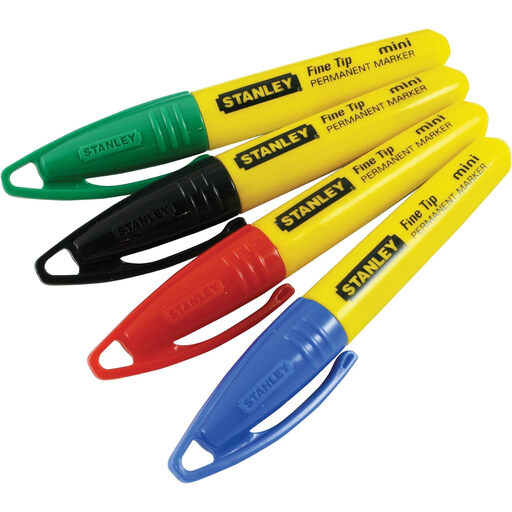
Why This Fits Their Persona: Four familiar colours cover everyday school, office and household tasks without committing to a large stationery set.
The pack specifies a fine tip and clearly identifies the included black, red, green and blue colours, making the selection easy to assess before purchase.
Four-colour selection; fine tip intended for precise writing or drawing; lightweight plastic barrel.
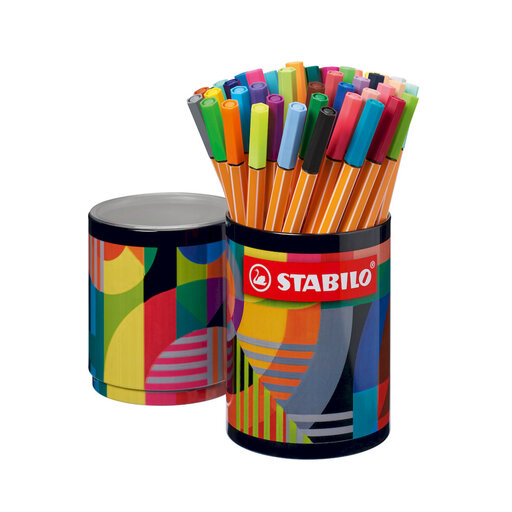
Why This Fits Their Persona: A broad colour selection suits artists, journal writers, teachers and planners who need varied shades for detailed projects.
Its listed 0.4 mm line width and metal-cased tip make the intended precision clearer than a general “fine” label.
45 assorted colours; 0.4 mm line width; water-based ink; suitable for rulers and stencils.
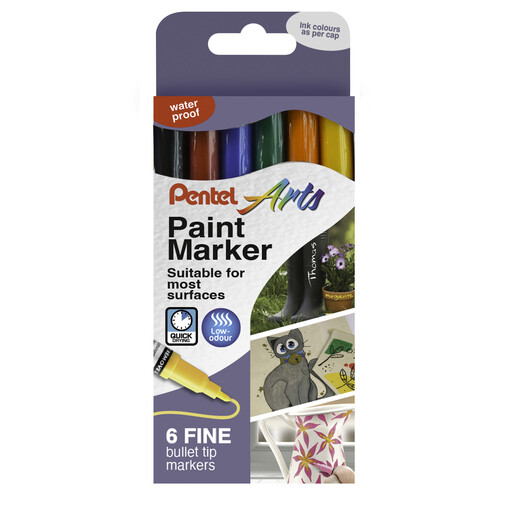
Why This Fits Their Persona: Crafters and frequent labellers working on card, metal, glass, plastic or rubber need a paint-style marker rather than an ordinary writing pen.
The product is specifically described for multiple non-paper surfaces and provides storage, ventilation and priming instructions.
Six standard colours; 2.9 mm fine bullet point; permanent opaque pigment-based ink; aluminium barrel.
They can be, but ink choice matters. Quick-drying gel pens may reduce smearing, while some water-based fineliners can remain wet briefly on smooth paper. Test the pen on the paper you use most often and allow ink to dry before closing notebooks.
Lifespan depends on frequency of use, ink capacity, pressure and storage. Replace caps immediately on capped pens, retract click pens after use and follow horizontal-storage instructions for markers. A pen used daily for heavy note-taking will naturally run out sooner than one used occasionally for diagrams.
For ordinary writing, black ink pens or a small coloured set are generally practical. Choose a 0.5–0.7 mm gel pen for smooth notes, a 0.4 mm fineliner for detailed writing and a permanent marker only when you need marks that adhere to a particular surface. Always check the product warnings and keep pens away from young children.