
24/7 Customer Support

Free returns

Same-day & Next-day Delivery

Quality Guaranteed

Unlock Your Welcome Offers: FREE Delivery | Up to 80% OFF | Free 30-day JoyPlus trial
Download the APP
Choosing fish cat food for a UK household can seem straightforward until you compare ingredient percentages, feeding labels and texture options. A colourful pouch may feature salmon on the front, yet the recipe may contain only 4% salmon in the chunks. Meanwhile, a tempting snack may be labelled with added taurine or vitamins but still be unsuitable as a complete meal.
The following guide focuses on practical checks that help prevent wasted money and unsuitable purchases.
Words such as “salmon”, “tuna” or “ocean selection” do not automatically mean the food is mostly that fish. Check the composition and any declared percentage. Several recipes in this category list the named fish at 4%, usually within the visible chunks or fillets.
That does not make the food unsuitable, but it gives a more accurate picture of what you are buying. Compare the full ingredients list rather than relying on the front-of-pack image.
Soup-style products, creamy snacks and salmon cat treats can add variety, but they are not necessarily nutritionally complete. For example, soup with tender fish strips is described as a complementary pet food and should be served alongside a complete product.
Look for wording such as “complete pet food” or “100% complete and balanced” when choosing a main meal. Use complementary products as occasional additions, toppers or rewards, while accounting for their calories.
Adult cat food is not automatically suitable for every life stage. A senior recipe may be labelled for cats aged 7+ or 11+, while adult products are generally intended for cats aged 1 year and above. A dry recipe may suit a cat that enjoys crunch, whereas jelly, gravy or mousse can be easier to serve in smaller portions and may be preferred by cats with particular texture habits.
Always check the feeding guide, adjust portions for body condition and introduce a new recipe gradually over around seven days.
First, confirm whether the product is a complete meal or a complementary food. Then match the age designation to your cat:
If your cat has a diagnosed condition, food allergy or persistent digestive issue, consult a vet before making a significant dietary change.
Wet fish cat food commonly has a high moisture content. The products listed here include jelly, gravy, mousse and broth textures, with moisture figures ranging from around 78% to 88.5% depending on the recipe. This can be useful for cats that prefer wet meals, but fresh drinking water should still be available.
Pouches and trays should be served according to the label. Refrigerate opened wet food where instructed and use it within the stated period. Dry fish cat food should be kept sealed in a cool, dry place to help preserve its texture.
Compare:
The phrase “complete and balanced cat food” is more useful than a broad claim about taste, because it addresses whether the product is intended to supply daily nutrition.

Why This Fits Their Persona: A multi-pack gives households a convenient supply of adult wet meals, with white fish, salmon, cod and plaice varieties in 85g pouches.
It is labelled 100% complete and balanced for adult cats, clearly separating it from complementary soups and treats.
Four fish varieties, jelly texture, 83% moisture and stated omega-6, vitamin A and vitamin E content.

Why This Fits Their Persona: Suits cats that prefer finely cut pieces and gravy, with four fish recipes for meal rotation.
The listing identifies it as complete and balanced for adult cats, rather than presenting gravy as a substitute for nutritional information.
Mini fillets in gravy, 80% moisture and four combinations including salmon, whitefish, tuna and plaice.
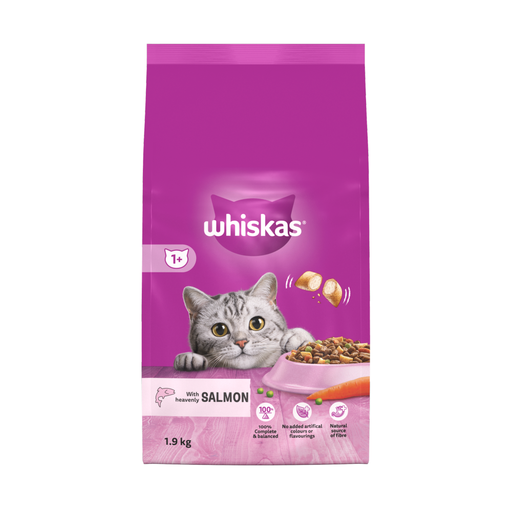
Why This Fits Their Persona: The larger dry-food bag works for multi-cat homes or owners wanting a cupboard-friendly everyday option.
The label supplies daily gram guidance for different cat weights and identifies the recipe as a complete adult diet.
1.9kg pack, 30.4% protein, 12.2% fat and salmon listed at 4% in the brown kibbles.

Why This Fits Their Persona: Made for cats aged 7 and above, it offers familiar fish flavours in soft steam-cooked chunks and jelly.
The age range is stated clearly, helping owners avoid using a standard adult recipe when a senior-labelled option is preferred.
100% complete and balanced, four fish recipes and stated vitamin A, D3, E and taurine additions.
We have compiled a complete, real-time list of products that fully satisfy these strict selection criteria and UK safety regulations.
Yes, if the packaging identifies it as a complete food for your cat’s life stage. Jelly, gravy and mousse recipes can be used as everyday meals when the feeding guide is followed. Complementary soup and treats should not replace the main diet.
Dry food often comes in larger packs and can be portioned by weight, which may help manage cost. However, compare the recommended daily amount rather than pack price alone. Wet and dry food have different moisture levels, so they should not be compared gram for gram.
Follow the product’s feeding limit and keep treats as a small part of the daily intake. For example, a creamy salmon treat may allow up to one sachet daily, but it remains complementary. Reduce the main meal if necessary and provide fresh water at all times.