Who needs which format?

Hosts serving several fish portions

If separate fillets need checking just before plating, a quick-to-read handheld probe lets you check each portion in turn. Consider whether the display is easy to read and how you will clean the probe between uses.

Hosts cooking a larger fish dish

For a whole fish, fish pie or deeper oven dish, a leave-in probe can show the food temperature while you attend to other courses. Salter describes continuous monitoring and an alarm on its Leave-In Digital Kitchen Thermometer; careful probe placement still matters.

Occasional cooks focused on safe handling

A straightforward centre check and a clean probe may matter more to you than extra monitoring features. GOV.UK advises cleaning a cooking thermometer after each use to help avoid cross-contamination.

What matters when choosing?

Decide whether you need brief checks of separate portions or ongoing monitoring of one larger dish. Then check the probe’s placement, stated specifications and cleaning instructions for the way you cook.

ConcernWhat to checkWho this matters to
Checking several portions quickly Look for a stated response time, a readable Celsius display and a probe that can reach the centre of each portion. A decimal display increment is not an accuracy tolerance. When separate fillets are nearly ready, I want to check each one without holding up serving; around 42% of consumers put quick portion checks first.
Monitoring a larger dish Check that the model is designed to stay in during your cooking method, that its probe can sit in the food centre and that it has the alarm you want. With a whole fish or deep fish pie in the oven, I want to keep an eye on its temperature while preparing other courses; roughly 33% of consumers prioritise ongoing monitoring.
Straightforward cooking checks Check for a suitable Celsius temperature range and clear cleaning instructions; follow the packet or recipe as well as taking a centre reading. If I cook fish for guests only occasionally, I want a probe I can use and clean confidently without extra features; about 25% of consumers place straightforward checks first.

Mistakes to avoid

  • Equating a decimal display with measurement accuracy

    A reading shown in 0.1°C steps does not establish that the measurement is accurate to 0.1°C. Thermapen states an accuracy tolerance for the Thermapen ONE, while Salter describes 0.1°C increments for its folding model; those specifications mean different things.

    If a narrow temperature margin matters, look for a stated accuracy tolerance and the temperature range over which it applies.

  • Choosing a leave-in probe for thin, separate fillets

    Continuous monitoring suits a dish with enough depth to position the probe, but one placement cannot represent every separate portion.

    Use an instant-read probe to check individual fillets in turn; consider a leave-in model for a whole fish or deeper dish where it can remain correctly positioned.

  • Moving an unclean probe between raw and cooked food

    A probe that touches raw fish can transfer contamination during later checks. GOV.UK advises fully cleaning a cooking thermometer after each use.

    Clean the probe after use, and make sure it is clean before checking food that is ready to serve.

  • Treating every fish product as a cooked fillet

    Food Standards Scotland notes that cold-smoked and cured fish have not undergone a full cooking step. A temperature check on a cooked dish does not settle how a ready-to-eat or raw-intended product should be handled.

    Check the product label and intended preparation, particularly when serving guests who may be more vulnerable to foodborne illness.

Brands and models to consider

Thermapen

The Thermapen ONE is an instant-read option for hosts making repeated checks across portions.

  • Thermapen states one-second readings and ±0.3°C accuracy from -19.9°C to 119.9°C for the Thermapen ONE.
  • Its stated accuracy range belongs to this model; check whether those documented features matter for how often you will use it.

Salter

Salter has separate folding instant-read and leave-in models relevant to the two cooking setups.

  • Salter states 2–3-second readings for its Instant Read Foldable Digital Thermometer and continuous monitoring with an alarm for its Leave-In Digital Kitchen Thermometer.
  • Check the exact model: the folding probe’s features should not be assumed to apply to the leave-in model, or vice versa.

Taylor Pro

The Taylor Pro Digital Meat Thermometer Probe is a handheld option for manual checks around hot cookware.

  • Its listed features include a -40°C to 230°C range, a hold function and a protective cover that doubles as an extended handle.
  • If response time or an accuracy tolerance is decisive for you, confirm the figures for this model before choosing it.

Joybuy product choices

This digital thermometer is a choice to consider for manual cooking checks. Before using it for fish portions, confirm that its probe can measure at the centre of the food.
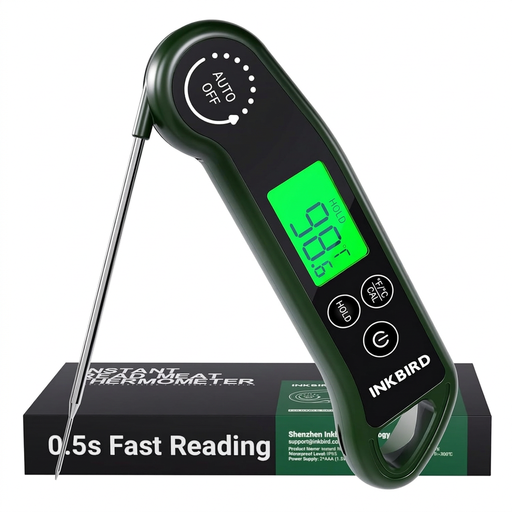
INKBIRD RHT-11K K-Sensor Green digital meat thermometer

INKBIRD RHT-11K K-Sensor Green digital meat thermometer

For spot checks while grilling or roasting, the listing describes an LCD screen and a 0.5-second reading; treat the reading time as a product claim rather than an independent test result.

Before using it to check fish, confirm that it has an insertion probe suitable for reaching the centre of a portion, a suitable Celsius temperature range and cleaning instructions.

View on Joybuy

Common questions

What temperature should I check for cooked fish?

Follow the fish’s packet or recipe instructions and check the centre with a clean probe. GOV.UK’s food-business guidance gives 70°C for two minutes as a standard core-temperature combination for thorough cooking; it is not a single rule for every fish product or preparation.

Where should I put the probe in a fish portion?

Place a clean probe in the centre of the food, using the thickest edible part of the portion where there is enough depth for its sensing tip. A surface reading is not an internal temperature check.

Do I need to clean the thermometer between checks?

Yes. GOV.UK advises fully cleaning the temperature probe after each use, particularly important if it could touch raw fish before food that is ready to serve.

When should I choose a leave-in probe?

Choose a leave-in probe for a larger oven dish when continuous monitoring and an alarm would help, provided you can position it correctly in the food. For quick checks across separate fillets, an instant-read probe is more practical than monitoring a single placement.

Does a thermometer settle the safety of cold-smoked salmon or gravlax?

No. Food Standards Scotland says cold-smoked and cured fish have not undergone a full cooking step. Check the label and intended preparation; its advice for people who are pregnant or immunocompromised is to avoid ready-to-eat cold-smoked or cured fish.