Repeat-approach pilots
If you fly circuits and landings repeatedly, you may want trim, throttle and configuration controls within reach instead of returning to the mouse or keyboard for each approach.


For repeated virtual approaches, choose controls that give you access to pitch, throttle and trim; a display-only panel cannot replace primary flight controls. An add-on panel makes more sense if you already have a yoke or stick, while a fuller system suits a new cockpit. Check the exact simulator, platform and space available before choosing either route.
If you fly circuits and landings repeatedly, you may want trim, throttle and configuration controls within reach instead of returning to the mouse or keyboard for each approach.
If you already have primary flight controls, a modular panel can add physical access to selected functions or instrument readouts without replacing your yoke or stick.
If you are assembling controls from scratch or use Xbox, an integrated system with stated support for your platform may be more straightforward than combining PC-focused add-on panels.
Choose it when: You need primary pitch and roll control as well as throttle and trim for a new landing-practice setup.
Allow for: A yoke and throttle quadrant need more desk or rig space than a single add-on panel.
Choose it when: You already have a yoke or stick and want physical access to selected approach functions.
Allow for: The panel will not replace primary controls, and some PC panels require a simulator plug-in.
For consumers choosing controls for repeated virtual landings over long sessions, the priorities below distinguish the need each consumer puts first.
| Concern | What to check | Who this matters to |
|---|---|---|
| Approach and flare control | Check for primary pitch and roll control, an accessible throttle and a trim input you can use during approaches. | If I hand-fly one approach after another, I want to adjust pitch, thrust and trim without relying on an instrument display for control. Around 36% of consumers put repeatable approach control first. |
| Long-session layout | Compare the controls' dimensions and mounting method with your desk or rig; check whether frequently used inputs will be within reach. | During a long session, I need a layout I can reach comfortably without repeatedly changing position. Practical layout comes first for around 29% of consumers. |
| Platform compatibility | Check the exact model against your platform and simulator version, including any required hub or plug-in. | If my cockpit uses a particular console or PC simulator, I need the controls and connection arrangement to work with it. Around 21% of consumers make compatibility their primary concern. |
| Aircraft-specific layout | Check the lever arrangement, detents and reverser controls against the aircraft you regularly fly. | When I mainly practise one airliner family, I want its throttle and systems layout to suit that routine, even if I also fly other aircraft. Around 14% of consumers prioritise that aircraft-specific layout. |
A display can show flight information, but it does not provide the pitch, roll or thrust inputs needed to hand-fly an approach.
Check whether your current setup already has primary controls. If not, choose a yoke or stick and throttle arrangement before considering a display-only panel.
Compatibility depends on the model and connection: Honeycomb lists Xbox use of the Bravo Throttle Quadrant only with the Alpha XPC and Xbox Hub, while Logitech G describes its Multi Panel as a Windows PC product.
Check the precise model, platform, simulator and required accessories or plug-ins before ordering.
Detents and reverser controls arranged for one aircraft style may be less convenient when you switch regularly between airliners and general aviation.
If you fly different aircraft types, check whether the lever arrangement suits each one. Thrustmaster documents adjustable or disableable detents and reversers for its Airbus TCA Quadrant; check the exact product you intend to buy.
Civil-flight yokes and configurable throttle controls for general-aviation and airliner setups.
Modular PC panels for adding physical controls or instrument readouts to an existing cockpit.
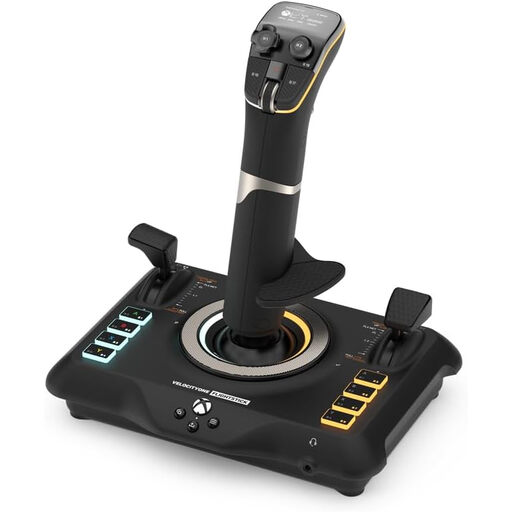
Integrated VelocityOne controls for buyers considering a yoke, throttle and trim arrangement.
Civil-aviation controls with distinct Boeing- and Airbus-oriented product lines.
These choices include a yoke system, an Airbus-style pack and stick-based controls. Decide whether you need primary controls or are adding to an existing cockpit, then check the exact simulator mappings for the aircraft you fly.
 No image available
Consider this system if you are building a yoke-based cockpit for repeated approaches. The VelocityOne Flight has a modular throttle quadrant and trim wheel, and Turtle Beach lists Xbox and Windows compatibility. Check its footprint and your aircraft's flap and landing-gear mappings.
 No image available
Consider this Airbus-oriented pack if that aircraft style is central to your landing practice. Check the exact simulator version, trim inputs and control mappings you need, particularly if you also fly other aircraft types.
 No image available
Consider a stick-based control if you prefer it to a yoke for hand-flying approaches. Check support for your simulator version and how trim, flaps and landing gear can be mapped for your aircraft.
 No image available
Consider this HOTAS-and-mount setup for a Windows 11/10 cockpit if stick-based primary controls suit your practice. Check how trim and your aircraft's configuration functions will be operated in the intended simulator.
Prioritise a pitch-and-roll control, throttle and trim input, then check how you will operate flaps and landing gear for your aircraft. An instrument display can show flight information, but it cannot replace the controls used to hand-fly an approach and flare.
Only if the exact panel and its connection arrangement support Xbox. Logitech G describes its Multi Panel as a Windows PC product; Honeycomb lists Xbox use of the Bravo Throttle Quadrant only with the Alpha XPC and Xbox Hub. Check the model and required accessories rather than relying on brand-level compatibility.
Separate pedals are a choice to assess against the controls you already have and the way you want to operate rudder and brakes. Some integrated systems provide rudder and braking inputs; check the exact model before deciding whether separate pedals and the space for them make sense.
Confirm the seller and exact product, any supplied plug or power arrangement, and how returns, warranty claims and support would be handled for that offer. Check the product information and applicable markings rather than assuming that a brand name establishes the details of a particular listing.