For repeated virtual circuits, choose physical controls for the actions you use most often, rather than a panel simply because it adds another display. Logitech G’s modular panels can add particular functions around existing controls, while the Honeycomb Bravo brings several configuration controls into one quadrant. Neither establishes whether your PC and simulator can run several monitors, and the right choice depends on your simulator, platform, aircraft and desk layout.
Who is this setup for?
Circuit-practice pilots who want configuration controls to hand
If take-off, downwind, base and final have you reaching repeatedly for throttle, flaps, trim, gear or switches, consider which of those actions you want off-screen. Honeycomb lists several of these control types for its Bravo quadrant.
Cockpit builders adding specific functions
If you already have primary flight controls, a separate radio, autopilot or instrument panel may fill a narrower gap. Logitech G describes its Radio, Multi and Instrument panels as modular units that can be arranged around an existing setup.
PC sim users who also fly combat or space scenarios
If extensive custom bindings matter alongside civilian flying, a HOTAS may suit that wider use. Turtle Beach describes the Windows PC VelocityOne Flightdeck as a fighter- and space-oriented HOTAS with 139 programmable buttons; its layout is less directly aimed at a conventional civilian circuit workflow.
What matters when choosing controls?
For repeated circuits with several monitors, identify the controls you want to reach without a mouse, then check that the chosen hardware fits your simulator and desk.
Modular Logitech G panels
Consider when: You have primary controls and want to add radio functions or selected autopilot, flap and trim controls.
Trade-off: Logitech G’s Radio and Multi panels cover different tasks, and software support needs checking for each panel.
Honeycomb Bravo quadrant
Consider when: Your main gap is a shared control area for throttle, flaps, gear, switches and autopilot functions during civilian circuits.
Trade-off: Honeycomb lists a depth of 382 mm and a mass of 3.794 kg, excluding the mounting plate or clamp; check the space beside your monitors and other controls.
Combat- or space-oriented HOTAS
Consider when: Combat, space or highly customised flying is also a substantial part of your sim use.
Trade-off: A fighter-style layout may be a less direct match for civilian throttle-quadrant, gear and radio routines.
| Concern | What to check | Who this matters to |
|---|
| Circuit-flow controls |
Check which throttle, flap, trim and gear actions have dedicated controls, and whether the unit fits beside your existing equipment. |
If repeated configuration changes interrupt my circuits, I want those actions within reach rather than on-screen; around 36% of consumers would put hands-on circuit controls first. |
| Radio and procedure workflow |
Check the radio functions you use and whether flap or trim controls are available without replacing your existing yoke or throttle. |
When I already have primary controls, I want easier access to frequency changes and other repeated procedures; roughly 29% of consumers would make that workflow their primary concern. |
| Software compatibility |
Match the exact panel against your simulator edition, operating system, platform and aircraft profile. |
I do not want a panel that needs a different driver or profile for the aircraft I fly; about 21% of consumers would prioritise compatibility. |
| Desk and display integration |
Check mounting space around monitor arms and existing controls; assess monitor connections and simulator display settings separately. |
With several screens already taking up my desk, I need controls and any supplementary readouts to fit around them; around 14% of consumers would put physical integration first. |
Common buying mistakes
-
Treating a control panel as a multi-monitor solution
A physical panel does not establish whether your graphics hardware and simulator can drive or arrange several views. X-Plane documents multi-monitor operation as a display configuration, separate from choosing flight controls.
List your intended views, monitor connections and available desk space before deciding which control gap a panel should fill.
-
Buying before checking the exact software and platform
Manufacturer compatibility statements differ by product. Honeycomb lists named simulators for its software, while Logitech G documents specific PC systems and simulator support for its Multi Panel.
Check the precise simulator edition, operating system, platform, aircraft add-on and existing controls against the documentation for the model you plan to buy.
For Xbox use, Honeycomb states that the Bravo requires an Alpha XPC and Xbox Hub in addition to the quadrant.
-
Choosing button count over circuit workflow
A programmable HOTAS may serve combat or space flying, but that layout does not by itself put civilian throttle, flap, trim, gear and radio actions where you want them.
Write down the actions used on every circuit. If you already have a suitable yoke and throttle, consider whether a targeted radio or Multi Panel fills the remaining gap; if configuration controls are the gap, assess a quadrant.
-
Leaving mounting checks until after ordering
A quadrant and several monitors compete for desk and mounting space. Honeycomb lists the Bravo at 273 mm wide, 382 mm deep and 3.794 kg, excluding its mounting plate or clamp.
Measure around your monitor arms, keyboard and existing controls, then check the intended mounting position and test simulator recognition promptly after delivery.
Relevant flight-simulator brands
Logitech G
Modular Radio, Multi and Instrument panels for adding particular functions around an existing control setup.
- Logitech G lists COM, NAV, DME, ADF and transponder functions for its Radio Panel, flap and trim controls for its Multi Panel, and a 3.5-inch LCD for its Instrument Panel.
- Check compatibility panel by panel: Logitech G names particular Windows versions and PC simulators for the Multi Panel, while its Instrument Panel documentation names a different set of simulators.
Honeycomb Aeronautical
The Bravo combines a throttle quadrant with gear, switches, indicator lights and autopilot controls for a civilian-style desk cockpit.
- Honeycomb lists six levers, a gear lever, seven assignable switches and 14 indicator lights, with configurations described for single-engine general aviation through four-engine aircraft.
- At a listed 382 mm deep and 3.794 kg before its mounting plate or clamp, the Bravo needs a desk-fit check. Honeycomb conditions Xbox use on an Alpha XPC and Xbox Hub.
Turtle Beach
The VelocityOne Flightdeck is a Windows PC HOTAS aimed at fighter-, space- and custom-binding workflows.
- Turtle Beach lists Windows 10/11 PC compatibility, 139 programmable buttons and a configurable Flight Touch Display for the Flightdeck.
- Its fighter- and space-oriented layout is a less direct match if the priority is a conventional civilian throttle quadrant and panel arrangement.
Joybuy controls for circuit practice
These flight-control systems offer different starting points for hands-on circuit practice, from an integrated control system or Airbus-style pack to a flight stick or HOTAS. Choose by the controls and aircraft workflow you need; assess multi-monitor capability separately.
 No image available
Turtle Beach VelocityOne Flight Universal Control System
Consider this integrated control system if you want hands-on flying controls for repeated circuits. Check compatibility with your simulator edition and aircraft profile, and confirm that its layout fits alongside your monitors.
View on Joybuy
 No image available
Thrustmaster TCA Captain Pack X Airbus Edition Flight Controls – Xbox Series X/S, PC
Consider this pack when your circuit practice follows an Airbus-style control workflow rather than a general-aviation layout. Its title identifies Xbox Series X/S and PC variants; check the exact simulator edition and aircraft profile you intend to use.
View on Joybuy
 No image available
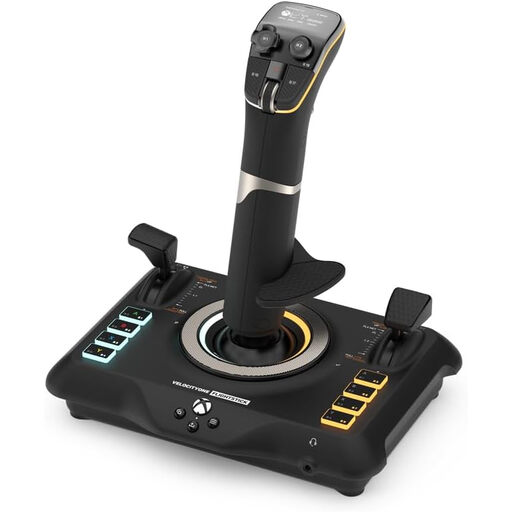
Turtle Beach VelocityOne Flight Stick Simulator Control for Xbox/PC
Consider a flight stick if your immediate need is a hands-on primary control rather than a separate radio or instrument panel. Check the controls required for your circuit routine and support for your simulator and aircraft profile.
View on Joybuy
 No image available
HORI HOTAS Flight Control System & Mount – Windows 11/10 PC
Consider this HOTAS if your flying extends beyond civilian circuits and you want a PC control layout for varied bindings. The title identifies a mount and Windows 11/10 PC use; check simulator support and whether the mounting arrangement suits your desk.
View on Joybuy
Questions before you buy
Will a flight-simulator panel make several monitors work?
No: choosing physical controls is separate from configuring several simulator displays. Check your graphics outputs, intended monitor arrangement and simulator display settings; X-Plane’s desktop manual discusses multi-monitor configurations separately from flight controls.
How can I check whether a panel works with my simulator?
Match the exact model to your simulator edition, operating system, platform and aircraft profile. Honeycomb lists particular simulators in its downloads information, while Logitech G documents a specific PC software set and plug-in requirements for its Multi Panel; neither statement automatically covers every aircraft add-on.
What should I measure before mounting a quadrant beside several monitors?
Measure the free desk and mounting space after allowing for monitor arms, existing flight controls, the keyboard and cables. Honeycomb lists the Bravo at 273 mm wide, 382 mm deep, 198 mm high and 3.794 kg, excluding its mounting plate or clamp.
What if an online purchase does not suit my setup?
For an eligible distance purchase from a UK trader, GOV.UK says you can tell the seller you wish to cancel within 14 days of receiving the item, then have another 14 days to return it. Remedies for faulty or misdescribed goods are separate from change-of-mind cancellation; check the seller’s voluntary returns terms for any additional arrangements.


