What matters when choosing?
For cockpit-check practice at a shared bedroom desk, start with the requirement that could rule out a controller: where it will sit, which actions you need to reach, or whether it works with your simulator and aircraft.
Single-base flight stick
Choose it when: You want one unit to move off the desk after a session.
Trade-off: Built-in levers do not give you the separate throttle position available with a two-section HOTAS.
Detachable HOTAS
Choose it when: You want a dedicated throttle but need the option to keep the sections together or separate them.
Trade-off: The separated arrangement needs two positions and space for its cables.
PC HOTAS with more controls
Choose it when: You use a PC, can accommodate a separate throttle and want more inputs for a planned set of recurring commands.
Trade-off: More controls take time to map and remember; they do not remove the need to check simulator profiles.
| Concern |
What to check |
Who this matters to |
| Desk space and pack-away |
Measure the usable surface with your keyboard, mouse and cables in place. Check the controller's dimensions and, for a HOTAS, both attached and separated layouts. |
If the desk has to be cleared after every session, a controller that is awkward to put away could outweigh its extra controls. Around 29% of consumers would put pack-away practicality first. |
| Reachable, repeatable controls |
List the commands you use regularly, then check for reachable buttons, a view control and a way to save suitable bindings. |
When I rehearse the same cockpit sequence, I want to find its controls without searching through a large set of unfamiliar buttons. Control access would come first for around 36% of consumers. |
| Throttle and flight axes |
Check whether the throttle is built into the base or separate, which flight axes are available and whether any pedals you want are included or optional. |
If power changes are part of my practice, I may want a distinct throttle position even though it takes more room. Around 21% of consumers would make throttle and axis layout their primary concern. |
| Platform and aircraft fit |
Confirm the exact PC or console support and consider whether a stick matches the aircraft you usually fly. Check the simulator's controller-profile options. |
A controller with plenty of inputs is little use to me if it does not work with my platform or suit my usual aircraft. Platform and aircraft fit would decide the choice for around 14% of consumers. |
Flight-control products on Joybuy
These flight-control choices cover a single-base stick, stick-and-throttle arrangements and an Airbus-focused bundle. Choose around your desk space, platform and usual aircraft; the products do not all offer the same control layout.
 No image available
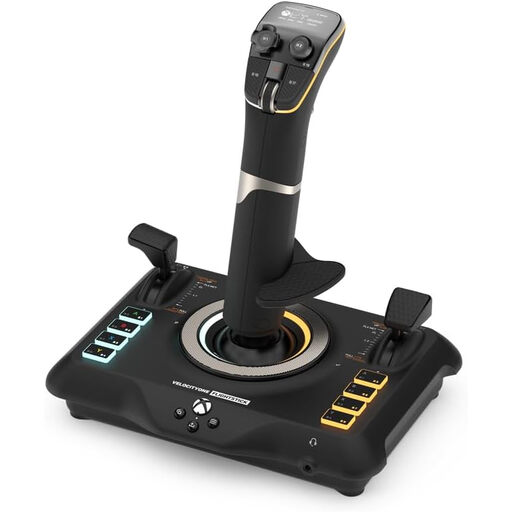
Turtle Beach VelocityOne Flight Stick for Xbox and PC
Consider this flight stick if you want to keep your cockpit-check setup to one controller rather than position a separate throttle. Its name identifies Xbox and PC versions of the setup; check compatibility with your particular simulator before choosing it.
Measure the available desk space and check how the commands you practise can be assigned. If someone else sleeps nearby, consider whether its operating noise is acceptable for your room.
View on Joybuy
 No image available
Thrustmaster T.Flight Hotas 5 Stick and Throttle for PS5, PS4 and PC
This stick-and-throttle product is relevant if you want to practise power changes with a dedicated throttle control. Its named platforms are PS5, PS4 and PC; confirm support for the simulator you intend to use.
Check the space needed for your preferred stick-and-throttle arrangement and whether the actions in your cockpit-check sequence can be mapped as you need.
View on Joybuy
 No image available
Thrustmaster TCA Captain Pack X Airbus Edition for Xbox Series X/S and PC
This Airbus Edition flight-control pack is worth considering if your cockpit-check practice centres on Airbus-style aircraft, rather than a mix of unrelated control layouts. The product name specifies Xbox Series X/S and PC.
Check that the pack's controls suit the aircraft and actions you practise, and measure the desk space needed for the bundle before choosing it for a shared room.
View on Joybuy
 No image available
HORI HOTAS Flight Control System and Mount for Windows 11/10 PC
Consider this HOTAS and mount if you practise on a Windows PC and have room for a mounted control setup. The product name specifies Windows 11/10; it does not identify a console version.
Check mounting fit, the space the assembled arrangement will occupy and how your simulator handles the commands you need for cockpit checks.
View on Joybuy
Frequently asked questions
Should I choose a joystick or a yoke for virtual cockpit checks?
Choose around the aircraft you mostly fly and the commands you need to reach. Microsoft Flight Simulator says a joystick offers flexibility across aircraft types, while a yoke better matches aircraft that use one; either layout still needs suitable bindings for your recurring checks.
How should I set up a flight stick for cockpit-check practice?
Map the small set of commands you repeatedly use in your chosen aircraft and save a suitable controller profile. Microsoft Flight Simulator guidance notes that common controllers may receive an automatic profile, while others require manual assignment; check the resulting bindings before relying on them for a practice sequence.
Do I need a separate throttle at a shared bedroom desk?
You need one only if a dedicated throttle position matters enough to justify its placement and storage. A single-base flight stick keeps the equipment together, while some HOTAS designs let you attach or separate the throttle; measure your usable desk area before deciding.
Does practising at home count as UK CAA-qualified flight training?
A home flight stick and simulator do not, by themselves, establish qualified training. The UK Civil Aviation Authority says FSTD qualification is confirmed through a certificate issued to the device operator; ask your training provider whether a specific course and qualified device can receive credit.


