Precision-first dockers
If small corrections during final approach matter more to you than a large command count, start by considering a stick with accessible pitch, roll and yaw controls. The exact mapping still depends on your game.


A single stick with twist yaw is a practical starting point if you want analogue steering for docking and are content to keep some movement and commands on a keyboard or other controls. Choose two sticks if independent analogue translation is your priority, or a stick-and-throttle HOTAS if you want more ship functions within reach. None of these layouts expands the view on a single monitor; check your game’s bindings, platform, USB ports and desk space before buying.
If small corrections during final approach matter more to you than a large command count, start by considering a stick with accessible pitch, roll and yaw controls. The exact mapping still depends on your game.
If you want analogue control of translation as well as rotation, investigate a two-stick layout. Confirm that your simulator and platform accept both devices and let you bind their axes as intended.
If you want thrust and numerous ship-system controls within reach, consider a HOTAS with a separate throttle. Allow space for both modules and time to set up the bindings.
Decide how much movement you want on analogue axes before weighing extra buttons: that choice separates a compact single stick from two sticks or a throttle-based setup.
Choose it when: Docking is your main use and you are happy to keep some translation and secondary commands on other inputs.
Trade-off: One stick alone does not put every translational direction on its own simultaneous analogue control.
Choose them when: Independent analogue inputs for lateral and vertical corrections are a priority and your game supports the required bindings.
Trade-off: Two devices need more placement space, connections and initial mapping than one stick.
Choose it when: Reachable thrust and ship-system controls matter more to you than a two-stick approach to translation.
Trade-off: A separate throttle adds desk footprint and bindings to manage; extra controls do not make docking automatically easier.
| Concern | What to check | Who this matters to |
|---|---|---|
| Fine approach control | Check which axes the stick provides and whether your game can bind twist yaw as you prefer. | When I make small alignment corrections, I want pitch, roll and yaw where I can control them deliberately. Around 31% of consumers put fine approach control first. |
| Analogue translation | Check support for multiple joysticks and independent bindings for forward, lateral and vertical movement. | If I regularly correct my position sideways or vertically, I want those movements on analogue inputs rather than relying chiefly on keys or hats. Independent translation comes first for around 31% of consumers. |
| Desk space and setup | Measure room beside your keyboard and check the connections and rebinding options you will need. | I would rather keep the controls compact and spend less time arranging and mapping devices, even if some actions stay on the keyboard. That is the primary need for around 19% of consumers. |
| Reachable commands | Identify the ship functions you use while docking and check whether the game can bind the relevant inputs. | When I manage thrust and several ship systems during approach, I want those commands close to hand without losing track of their assignments. Around 19% of consumers prioritise reachable commands. |
A large control count still leaves you to decide which actions matter during approach and how to avoid conflicting assignments. Roberts Space Industries, for example, documents profile selection and editable peripheral bindings for Star Citizen.
List the actions you need while docking, then look for a layout that puts those particular inputs within comfortable reach.
Thrustmaster’s T.16000M FCS Space Sim Duo contains two joysticks; Turtle Beach describes VelocityOne Flightdeck as two USB-connected modules. Either arrangement needs a place for each control.
Measure the usable space beside your keyboard and mouse, plan the cable routes and check your available USB connections.
Support for profiles in one game does not establish a ready-made profile for another. Roberts Space Industries documents joystick and HOTAS bindings for Star Citizen, but your intended simulator may require a different setup.
Check the current controller documentation and binding menu for your exact game, platform and controller model before purchase.
The Gladiator NXT EVO Space Combat Edition Standard Right is a reference point for a single-stick desktop layout.
The T.16000M FCS Space Sim Duo is a two-stick PC option for players considering separate left- and right-hand inputs.
The X56 is a HOTAS reference for players who want a separate throttle and extensive control assignments.
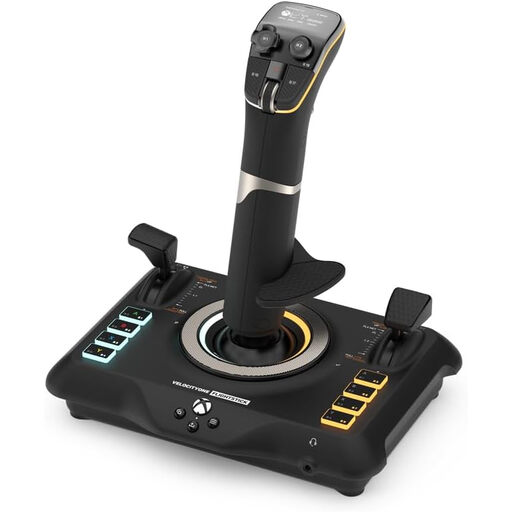
VelocityOne Flightdeck is a separate stick-and-throttle option for a Windows 10/11 PC setup.
This flight stick is an option to consider if you want to start with one device for space-simulator docking. Check its axis layout and your game’s bindings before deciding whether it covers the movements you want.
 No image available
Consider this single flight stick if you want to keep a space-simulator docking setup to one controller. Its product title lists Xbox/PC; confirm support for your exact game and platform, then check how its axes can be assigned to yaw and translational movement.
One stick can be enough if you mainly want analogue pitch, roll and yaw control and are willing to put some translation and secondary commands on keys, hats or another input. A second stick is more relevant when independent analogue translation is your priority; neither choice changes how much you can see on one monitor.
Yes: check your exact game and platform before relying on a controller layout or supplied profile. Roberts Space Industries documents peripheral profiles and editable bindings for Star Citizen, but that does not establish profile support in another simulator.
Start with the rotational controls and the forward, lateral and vertical movements your game provides, then confirm that each physical input is recognised as intended. If the game offers a precision modifier or adjustable axis curves, try those only after the basic assignments work, and save a profile you can restore.