Beginners with limited desk space
You want stick, power and yaw inputs within reach for repeated home practice, without arranging several separate devices.


For virtual take-off practice, start with a stick that gives you accessible throttle and yaw controls. An all-in-one stick keeps the setup compact, while a HOTAS separates power control from stick movement; choose a sidestick or yoke for its aircraft-style layout only if that matches what you fly. Confirm compatibility with your platform and simulator before choosing additional controls.
You want stick, power and yaw inputs within reach for repeated home practice, without arranging several separate devices.
You want to move a separate throttle independently of the stick and have room on your desk for both units.
You mainly fly airliners or conventional fixed-wing aircraft in a simulator and want to choose between a sidestick and a yoke layout.
Choose when: You want throttle and yaw inputs close to the stick in a compact setup.
Trade-off: The controls are less physically separated than a throttle-and-pedals arrangement.
Choose when: You want a dedicated throttle for practising power changes independently of stick movement.
Trade-off: Separate stick and throttle units take more desk space.
Choose when: You mainly fly aircraft with a sidestick-style layout.
Trade-off: A separate throttle quadrant is a different component from a standalone sidestick.
Choose when: A conventional yoke layout matches the fixed-wing aircraft you practise in.
Trade-off: It is not a flight stick, and the controls included depend on the particular system.
| Concern | What to check | Who this matters to |
|---|---|---|
| Take-off controls within reach | Check how you will operate throttle and yaw, and assign any flap or trim inputs you plan to use. | I want to practise changing power and direction without arranging several devices around my desk. Around 36% of consumers put integrated controls first. |
| Platform compatibility | Check the exact controller version against your PC or console, chosen simulator and planned peripherals. | Before setting up a take-off sequence, I need to know that my controller and any add-ons will work together. For around 29% of consumers, compatibility is the primary concern. |
| Aircraft-style layout | Consider whether the aircraft you fly calls for a stick, sidestick or yoke, and where the throttle will sit. | I mostly practise one aircraft type and want the physical controls to match that cockpit. This layout choice comes first for around 21% of consumers. |
| Room to expand | Check which throttles or pedals work with the exact controller and whether console expansion needs a hub. | I would rather start with the controls I need now and add separate hardware later. Around 14% of consumers make that expansion path their main priority. |
Compatibility depends on the exact model. Turtle Beach lists both supported Xbox consoles and Windows versions for its VelocityOne Flightstick, while Honeycomb describes a specific hub arrangement for adding certain peripherals to an Xbox setup.
Check the controller version, simulator platform and any throttle or pedals you intend to connect before ordering.
Integrated levers and twist-rudder input can keep take-off controls together, but they do not provide the same physical arrangement as separate throttle and pedal units.
Decide which throttle, yaw, flap, trim and brake inputs you intend to map, then check the controls available on the particular device.
A yoke changes the physical control format. It may suit the conventional fixed-wing aircraft you fly, but it is not a compact stick substitute.
Choose the format around the aircraft you practise in most often, rather than the number of switches on the controller.
The UK Civil Aviation Authority distinguishes approved flight simulation training devices from consumer home controls. Owning a flight stick does not establish that a home session qualifies for licence credit.
If training credit matters, ask your training organisation about the approved device and session before relying on simulator time.
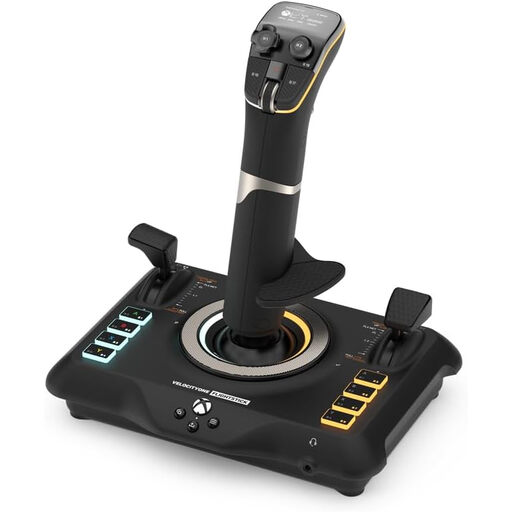
The VelocityOne Flightstick is a compact stick route for users considering the Xbox and Windows platforms listed by Turtle Beach.
The X52 Pro provides a PC HOTAS layout for buyers who want a stick and a dedicated throttle.
The TCA Sidestick Airbus Edition and separate TCA Quadrant offer an airliner-oriented PC control layout.
The Alpha Flight Controls XPC is a yoke-led alternative for conventional fixed-wing simulation, not a flight stick.
These choices span compact sticks, separate-throttle controls, an Airbus-style pack and a yoke alternative. Choose the control format first, then check the exact platform and simulator you will use.
 No image available
Consider this compact stick if you want power and directional inputs close together for home take-off practice. Turtle Beach specifies two multifunction levers for the VelocityOne Flightstick; check the control mappings for your simulator.
 No image available
Consider this Airbus-oriented pack if that is the aircraft layout you mainly practise. Check its included components and the bindings for your simulator before choosing it over a standalone stick.
 No image available
Consider a stick-and-throttle arrangement if you want to practise power changes separately from stick movement. Its product title lists PS5, PS4 and PC; check your simulator and required yaw bindings before purchase.
 No image available
This PC-focused HOTAS is a route to consider if you want separate stick and power controls and space for a mounted setup. Its title lists Windows 10/11; confirm simulator bindings and desk fit.
 No image available
Consider this yoke-format system only if a yoke matches the aircraft you practise in; it is not a flight stick. Check its mounting requirements, platform compatibility and simulator mappings for your setup.
Not necessarily for home practice: a twist-rudder input can provide yaw control without pedals. Logitech G lists one on the X52 Pro, and Thrustmaster lists a rotating rudder input on the TCA Sidestick Airbus Edition. If you want separate foot-operated controls, check pedal compatibility with your platform and simulator.
Choose a separate throttle if physically independent power control matters more to you than a compact setup. An integrated lever keeps controls together; check where the throttle sits on the exact stick or bundle you are considering.
Not automatically: compatibility is model-specific. Turtle Beach lists Xbox Series X|S, Xbox One and Windows 10/11 for the VelocityOne Flightstick. Check the exact controller, simulator and any peripheral connections rather than assuming that another stick has the same support.
A consumer flight stick alone does not establish that home practice qualifies for licence credit. The UK Civil Aviation Authority refers to approved flight simulators in its private pilot licence requirements and maintains lists of qualified flight simulation training devices. Ask your training organisation whether a particular device and session meet the applicable requirements.