Home taxi-practice learners
You want to practise ground steering, throttle handling and cockpit flows at a desk without building a full cockpit straight away.


For home taxi practice, start with a stick that gives you a usable rudder input and an accessible throttle. A twist-rudder HOTAS keeps the setup compact, while dedicated pedals are worth considering if separate rudder and left/right brake inputs matter to your practice. Airbus-style controls offer a different layout for airliner procedures, but you still need to check desk space and the bindings for your simulator and aircraft.
You want to practise ground steering, throttle handling and cockpit flows at a desk without building a full cockpit straight away.
You use several displays for a wider cockpit view and want physical controls you can reach without crowding the monitors and keyboard.
You want separate rudder and brake inputs for taxi practice and have room for pedals beneath the desk.
Work out how you will assign rudder and brakes before choosing a layout, then check how the controls will fit around your monitors.
| Concern | What to check | Who this matters to |
|---|---|---|
| Ground steering and braking | Check your simulator and aircraft bindings for rudder, brakes and, if used, nosewheel steering. Decide whether twist rudder and button-based braking meet your needs or whether you want pedal inputs. | If I am practising ground turns, I want steering and braking controls I can assign separately. Around 42% of consumers put ground steering and braking first. |
| Desk fit | Measure clear desk space around monitor stands and legroom for any pedals. If adding a clamp, check its fit against your desk and controller. | With several displays on my desk, I need to place the controls without losing access to the keyboard. Roughly 25% of consumers prioritise desk fit. |
| Airliner workflow | Check the exact aircraft and simulator mappings for the quadrant functions you intend to use, such as throttle detents, reverser and parking brake. | When I rehearse Airbus-style procedures, I want relevant controls within reach rather than assigning every function to the keyboard. About 33% of consumers give airliner workflow first priority. |
Thrustmaster and Logitech G describe sticks with twist-rudder control, while Logitech G specifies independent left and right toe brakes on its separate pedals. Those are different control layouts for ground tasks.
List the rudder and brake assignments you want to practise, then check whether your simulator and aircraft support them on the controls you plan to buy.
Choosing pedals also means finding floor space and accommodating another peripheral.
Monitor stands, a separate throttle and pedals all affect where you can place and reach the controls. Thrustmaster specifies its TM Flying Clamp for desks 15–45 mm thick and for selected compatible product lines.
Measure usable desk width and depth, desk thickness and legroom; check mounting compatibility before adding a clamp.
The UK Civil Aviation Authority lists qualified flight simulation training devices and sets approval requirements for the training and checking programmes within its applicable rules. An airliner-style consumer controller does not, by itself, establish that home practice qualifies for credit.
If you need credited training, ask your training organisation whether the specific device, configuration and exercise are accepted.
Platform compatibility does not tell you how an individual simulator and aircraft assign taxi functions.
Check the exact simulator version, aircraft documentation and controller-binding options for rudder, brakes and any quadrant functions you intend to use.
Thrustmaster offers twist-rudder flight controls, Airbus-style sidesticks and quadrants, pedals and desk-mounting accessories.
Logitech G offers X52 and X56 HOTAS controls alongside separate flight-simulator pedals and panels.
VIRPIL lists flight sticks, throttles, panels, rudder pedals and yokes for modular flight-simulator setups.
These choices include stick-and-throttle arrangements, an Airbus-style bundle and a single flight stick. Compare the controls you need for taxi practice with each product's desk fit and your simulator's available bindings.
 Image unavailable
Consider this stick-and-throttle arrangement if you want both controls at your desk. The listed variant is for PS5, PS4 and PC; check rudder and brake assignments for your simulator and aircraft before choosing it for taxi practice.
 Image unavailable
This PC stick-and-throttle option is worth considering if a mounted desk arrangement suits your monitors. The named variant is for Windows 11/10; check the mount's fit and your simulator's rudder and brake bindings.
 Image unavailable
Consider this sidestick-and-quadrant bundle if your practice centres on Airbus-style procedures. Thrustmaster describes quadrant controls including a parking brake; check the space required and the rudder, brake and quadrant bindings for your exact aircraft and simulator. The listed variant is for Xbox Series X/S and PC.
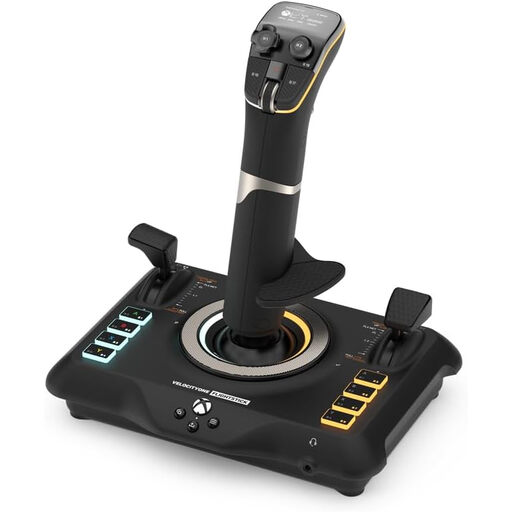 Image unavailable
Consider this single-stick option if you prefer one controller on the desk. Before selecting it for taxi practice, confirm how your simulator and aircraft would assign rudder, throttle and braking controls.
It can be enough for compact home practice if your simulator lets you assign the twist axis to rudder and gives you usable brake controls. If you want independent left and right toe-brake inputs, consider compatible pedals instead.
Consider pedals first if separate rudder and differential-brake inputs are central to what you want to practise. Choose a HOTAS first if a separate, reachable throttle matters more and you can work with its available rudder and brake assignments.
Choose the stick for the controls you need, not for the number of displays. Check multi-monitor display support in your PC and simulator separately, and measure the space left around your monitor stands for the stick, throttle and any mounts.
Do not assume that a consumer setup earns training credit. The UK Civil Aviation Authority lists qualified flight simulation training devices and sets approval requirements for programmes within its applicable training rules; ask your training organisation whether your specific device, configuration and exercise are accepted.