PC landing-practice pilots
If you repeatedly practise approaches and landings at a desk, direct access to throttle, trim, flap and gear actions may matter more to you than building a full cockpit.


Choose a throttle that connects to your PC or Xbox setup, then match its controls to the aircraft and landing procedures you practise most. A focused quadrant can put trim and landing controls within reach, while a configurable layout suits several aircraft types; some Xbox setups require a named companion stick, yoke or hub. Choose headphones separately for your platform and simulator rather than assuming the throttle handles audio.
If you repeatedly practise approaches and landings at a desk, direct access to throttle, trim, flap and gear actions may matter more to you than building a full cockpit.
If you move between general-aviation aircraft, twins and airliners, consider whether interchangeable levers and assignable controls will serve those different layouts.
Check the connection chain for the exact model: a quadrant that connects to a PC may require a compatible stick, yoke or hub before an Xbox recognises it.
Start with platform compatibility, then decide which landing actions need physical controls and whether your aircraft favour a fixed or adaptable layout. Keep the headphone connection as a separate check.
| Concern | What to check | Who this matters to |
|---|---|---|
| Platform connection | Check the exact PC or console connection and any required companion device for the throttle model. | If I use an Xbox, I need to know whether the console will recognise the complete setup before choosing a quadrant. Around 29% of consumers put connection compatibility first. |
| Landing controls | Identify the inputs you intend to map for trim, flaps, gear or reverse thrust, and check whether relevant detents can be changed. | When I repeat approaches and rollouts, I want the actions I use most within reach rather than relying on shortcuts. Direct access is the main concern for around 29% of consumers. |
| Aircraft layout | Compare the available levers and axes with the aircraft you fly; check whether lever heads or assignments can change. | If I alternate between aircraft types, I need controls I can adapt; if I mainly fly one airliner, its familiar layout may matter more. Around 24% of consumers prioritise that layout decision. |
| Desk setup | Check the unit’s dimensions, mounting arrangement and whether you need a throttle alone or additional flight controls. | I may need to leave room for a keyboard and later additions, or fit a complete control system on the desk now. Space and expansion come first for around 18% of consumers. |
Some documented Xbox configurations depend on named companion hardware. Turtle Beach specifies the Xbox-compatible VelocityOne Flightstick II for its Dual Throttle; Thrustmaster documents a companion sidestick for its Airbus quadrant and a yoke for its Boeing quadrant.
Check the manufacturer’s connection instructions for your exact throttle and console before ordering.
The required compatible stick or yoke may be a separate piece of equipment.
Thrustmaster’s TCA Airbus quadrant has Airbus-style thrust detents and reverse controls. Those controls address a different practice routine from a quadrant intended to be reconfigured across aircraft types.
List the aircraft you actually use for landing practice, then decide whether a type-specific layout or interchangeable controls better match those sessions.
Flight-control connections and headset audio are separate decisions; a throttle’s stated PC or Xbox compatibility does not establish an audio path.
Check your headphones against the PC or Xbox connection and the simulator, voice-chat or ATC application you use.
Honeycomb offers PC/Mac throttle quadrants for both focused landing controls and broader, configurable cockpit setups.
Thrustmaster’s TCA quadrants offer Airbus- and Boeing-inspired control layouts for pilots practising those aircraft styles.
Turtle Beach has both a separate throttle and the VelocityOne Flight yoke-and-throttle system for Windows and Xbox flight simulation.
The Flight Throttle Quadrant provides a configurable three-lever option for assigning simulator controls.
These choices include Airbus-style flight controls, a yoke-and-throttle system, flightsticks and HOTAS setups. Match the stated platform to your simulator, then decide whether you need a separate throttle or a wider set of controls.
 No image available
Consider this Airbus Edition pack if you mainly practise Airbus-style procedures. The product name lists Xbox Series X/S and PC; check the pack’s included controls and your simulator’s support before choosing it for particular landing actions.
 No image available
This is a route for consumers who need a yoke as well as throttle controls. Turtle Beach describes the VelocityOne Flight as an Xbox/Windows system with a yoke, modular throttle and trim wheel; make sure the wider setup fits your desk.
 No image available
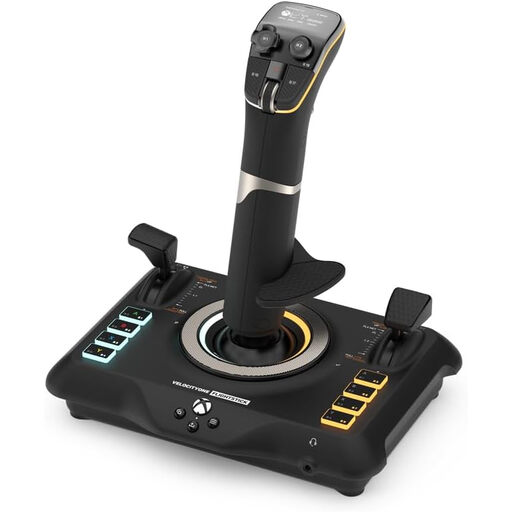
Choose a flightstick format if you want stick and throttle control rather than a separate quadrant. The product name specifies Xbox and PC; check which landing actions you can assign and arrange your headset connection separately.
 No image available
Consider this HOTAS and mount if you want a fixed desk arrangement for Windows PC practice. The product name specifies Windows 11/10; check your simulator and the space needed for the mounted controls.
 No image available
This stick-and-throttle format may suit practice that does not call for a separate quadrant. The product name lists PS5, PS4 and PC; confirm that your exact simulator works with it on the platform you intend to use.
A throttle’s flight-control compatibility does not establish how your headphones connect. Check the headset’s connection to your PC or Xbox and its suitability for the simulator, voice-chat or ATC application you plan to use.
No; the connection depends on the model. Turtle Beach specifies a VelocityOne Flightstick II for Xbox use of its Dual Throttle, while Thrustmaster documents a TCA Sidestick X Airbus Edition for its Airbus quadrant and a TCA Yoke Boeing Edition for Xbox recognition of its Boeing quadrant.
Start with throttle control, then identify the trim, flap, gear, speed-brake or reverse-thrust actions used by the aircraft you practise. Check whether the exact device has suitable physical or assignable inputs; for example, Honeycomb specifies trim and gear controls on Bravo LITE, while Thrustmaster specifies reverse thrust and detents on the TCA Airbus quadrant.
Choose based on which controls you still need and how much desk space you can give them. Turtle Beach’s VelocityOne Flight combines a yoke, throttle and trim wheel; a throttle-focused quadrant such as Honeycomb Bravo LITE makes more sense to consider if you already have your primary flight control and want accessible landing inputs.