Airliner landing-procedure practisers
If you repeatedly practise airliner approaches, physical reverse-thrust controls, identifiable detents and access to landing controls may matter more than a layout designed for many aircraft types.


Choose an Airbus-style quadrant if physical throttle detents and reverse-thrust actions are central to your airliner landing practice. A configurable multi-lever quadrant suits switching between aircraft types, while a simpler desktop control may suit a smaller setup. Check your simulator and platform, the controls included with the exact model, and the space available for mounting it.
If you repeatedly practise airliner approaches, physical reverse-thrust controls, identifiable detents and access to landing controls may matter more than a layout designed for many aircraft types.
If you alternate between general aviation aircraft, twins and airliners, configurable lever assignments may be more useful than controls modelled on one cockpit family.
If your controls must fit securely on a desk or small rig, mounting and lever clearance deserve attention before you commit space to a larger control station.
Start with the aircraft and landing actions you practise, then check whether the control layout fits your simulator, platform and mounting position.
| Concern | What to check | Who this matters to |
|---|---|---|
| Airliner landing controls | Check for physical reverse thrust and whether throttle detents can be changed or disabled. | If I rehearse airliner touchdowns, I want the throttle actions to match the procedures I practise. Around 36% of consumers put those landing controls first. |
| Aircraft coverage | Count the lever axes your usual aircraft need and check which assignments or lever heads can be changed. | Switching between general aviation aircraft and airliners makes a fixed cockpit layout less useful to me. Configurable controls are the primary need for around 29% of consumers. |
| Desk fit and mounting | Measure the usable surface, clamp access and clearance for lever movement. | My games-room desk still has to hold the controller securely without obstructing its levers. Fit is the first concern for around 21% of consumers. |
| Platform compatibility | Confirm support for your exact simulator and platform, including any hardware required for console use. | If I use an Xbox rather than a PC, the right lever layout is no help unless the full setup works with my simulator. Around 14% of consumers prioritise that compatibility check. |
Thrustmaster documents a built-in reverser on its TCA Quadrant Airbus Edition, while other controls may rely on programmable assignments. Those are different actions to practise after touchdown.
If reverse thrust matters to your routine, check the mechanism on the exact model and whether its behaviour can be changed for other aircraft.
The dedicated flap and speed-brake levers in Thrustmaster’s Airbus range belong to its separate TCA Quadrant Add-On, not the base TCA Quadrant Airbus Edition.
List the controls you want during approach, touchdown and taxi, then check what comes with the exact unit or bundle.
Honeycomb lists Xbox use for the Bravo Throttle Quadrant with an Alpha XPC and Xbox Hub; Thrustmaster identifies the TCA Quadrant Airbus Edition as a PC product.
Check the complete model-and-platform combination, including any required companion hardware.
A standalone quadrant and an integrated yoke-and-throttle system place different demands on a desk or rig, even in a dedicated games room.
Measure the mounting surface and allow room to move the levers and reach any clamps.
Its TCA range includes Airbus- and Boeing-inspired throttle quadrants for flight simulation.
The Bravo Throttle Quadrant is configurable for aircraft ranging from single-engine general aviation types to multi-engine airliners.
Its Flight Sim Throttle Quadrant offers programmable desktop controls rather than an aircraft-specific throttle layout.
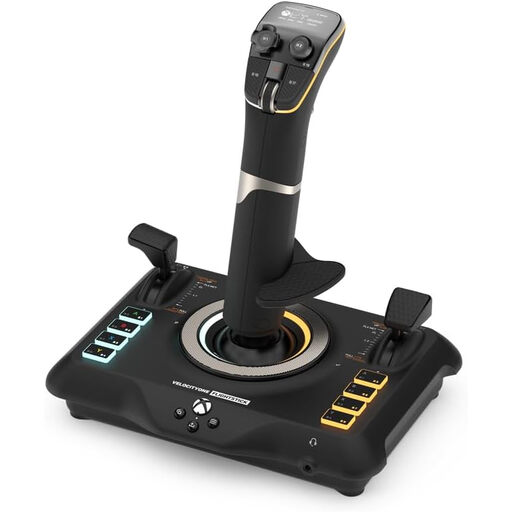
Its flight-simulation range includes separate throttle controls and the VelocityOne Flight integrated yoke-and-throttle system.
These choices cover an Airbus-style flight-control pack and a flight stick with throttle controls. Compare what each exact model includes before deciding which landing actions you can practise physically.
 No image available
Consider this Airbus-style pack if your landing practice centres on airliner throttle procedures. Check the controls included with this exact bundle, its reverse-thrust behaviour, simulator compatibility and mounting space.
 No image available
Consider this flight stick if you want throttle controls alongside a stick rather than a standalone quadrant. Check the lever configuration and reverse-thrust detent behaviour for this exact model, as well as simulator compatibility and desk fit.
No, not for every aircraft or simulator profile. If operating reverse thrust after an airliner touchdown is central to your practice, a physical mechanism such as the one Thrustmaster documents for the TCA Quadrant Airbus Edition lets you rehearse that action directly; check how your chosen simulator maps it.
Yes, provided its controls can be configured for the aircraft you fly. Honeycomb describes Bravo layouts spanning single-engine general aviation aircraft and multi-engine airliners; count the axes your usual aircraft require before choosing a quadrant.
That depends on the exact unit or bundle. Honeycomb lists a gear lever and configurable levers on Bravo, while Thrustmaster sells the dedicated Airbus-style flap and speed-brake controls as a separate add-on to its base TCA Quadrant Airbus Edition. Check included controls rather than assuming that an aircraft-themed name covers every function.
Measure the usable desk or rig surface, clamp access and clearance for the full lever movement. Then confirm that the exact control works with your simulator and platform; console compatibility may require companion hardware.