Who needs a desk-based setup?
The useful control layout depends on whether you mainly need steady thrust, hand-operated yaw or quick access to movement controls while docking.
Cargo pilots avoiding pedals
If floor space is scarce, a twist-rudder stick can put yaw control in your hands while a separate throttle handles thrust. Logitech G lists twist rudder on the X52 Pro, and Thrustmaster lists it on the T.16000M FCS stick; your game must also accept the yaw binding.
Pilots who manoeuvre in six degrees of freedom
If docking or close manoeuvres call for translation as well as rotation, consider how many movement inputs you want within reach. Logitech G lists additional analogue axes on the X56 thumb mini-sticks; Turtle Beach lists independently adjustable or linked throttle levers on the VelocityOne Flightdeck.
PC players prepared to adjust bindings
Check that your simulator recognises the exact controller and lets you assign the functions you use. For Star Citizen specifically, Roberts Space Industries provides a Joystick/HOTAS keybinding route and describes editable control profiles.
What matters when choosing controls?
Start with the space available around your desk and how you will control yaw. Then match the inputs to your manoeuvres and check the binding options in your game.
| Concern |
What to check |
Who this matters to |
| Yaw without pedals |
Check for a twist or other hand-operated yaw input, and measure where the controller bases would sit. |
I have no room for pedals but still need to align the ship during turns and landing; around 36% of consumers put pedal-free yaw first. |
| Manoeuvring inputs |
Count the axes and hats needed for your game’s movement functions; decide whether separate throttle levers would serve a purpose. |
When docking, I want translation controls close to hand rather than relying on repeated keyboard switches. For around 29% of consumers, access to these manoeuvring inputs is the primary concern. |
| Game bindings |
Confirm your operating system, the exact model’s recognition in-game and whether you can create or edit a usable profile. |
I would rather sort out controller recognition and mappings before committing to hardware; that is the leading need for around 21% of consumers. |
| Controls within reach |
Compare the types of assignable controls and whether you can reach the ones you use frequently while holding the stick or throttle. |
If I regularly manage flight and ship functions, I want more commands on the controller without adding floor hardware; around 14% of consumers prioritise that control access. |
Relevant brands for reference
These manufacturer-listed models illustrate different control layouts; the features of one model should not be assumed to apply to every product from its brand.
Thrustmaster
The T.16000M FCS HOTAS pairs a separate TWCS sliding throttle with a twist-rudder stick for PC use.
- Thrustmaster lists PC USB compatibility, 5 (+3) throttle axes, 30 action buttons across the set and two 8-way hats.
- Check your particular game’s controller recognition and bindings; those product specifications do not establish a supplied cargo-ship profile.
Logitech G
Its X52 Pro and X56 offer different HOTAS control layouts for flight and space-sim use.
- Logitech G lists twist rudder and adjustable throttle resistance for the X52 Pro; the X56 has twin throttles and thumb mini-sticks with four additional axes.
- More listed controls do not establish that a model fits your desk or has the bindings your game requires.
Turtle Beach
The VelocityOne Flightdeck is a two-unit PC HOTAS aimed at users who want extensive assignable controls. It is a different product from the VelocityOne Flight Stick shown below.
- Turtle Beach lists 139 programmable buttons, throttle levers that can move independently or be linked, and hall-effect main controls for the Flightdeck.
- Its two-unit layout still needs desk space, and its listed controls need suitable bindings in the intended game.
Joybuy products for desk-based control
These choices cover separate stick-and-throttle arrangements and a flight stick with integrated throttle controls. They are distinct models, so check the yaw input, installed desk space and game bindings for the one you are considering.
 No image available
HORI HOTAS Flight Control System & Mount (PC Windows 11/10)
Consider this stick-and-throttle set if a desk mount and hand-operated yaw are priorities. Check whether its rudder paddles can be assigned as yaw in your game, and measure the space needed for the mounted setup.
View on Joybuy
 No image available
Thrustmaster T.Flight Hotas 5 (PS5, PS4, PC)
If you want a throttle you can position separately from the stick, consider how the two parts would fit beside your keyboard. Check that its twist-rudder control can provide the yaw binding you need and that your game recognises this exact model.
View on Joybuy
 No image available
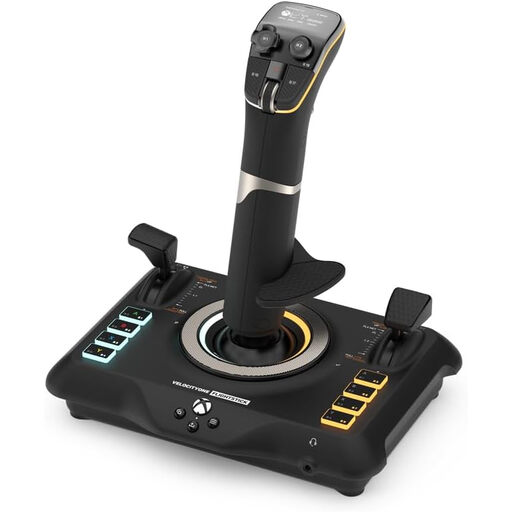
Turtle Beach VelocityOne Flight Stick (Xbox/PC)
Its integrated throttle controls make this a route to consider if you prefer a flight stick rather than a separate throttle unit. If avoiding pedals is essential, confirm which control your game can use for yaw, as well as the stick’s desk dimensions and bindings.
View on Joybuy
Common questions
Do I need rudder pedals for a virtual cargo-ship setup?
Not if your game accepts a suitable hand-operated yaw binding. Logitech G lists twist rudder on the X52 Pro, and Thrustmaster lists a twist-rudder axis on the T.16000M FCS stick; check the exact controller and game before choosing to leave pedals out.
Will a HOTAS work in Star Citizen?
Star Citizen supports joystick and HOTAS bindings, according to Roberts Space Industries. Its guidance names X52, X52 Pro and X56 profile examples and explains that bindings can be changed; it does not establish a supplied profile for every HOTAS.
Why might cargo-ship controls need more than a forward-thrust lever?
Docking in a game with six-degree-of-freedom movement can call for translational and rotational inputs as well as forward thrust. Logitech G lists four additional axes on the X56 thumb mini-sticks, while Turtle Beach lists independent or linked throttle levers on the VelocityOne Flightdeck; their usefulness depends on your game’s available bindings.
What should I check after connecting a HOTAS?
Check that the game recognises the exact device, then test throttle direction, yaw and the ship commands you use most. In Star Citizen, Roberts Space Industries directs players to Joystick/HOTAS keybindings, where an available profile can be loaded or controls customised.


