Practisers with existing flight controls
If your yoke or joystick already handles pitch and roll, a separate throttle can put power and aircraft-system inputs within reach. For crosswind practice, keep a usable rudder input in the setup too.


Choose a standalone throttle quadrant if you already have pitch, roll and usable yaw controls, and mainly want physical levers for power or aircraft systems. If you are building a games-room setup from scratch, consider a stick-and-throttle or yoke-and-throttle system instead; for virtual crosswind practice, check that you can assign a rudder input, because a throttle alone cannot provide the yaw control used to align an aircraft with the runway.
If your yoke or joystick already handles pitch and roll, a separate throttle can put power and aircraft-system inputs within reach. For crosswind practice, keep a usable rudder input in the setup too.
If you mostly fly Airbus-style airliners, separate thrust levers and an aircraft-specific layout may matter more to you than a neutral quadrant for mixed aircraft.
If you have no primary flight controls yet, look at a coordinated stick-and-throttle or yoke-and-throttle setup. Check how it will provide yaw input before treating it as complete for virtual crosswind practice.
For virtual crosswind practice in a dedicated games room, decide whether you need a complete set of flight inputs or an addition to controls you already own.
Choose it when: You already have suitable primary controls and want dedicated levers for power or aircraft systems.
Trade-off: A quadrant does not replace the pitch, roll and yaw inputs needed elsewhere in the setup.
Choose it when: You are starting from scratch and want primary flight controls and a throttle together.
Trade-off: Allow room for the larger arrangement, and check how the particular system provides rudder input.
| Concern | What to check | Who this matters to |
|---|---|---|
| Coordinated controls | Check for an assignable rudder axis alongside pitch, roll and throttle. The Federal Aviation Administration describes rudder use for runway-heading alignment in its crosswind guidance. | If I want to practise lining up with the runway, I need yaw control as well as a way to change power. Around 42% of consumers might put coordinated controls first. |
| Aircraft layout | Compare the lever arrangement with the aircraft you fly most: configurable levers for mixed flying or separate thrust levers and detents for Airbus-style operation. | When I mainly fly airliners, I want the throttle layout to match those aircraft rather than choosing controls solely for flexibility. Roughly 33% of consumers might make aircraft layout their primary concern. |
| Space and installation | Check platform compatibility and measure the space for controls, lever travel and mounting. Decide whether the throttle must be removable. | If my games-room desk must also accommodate a stick or yoke, I need a setup that fits and stays stable in use. About 25% of consumers might prioritise space and installation. |
A throttle controls power, but it does not supply the rudder input described in the Federal Aviation Administration’s crosswind-alignment guidance.
Before buying, list the pitch, roll, throttle and yaw inputs your simulator can use. If yaw is still missing, plan how you will provide it.
That may mean making room for pedals or using another suitable rudder-control arrangement.
Thrustmaster’s TCA Quadrant Airbus Edition has two separate Airbus-inspired thrust levers, while Honeycomb Aeronautical describes the Bravo Throttle Quadrant as configurable for aircraft from single-engine types to four-engine airliners. Consider which layout fits the aircraft you use most.
Choose Airbus-style controls for predominantly Airbus-focused sessions; for a varied fleet, compare how readily each layout can be assigned to your usual aircraft.
Platform support can differ even within a brand’s flight-control range, and a fixed cockpit arrangement still needs enough desk or rig space.
Check the exact model against your platform and simulator, then measure the available surface and confirm its mounting method before ordering.
Its flight-simulation range includes a standalone Flight Sim Throttle Quadrant and a yoke system.
Its flight-control range covers standalone throttles alongside combined stick-and-throttle and yoke-and-throttle systems.
Its TCA range is particularly relevant to Airbus-style virtual airliner controls.
Its Bravo Throttle Quadrant is aimed at configurable civil-aviation cockpit layouts.
These stick-and-throttle and yoke-and-throttle choices suit consumers assembling a games-room setup rather than adding only a standalone quadrant. Check each model’s simulator compatibility and how you will provide rudder input.
 No image available
Consider this yoke-and-throttle system if you are starting a cockpit setup and want primary controls alongside a throttle. Turtle Beach describes built-in rudder controls; check that your intended simulator lets you assign them as needed.
 No image available
Consider this HOTAS and mount for a Windows 10 or 11 PC games-room arrangement. Check simulator compatibility, mounting space, available connections and how you will assign yaw control.
 No image available
Consider this stick-and-throttle package if you want controls listed for PS5, PS4 or PC. Confirm support in your specific simulator and identify the rudder input you will use for virtual crosswind practice.
 No image available
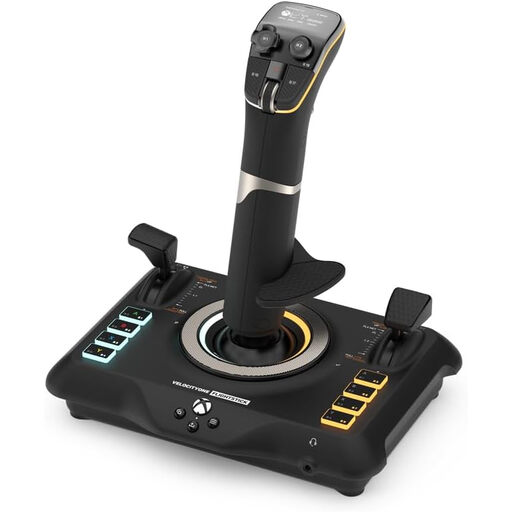
Consider this flight stick if you want an Xbox or PC controller with throttle inputs. Before choosing it for crosswind practice, confirm which yaw control you can use and bind in your simulator.
Not if you want to practise coordinating the controls used to line up with a runway. The Federal Aviation Administration describes rudder use for heading alignment in its crosswind guidance, so check that your simulator setup provides an assignable yaw input alongside the throttle. This is guidance for choosing simulation controls, not real-flight instruction.
Choose a standalone quadrant when your existing controls already cover pitch, roll and yaw; choose a combined setup when you need primary controls as well as a throttle. In either case, check the exact model’s platform and simulator compatibility before buying.
No, provided it can sit securely in the space available and its controls remain easy to reach. Turtle Beach specifies rubber feet for desktop use and threaded mounting holes for the VelocityOne Dual Throttle; choose a mounting arrangement that fits your desk or rig.