PC instrument-scan learner
You want repeatable pitch, roll, trim and power changes while keeping your attention on the panel. If you have room for it, a separate throttle may suit the way you practise procedures.


For virtual instrument-scan practice, start with controls that let you make small pitch-and-roll corrections, reach trim and adjust power while watching the panel. A standalone stick suits a compact desk or a supported Xbox setup; a separate stick and throttle suits learners who want distinct power controls, provided their simulator supports the required mappings. As the UK Civil Aviation Authority’s training-device requirements make clear, a home flight stick alone does not establish eligibility for instrument-rating training credit.
You want repeatable pitch, roll, trim and power changes while keeping your attention on the panel. If you have room for it, a separate throttle may suit the way you practise procedures.
You would rather begin with one desktop device that brings levers and rudder input together than assemble several controls immediately. Check support for your particular simulator before relying on its available assignments.
You plan to add controls as your practice develops. Pedals or avionics hardware may become relevant once you know which aircraft and procedures you want to simulate; the Flight Simulation Association recommends approaching such additions incrementally.
For virtual instrument scans, settle the basic control layout before comparing extra buttons: consider how you will adjust attitude, trim and power, then check whether that layout fits your platform and desk.
Consider it when: You need a compact desktop arrangement or a stick model that explicitly supports Xbox as well as PC.
Trade-off: Integrated levers keep controls together rather than giving the throttle its own separate unit.
Consider it when: You want a physical power control apart from the stick during procedures, and the particular setup supports your platform and simulator.
Trade-off: Two control units need more desk space; console compatibility cannot be assumed from the HOTAS label.
| Concern | What to check | Who this matters to |
|---|---|---|
| Attitude and trim control | Look for a controllable pitch-and-roll input and a trim assignment you can reach without leaving your usual hand position. Treat stated sensor resolution as a specification, not proof of better practice outcomes. | If small corrections keep drawing my eyes away from the instruments, I want trim close at hand while I steady the aircraft; around 42% of consumers put fine attitude and trim control first. |
| Power and command access | Decide whether integrated levers or a separate throttle fit your workflow, then check that your simulator recognises the inputs you intend to assign. | When a procedure calls for power changes, I want the controls I use regularly within reach while I watch the panel; roughly 33% of consumers prioritise hands-on control access. |
| Platform and space | Match the exact model to your PC or console and simulator. Check the available desk space before choosing a separate throttle or planning later additions. | If desk space is tight or I use a console, I need a starting setup that fits and works with my chosen platform; about 25% of consumers put compactness and compatibility first. |
Extra inputs help only if your simulator recognises the assignments and you can reach the important controls while monitoring the instruments.
Work out where pitch, roll, trim and power will go first. Check device and profile support before treating additional buttons as a reason to choose a model.
Platform support depends on the model. Thrustmaster lists the T.16000M FCS HOTAS for Windows PC, while Turtle Beach lists its VelocityOne Flightstick models for Xbox and Windows PC.
Check the exact controller, console or operating system, and simulator title together rather than relying on the general flight-controller description.
The UK Civil Aviation Authority identifies specific device categories for potentially creditable instrument ground time. Owning a consumer controller does not establish that the complete setup or your practice qualifies.
If training credit is your aim, ask your Approved Training Organisation which device and syllabus it accepts before choosing home hardware.
Mounting space and the controls you actually use matter more at the outset than collecting peripherals. The Flight Simulation Association describes starting with basic controls and expanding as your needs become clearer.
Begin with a compatible stick and a workable control profile. Add pedals or avionics controls when a specific practice task calls for them.
The VelocityOne range includes standalone Flightstick models and a larger HOTAS layout, giving buyers different ways to arrange stick and power controls.
The T.16000M FCS HOTAS pairs a flight stick with a separate TWCS throttle for a Windows PC setup.
The X52 Pro HOTAS and separate rudder pedals are options to examine when planning a multi-device PC simulation arrangement.
These choices include a single-unit Xbox/PC flight stick and stick-and-throttle arrangements for the platforms named with each product. The Airbus-oriented pack is most relevant if that control layout matches the aircraft you intend to practise; for every option, confirm simulator support and the mappings you need.
 No image available
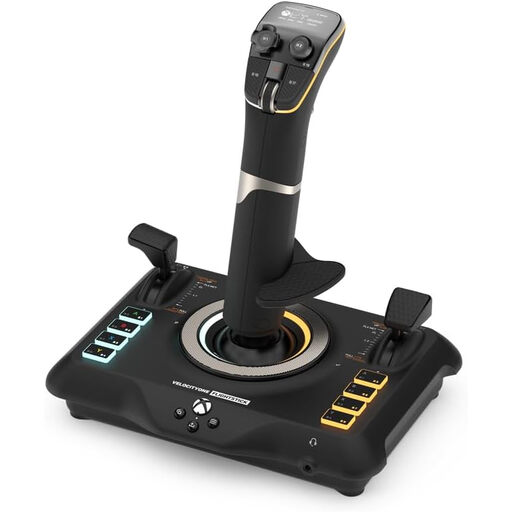
Consider this standalone stick if you want trim and power controls together on the desk. Turtle Beach specifies a trim wheel, two levers and eight axes for the VelocityOne Flightstick; confirm that your simulator supports the assignments you plan to use.
 No image available
Consider this mounted HOTAS arrangement if you use a Windows 11 or 10 PC and want distinct stick and throttle controls. Check that the mount fits your desk, and that your simulator permits the trim and other assignments your scan practice needs.
 No image available
The stick-and-throttle layout is worth considering if you want a physical power control for a simulator on one of the named platforms. Confirm support for your exact simulator and check how you would assign trim before buying.
 No image available
Consider this Airbus-oriented control pack if its sidestick-and-throttle layout matches the aircraft and procedures you plan to practise. Check your simulator’s support for the pack and how its controls, including trim, can be mapped.
A home flight stick does not qualify training time on its own. For the Basic Instrument Flight Module, the UK Civil Aviation Authority specifies 10 hours of instrument instruction, of which up to five hours may be instrument ground time in a BITD, FNPT I or II, or FFS. If you need credit, confirm the accepted qualified device and training arrangements with your Approved Training Organisation.
No: a compatible stick can provide a starting point for virtual instrument scans. The Flight Simulation Association supports adding peripherals progressively; pedals become more relevant if your intended practice calls for separate rudder input or differential toe braking.
Check the exact model’s PC or console support and whether your simulator recognises the axes and control assignments you need. Platform labels alone are not enough: Thrustmaster specifies Windows PC compatibility for the T.16000M FCS HOTAS, while Turtle Beach lists Xbox and Windows PC support for its VelocityOne Flightstick models; simulator mappings still need checking for either route.
Choose the layout around how you will reach power and trim controls during a scan. A standalone stick keeps the arrangement compact, while a separate throttle gives power its own physical control and takes more desk space. In either case, confirm that the particular model supports your platform and simulator profile.