Space-limited desk simmers
If taxi practice has to fit around work, study or gaming, look for a controller you can position and remove without taking over the desk. Measure the space left for your keyboard and mouse as well as the throttle itself.


Choose a compact programmable quadrant if the throttle must share a desk and be put away after each session: Logitech Support lists the Flight Throttle Quadrant at 175 mm × 175 mm, and Logitech G lists three axes and nine programmable commands. An Airbus-style quadrant makes more sense if separate engine levers, detents and reversers matter to your taxi practice; Honeycomb’s larger units suit a setup with room for broader aircraft controls. Check your simulator compatibility, usable desk edge and storage routine before choosing.
If taxi practice has to fit around work, study or gaming, look for a controller you can position and remove without taking over the desk. Measure the space left for your keyboard and mouse as well as the throttle itself.
If you practise twin-engine civil-airliner procedures, separate engine levers, reversers and detents may matter more to you than a generic compact layout. Check how those controls map in your simulator.
If you switch between general aviation and airliners, configurable levers and dedicated ground or cockpit controls may justify a larger unit. Allow for its mounted size, not just the space it occupies in storage.
Choose it when: the shared desk needs to return to other uses and assignable controls matter more than an aircraft-specific layout.
Trade-off: Logitech G’s Flight Throttle Quadrant has fewer dedicated airliner controls, and its published operating-system support is Windows-focused.
Choose it when: separate engine levers, detents and reversers are part of the twin-engine procedures you practise.
Trade-off: those controls may add complexity to basic taxi practice. Thrustmaster lists the standalone TCA Quadrant Airbus Edition for PC.
Choose it when: one mounted unit needs to serve several aircraft types and you will use its additional physical controls.
Trade-off: Honeycomb Aeronautical lists Bravo LITE at 330 mm deep and Bravo at 382 mm deep, excluding mounting hardware—considerably more desk depth than Logitech’s 175 mm unit.
| Concern | What to check | Who this matters to |
|---|---|---|
| Desk space and removal | Measure clear width, depth and the front edge for mounting; allow room for your keyboard, mouse and cables. | If I need the bedroom desk for other things after taxi practice, I want a throttle I can fit and put away without disrupting the rest of the setup. Around 44% of consumers put desk space and removal first. |
| Taxi and airliner controls | Decide whether separate engine axes, reversers and detents match your aircraft; check the intended simulator assignments. | When I rehearse twin-engine airliner procedures, I want the physical throttle movements to match the controls I intend to use. For around 33% of consumers, those procedure controls are the primary need. |
| Aircraft range | Check the supplied levers and dedicated controls against the aircraft you fly, then allow for the unit’s mounted depth. | If I regularly switch aircraft types, I would rather configure one control setup for those routines than focus only on a small footprint. Broader aircraft controls come first for around 23% of consumers. |
A deeper throttle can crowd out the keyboard, mouse or work area on a shared desk. Logitech Support lists the Flight Throttle Quadrant at 175 mm deep; Honeycomb Aeronautical lists Bravo LITE at 330 mm and Bravo at 382 mm deep, excluding mounting hardware for the Honeycomb units.
Measure the usable desktop and mounting edge, including clearance for cables and any other flight controls, before choosing a larger unit.
Detents and reversers can be useful for the airliner procedures they represent, but they may be more than you need for basic taxi practice.
Choose those controls when they match your routine; otherwise, prioritise axes and buttons you can assign consistently in your simulator.
The Thrustmaster TCA Captain Pack X Airbus Edition includes a sidestick, throttle quadrant and additional modules. It is a different purchase from the standalone TCA Quadrant Airbus Edition.
Check the complete model name, included pieces, platform version and space needed for the assembled setup before choosing the bundle.
Its Flight Throttle Quadrant is a compact, assignable PC option for a desk that also serves other purposes.
The standalone TCA Quadrant Airbus Edition is aimed at PC users practising twin-engine civil-airliner controls.
Bravo and Bravo LITE offer broader physical control layouts for a desk or mount with room to spare.
These options include a HOTAS system, a yoke-and-throttle system, a flightstick with throttle controls and an Airbus-style bundle. Decide whether you want a standalone throttle or can accommodate the other controls, then check the complete setup against your shared desk and simulator.
 No image available
Consider this if you want a HOTAS setup for Windows 11/10 rather than a standalone throttle. Check how both controls and their mounts would fit on the desk, and confirm the taxi functions you intend to assign in your simulator.
 No image available
This complete flight-control system suits consumers who also want yoke controls, rather than a throttle alone. Before choosing it for a shared desk, check the space required for the full setup and the control assignments in your simulator.
 No image available
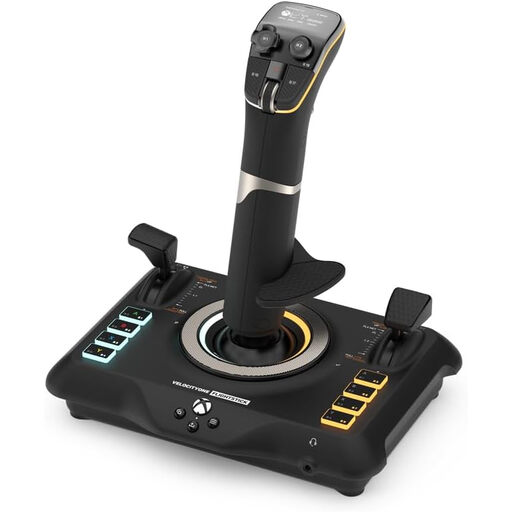
Consider a flightstick with throttle controls if you want both functions in this type of device, rather than a separate quadrant. Check its desk placement and whether your simulator supports the taxi assignments you plan to use.
 No image available
This Airbus-style bundle suits consumers who also want the included sidestick and separate flap and speed-brake modules. It includes a throttle quadrant but is not the standalone TCA Quadrant Airbus Edition; check the space for every piece and your simulator’s control assignments.
Allow for the controller, its mount and the equipment that must remain usable beside it. Logitech Support lists the Flight Throttle Quadrant at 175 mm × 175 mm; Honeycomb Aeronautical lists Bravo LITE at 273 mm × 330 mm and Bravo at 273 mm × 382 mm, excluding their mounting plate or clamp. Measure your desk edge and cable clearance too.
No: a programmable quadrant can provide assignable controls for basic taxi practice. Choose an Airbus-style layout when separate engine levers, detents and reversers are important to the procedures you rehearse, and check their assignments in your simulator.
Yes, Thrustmaster says the standalone TCA Quadrant Airbus Edition can have its detents and reversers disabled for linear-axis operation. You may still need to configure a suitable control profile for the other aircraft in your simulator.
Check the exact model against both your device and simulator. Logitech’s published Flight Throttle Quadrant support covers Windows 7 through Windows 11 at release, while Thrustmaster identifies the standalone TCA Quadrant Airbus Edition as a PC product. A bundle or different platform version should be assessed under its own product details.