What matters when choosing?
Compare the two speaker formats at a realistic listening level, then check whether your amplifier and the available positions in the room make your preferred pair practical.
Floorstanding speakers
Consider them when: You have room for larger cabinets and want to audition a floorstanding design for musical scale at your usual listening distance.
Allow for: More floor area and careful amplifier matching. Bowers & Wilkins, for example, specifies an 8Ω nominal impedance but a 3.0Ω minimum for the 603 S3.
Large standmount speakers
Consider them when: You prefer this cabinet format and can position the speakers securely at an appropriate listening height.
Allow for: Dedicated stands as well as the amplifier and cables required by a passive pair. Check the combined footprint rather than judging the cabinets alone.
| Concern |
What to check |
Who this matters to |
| Scale across the room |
Audition at your intended listening distance and volume; check how placement near walls changes the bass. |
If the room is large, I want a string quartet or piano trio to have enough presence at my seat without choosing on bass alone. Around 36% of consumers put room scale first. |
| Instrumental clarity and stereo image |
Use familiar acoustic recordings and try different speaker angles and seating positions. |
I want to follow the violin, viola, cello and piano as distinct parts of the ensemble. For around 29% of consumers, that clarity is the primary concern. |
| Amplifier and system matching |
Confirm whether the speakers are passive; check the amplifier against the stated power range and impedance, including any published minimum. |
If I already own an amplifier, I need a speaker pair it can drive and a workable connection to my music source. Around 21% of consumers prioritise system compatibility. |
| Placement and considerate listening |
Measure the floor area needed for cabinets or stands, and consider shared walls, floors and ceilings. |
I need a layout that leaves the room usable and lets me listen without disturbing neighbours. Placement and neighbour-aware listening come first for around 14% of consumers. |
Joybuy standmount options
These passive bookshelf speakers are options to assess if you are considering a standmount-style stereo setup. Check their placement and amplifier requirements, and audition them at your intended listening distance before deciding whether either meets your large-room needs.
 No image available
HiVi-Swans D3.1MKII Passive Bookshelf Speakers
Consider this passive model if you are planning a bookshelf-speaker stereo setup with a separate amplifier.
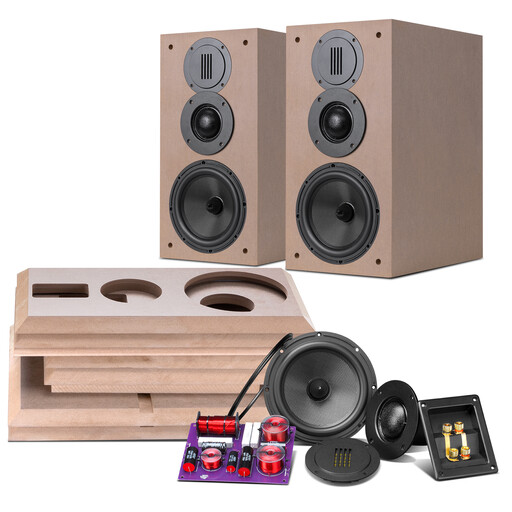
The listing names a two-way design with a 6.5-inch mid-bass driver, 28mm tweeter, rear bass reflex, 8Ω impedance and 10–120W amplifier range. Check the cabinet dimensions and intended placement, and audition at your listening distance before relying on it for a large room.
View on Joybuy
 No image available
HiVi-Swans DIY3.1 Passive Bookshelf Speakers, Pair
Consider this passive pair if a bookshelf-speaker arrangement fits your planned stereo system.
The product name specifies 6.5-inch speakers. Check amplifier requirements, cabinet dimensions and suitable placement, then audition at your intended listening distance to assess their fit for a large room.
View on Joybuy
Common questions
Do passive speakers need an amplifier?
Yes. Passive speakers need separate amplification; KEF distinguishes them from active speakers, which have amplification built in. Check the requirements of the particular pair and the capabilities of your amplifier before buying.
Should I choose floorstanders or standmounts for a large living room?
Choose the format you can position properly and that meets your needs in an audition, rather than assuming cabinet type settles the result. Floorstanders need sufficient floor space; large passive standmounts need suitable stands and amplification, so compare the complete setups at your usual listening level.
How should I position speakers for chamber music?
Start with the pair arranged symmetrically around your main listening position, then listen as you adjust their angle. KEF suggests starting at 0° toe-in and trying 2° increments; treat that as a starting method, not a required setting for every room or speaker.
Does a large living room remove the risk of disturbing neighbours?
No. Speaker placement and listening level still matter where homes share walls, floors or ceilings. In England, the Department for Environment, Food & Rural Affairs says councils must look into complaints about noise that could be a statutory nuisance; consider your surroundings when planning where and when you listen.


