
24/7 Customer Support

Free returns

Same-day & Next-day Delivery

Quality Guaranteed

Unlock Your Welcome Offers: FREE Delivery | Up to 80% OFF | Free 30-day JoyPlus trial
Download the APP
A foam baby play mat can make a hard floor more comfortable for crawling, tummy time and play. It can also protect carpets and flooring from spills, but not every mat suits every room or age group. The right choice depends on coverage, cushioning, cleaning and how often you expect to move or reconfigure it.
Before buying, watch for three common pitfalls.
Common options include EVA foam and XPE foam. An EVA foam play mat is often supplied as interlocking tiles, while XPE is commonly used in larger foldable mats. Both can provide a cushioned surface, but the product’s thickness, texture and construction affect everyday use.
Check whether the listing clearly states:
Avoid assuming that colourful designs, soft foam or the phrase “safe material” automatically mean the product is suitable for unsupervised infant use. Follow the manufacturer’s instructions and inspect the mat regularly for damage.
For a nursery or playroom, calculate the required area in square metres. A large padded crawling mat can be more convenient for babies who are learning to move, while interlocking foam floor mats let you create a smaller area or expand it later.
The AIYAPLAY foldable mat listed below measures 177 × 146cm, covers 2.57m² and is 1.5cm thick. By contrast, the Benrita tiles measure 12 × 12 inches each, so the final layout depends on how the pieces are arranged.
Thickness is only one factor. A thicker mat may feel softer, but it can also create a higher edge that toddlers may trip over. Check whether the mat lies flat and whether the surface has enough grip for crawling and early steps.
A waterproof kids play mat is practical for snacks, painting and messy play, although “waterproof” and “water-resistant” are not interchangeable. Follow the cleaning instructions and dry the mat fully before storing it.
For permanent play areas, puzzle floor tiles are easy to assemble and replace individually. For smaller homes, a foldable baby play mat can be folded away after use or taken to a relative’s house, garden or picnic. Whichever style you choose, keep it away from open flames and check that it does not slide on your flooring.
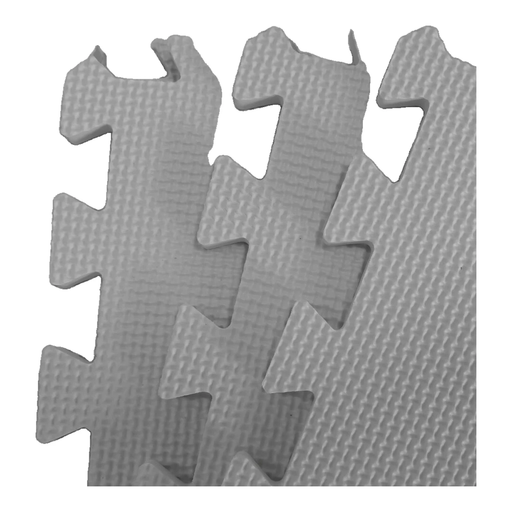
Why This Fits Their Persona: A six-tile set offers a straightforward starting point for a compact nursery corner, reading area or supervised floor play in a UK flat or smaller room.
The tile format makes the coverage clear, helping prevent overestimating the area from a pack quantity alone. Pieces can also be separated for cleaning.
Six 12 × 12-inch EVA foam tiles; light grey solid colour; includes edge pieces for a neater perimeter.
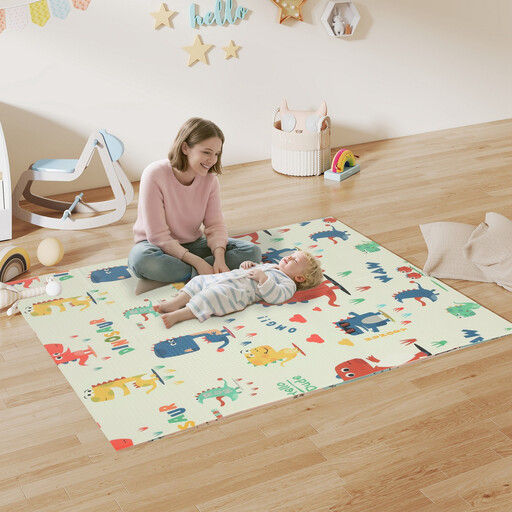
Why This Fits Their Persona: This larger option suits families wanting a defined nursery or playroom surface that can be folded for storage, visits and indoor or outdoor use.
Its stated measurements and 2.57m² coverage make it easier to compare with your available floor space. The water-resistant surface addresses everyday spill-cleaning needs.
1.5cm XPE foam; reversible dinosaur designs; foldable construction; anti-slip texture; approved age listed as 0+ and recommended age of 0.5–6 years.
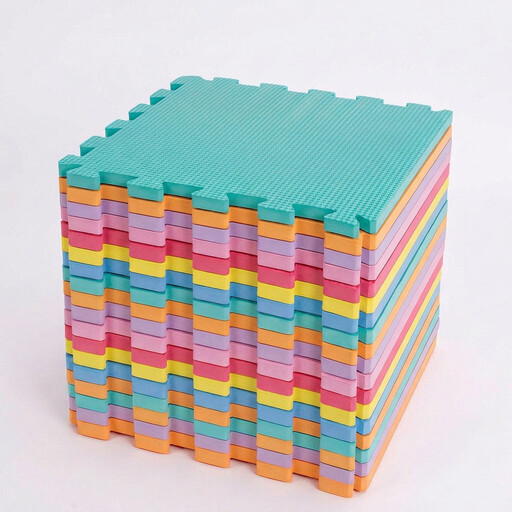
Why This Fits Their Persona: The modular design works for playrooms, classrooms and households that also need flooring for yoga, fitness or a home workout area.
The interlocking format can be expanded or divided rather than forcing one fixed layout. Individual pieces can be detached for cleaning or replacement.
18 colourful 12 × 12-inch squares; 27 edge pieces; EVA foam described in the listing as non-toxic; suitable for play, yoga and fitness use.
We have compiled a complete, real-time list of products that fully satisfy these strict selection criteria and UK safety regulations.
A play mat can also be used as a nursery floor mat, kids playroom mat or temporary yoga and exercise mat, but check whether the surface is suitable for the activity. Exercise equipment, shoes and pets may accelerate wear.
A foam mat provides a softer, more comfortable surface than many hard floors, but it is not a substitute for supervision. Check the stated age guidance, inspect the surface and use the mat on a stable floor. For products marketed for children, review available conformity and safety information before purchase.
Lifespan depends on thickness, frequency of use, sunlight, cleaning products and whether shoes or heavy equipment are used on it. Interlocking tiles may be practical because worn sections can be removed separately. Foldable mats should be stored flat or according to the manufacturer’s instructions to reduce creasing.
A foldable mat has fewer joins and can usually be wiped across its broad surface, making it convenient after snacks or messy play. Puzzle floor tiles can be separated, which helps with spot cleaning and layout changes. Choose based on whether portability or modular replacement matters more for your household.