What to check before buying
Start with the oat form and serving guidance, then compare the ingredient list, fibre declaration and preparation method against your usual breakfast routine.
| Priority |
What to check |
Your needs |
| Portion and oat form |
Check whether the oats are quick, rolled or another form. Use the current Monash FODMAP app guidance for the chosen form and serving, then assess toppings separately. |
I want a breakfast that fits my current low-FODMAP stage rather than assuming every oat product or bowl size is interchangeable. |
| Fibre information |
Compare fibre on the stated basis, such as per dry sachet, per serving made with water or per 100g. Quaker Original lists 2.4g per 27g sachet, while Flahavan’s Quick Oats lists 2.5g per 30g serving made with water. |
I want to see a clear fibre figure while choosing a plain base that lets me add tolerated ingredients gradually. |
| Added ingredients and allergens |
Read the full ingredient and allergen statement on the live pack. Ready pots may include milk or sugar, while oat products can also carry different allergen or may-contain statements. |
I need to choose my own liquid and toppings, or I have a separate coeliac disease, gluten or food-allergy requirement to consider. |
Joybuy oat options
Joybuy product options centred on plain oats and original oat sachets, where choosing your own liquid and toppings may be useful for a FODMAP-focused breakfast routine.
 No image available
Quaker Oat So Simple Big Bowl Original 6 Pack, 231g
A portioned microwave breakfast for choosing your own liquid and toppings.
Each 38.5g sachet contains wholegrain rolled oats and states 3.5g fibre. Check the current Monash FODMAP app guidance for the serving, and check the live allergen label if coeliac disease or gluten avoidance is relevant.
Joybuy
 No image available
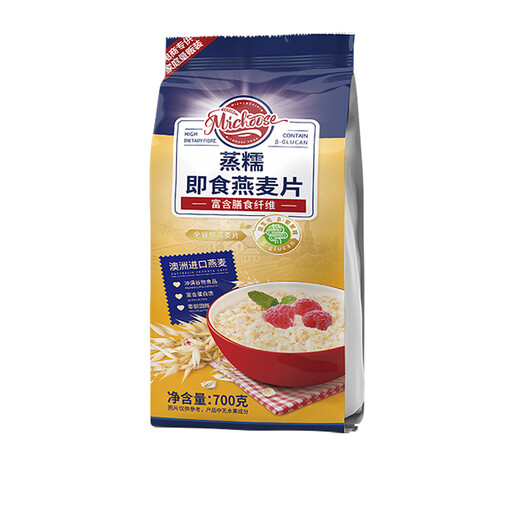
Steamed Instant Oatmeal, 700g
A hot-water option for a quick breakfast when a microwave is unavailable.
The description states 100% oatmeal, one-minute preparation and 9.9g dietary fibre per 100g. Check the oat form, portion guidance and live allergen label before relying on it for a FODMAP-focused routine.
Joybuy
 No image available
Scotts Porage Oats Old Fashioned Porridge Oats, 1kg
A plain rolled-oat porridge for microwave breakfasts with water or milk chosen separately.
The supplied details state 100% rolled oats and microwave preparation in two to three minutes. It may contain wheat and barley; check the current label and the relevant Monash FODMAP serving guidance.
Joybuy
 No image available
Scotts Porage Oats Original Porridge Oats, 1kg
A plain oat option for breakfasts where you want to select the liquid and additions yourself.
The product details state 100% oatmeal and 3.6g dietary fibre per 40g serving. Check the preparation method, the current FODMAP serving guidance and the live allergen label for your requirements.
Joybuy
 No image available
Flahavan's Organic Porridge Oats, 1kg
A plain wholegrain oat option for adding individually chosen milk and toppings.
The supplied details list 100% organic wholegrain oat flakes and 3.3g fibre per 40g serving. Check the preparation method, current FODMAP portion guidance and live allergen label before purchase.
Joybuy
Frequently asked questions
Are instant oats automatically low FODMAP?
No. Monash FODMAP says that oat forms, including rolled and quick oats, can have different FODMAP content, and people in Step 1 should check its app for serving sizes. Assess both the portion and added ingredients such as milk, fruit, sweeteners and flavourings.
Is a low-FODMAP diet the same as a gluten-free diet?
No. Monash FODMAP states that a low-FODMAP diet is not a gluten-free diet. If you have coeliac disease or another gluten-related requirement, assess that separately using product-specific allergen and gluten-free labelling; M&S Traditional Porridge, for example, states that it is not suitable for coeliacs.
Which preparation is easiest if I need to choose lactose-free milk or water?
Plain sachets or quick oats offer more control than a pre-mixed oat pot. Quaker Original is prepared with added milk, while Flahavan’s Quick Oats lists a serving made with water; Tesco Instant Oats Original already contains dried skimmed milk.
Should I remain on a strict low-FODMAP diet indefinitely?
Not as a general default. Monash FODMAP’s three-step approach describes a two- to six-week Step 1, followed by reintroduction and a minimally restrictive personalised long-term diet. The NHS says a dietitian may recommend a low-FODMAP diet for IBS.


