
24/7 Customer Support

Free returns

Same-day & Next-day Delivery

Quality Guaranteed

Unlock Your Welcome Offers: FREE Delivery | Up to 80% OFF | Free 30-day JoyPlus trial
Download the APP
Whether you are carrying camping equipment across a field, moving groceries from the car or transporting stock to a market stall, a foldable camping wagon can reduce repeated trips and make bulky loads easier to manage. However, product listings often emphasise a large capacity or impressive-looking wheels without explaining how the cart will perform on grass, gravel, sand or a sloped driveway.
The right choice depends on more than the headline number. Before buying, compare the usable capacity, stated load limit, frame construction, wheel design, braking system and folded dimensions.
A wagon may offer a spacious interior but still have a lower maximum load limit. Litres describe how much space is available, while kilograms indicate the permitted load. These are different measurements.
For example, a 127-litre cart may be easier to store than a 200-litre model, but both can be useful for different tasks. Check whether the product listing states a clear maximum load capacity and never assume that a larger body automatically supports heavier equipment.
Distribute weight evenly across the base rather than placing dense items at one end. This helps reduce tipping, particularly when crossing uneven ground.
A collapsible camping cart with small swivel wheels may be convenient on pavements, supermarket floors and compact grass. Loose sand, mud and gravel require a different wheel design.
Look for large off-road wheels with a suitable tread and enough clearance beneath the frame. Wheel size, material and width affect how easily the wagon rolls over outdoor surfaces. Even with rugged wheels, a fully loaded trolley should be pulled slowly and should not be used for high-speed transport.
A portable folding wagon is useful only if it opens fully, locks securely and remains stable when loaded. A compact folded shape does not guarantee a rigid frame in use.
Before loading, check that the frame is completely unfolded and locked. Keep fingers clear of folding joints and avoid using the wagon as a seat or step. For slopes, a camping trolley with brakes can provide additional control when stationary, but brakes are not a replacement for careful positioning.
Choose capacity according to the items you regularly carry:
A stated 200kg load capacity wagon may suit heavier equipment, but the limit must never be exceeded. One of the listed 127-litre models specifies a maximum load of 200kg, while the 150-litre off-road tank wheel models specify up to 260kg. Always refer to the individual product listing and distribute the load evenly.
Some listings also mention “stackable capacity”. Treat this as a storage-volume description rather than an additional safe carrying limit.
The frame affects rigidity and handling. Steel tubing or reinforced carbon steel can provide a firm structure, while fabric bodies may fold more easily and reduce storage bulk.
The 127-litre models reference heavy-duty spray-painted steel tubes, while the 200-litre black model combines a steel frame with 600D Oxford cloth and PVC off-road wheels. Fabric should be wiped clean and dried before folding. Avoid storing a damp wagon in a garage or boot, as moisture may contribute to mould or corrosion.
For pavements, indoor venues and shopping areas, 360° swivel wheels can make turning easier. For grass, gravel, mud or sand, larger off-road wheels are generally more appropriate.
Dual brakes are useful when loading or parking on an incline. Engage them whenever the wagon is stationary, but avoid steep or unstable surfaces where the cart could tip. An off-road garden trolley should be pulled at a controlled pace and kept away from public roads.
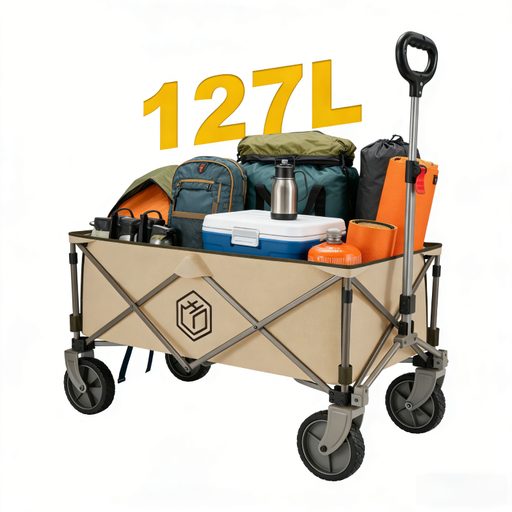
Why This Fits Their Persona: A practical starting point for households, picnickers and shoppers wanting a substantial interior without moving straight to a larger 200-litre body.
The listing states both its 127-litre interior and 200kg maximum load, helping shoppers compare space with carrying limits rather than relying on volume alone.
Foldable construction, dual brakes and 360° swivel wheels; no assembly is typically required.
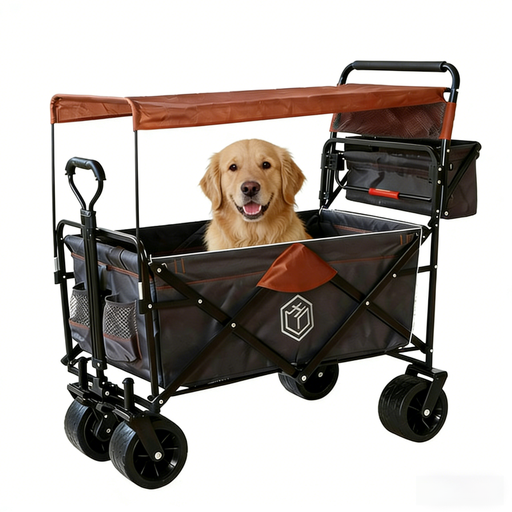
Why This Fits Their Persona: Suits buyers prioritising a reinforced structure and added features for regular camping, event work or outdoor transport.
Its specification identifies a reinforced carbon steel frame, dual brake wheels and a stated 260kg load capacity, giving more useful detail than a generic “heavy-duty” label.
150-litre body, detachable canopy, safety belt and off-road dual-brake wheels.
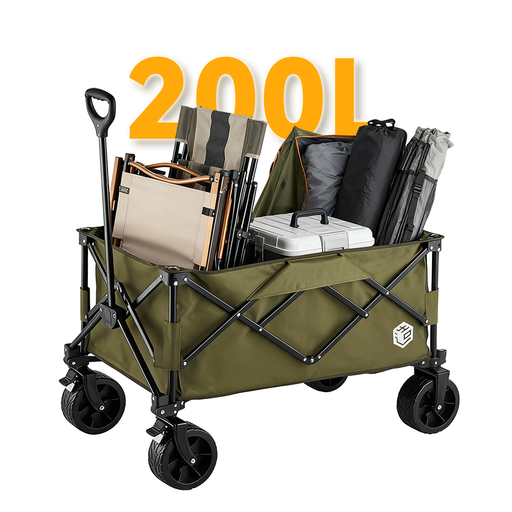
Why This Fits Their Persona: Designed for users moving bulky camping kit, beach supplies, garden materials, groceries or market-stall stock across outdoor terrain.
The product description specifies large all-terrain wheels and dual brakes, rather than relying only on the phrase “outdoor cart”.
200-litre high-sided design, fold-flat storage and wheels described for sand, grass, gravel, mud and uneven terrain.
Open the wagon on a stable surface and confirm that the frame has locked before adding equipment. Place heavier items low and centrally, keeping loose objects secured inside the body. Engage the brakes when stationary, especially on an incline.
After a beach trip or muddy walk, wipe the frame and wheels to remove grit and moisture. Fabric bodies should be allowed to dry fully before folding. Periodically check wheel fixings and brake operation and store the cart in a dry place. Do not use a camping wagon on public roads or as a child carrier unless the specific product is designed and approved for that purpose.
We have compiled a complete, real-time list of products that fully satisfy these strict selection criteria and UK safety regulations.
Models with large off-road wheels are generally more appropriate for sand than compact swivel-wheel designs. Pull slowly, avoid overloading and check the product instructions before use. Clean and dry the wagon after exposure to sand or salt air.
Lifespan depends on load frequency, terrain, storage and maintenance. Avoid exceeding the stated load limit, protect the frame from prolonged moisture and check wheels, brakes, stitching and folding joints regularly. These steps can help identify wear before the next camping or shopping trip.
There is no fuel or battery cost for a standard manual wagon. Ongoing costs are mainly related to cleaning and potential replacement parts such as wheels or fixings. Choosing the correct capacity and using it within its stated limits may help reduce avoidable damage.