
24/7 Customer Support

Free returns

Same-day & Next-day Delivery

Quality Guaranteed

Unlock Your Welcome Offers: FREE Delivery | Up to 80% OFF | Free 30-day JoyPlus trial
Download the APP
A foldable camping wagon can save repeated trips between the car and campsite, move gardening supplies across a lawn or carry bulky shopping from a market. However, the large capacity figures and “off-road” descriptions used in listings do not always tell the complete story.
A suitable trolley needs to match your load, terrain and storage space. Before buying, look beyond the headline capacity and check the construction, wheel design, brakes, folded dimensions and safety instructions.
A wagon advertised as 200L may offer plenty of space but still have a lower permitted weight than expected. Conversely, a smaller collapsible camping trolley may support a heavier load if it uses a reinforced steel frame.
Check both:
A high-sided large capacity wagon is useful for sleeping bags, picnic boxes and beach equipment, but bulky items should not protrude so far that they affect stability.
Standard PVC wheels may work well on pavements, patios and firm grass. Sand, gravel, mud and uneven fields usually require larger, deeper-tread wheels. Even an all-terrain camping cart should be used at a controlled pace, particularly when heavily loaded.
Look for clear information about the wheel material, tread and intended surfaces. A trolley designed for outdoor use is not automatically suitable for steep slopes, kerbs or public roads.
A folding wagon that is awkward to open or does not lock securely can become frustrating during regular use. Check whether it requires assembly, whether the frame locks when open and whether fingers can be kept clear of moving joints.
Storage also matters in UK homes and cars. Compare the folded size with your boot, shed, cupboard or garage rather than relying only on the word “compact”.
A heavy-duty utility wagon should have a frame suited to the intended weight. Steel or reinforced metal frames generally provide a firm structure, while Oxford or polyester fabric forms the flexible cargo body. Fabric thickness and stitching are relevant where the wagon will carry sharp-edged camping equipment, tools or boxed goods.
Do not exceed the stated load rating. For example, the TIMBER RIDGE model lists a maximum load of 100kg, while several ochama models list capacities of 127L or 200L and maximum loads of up to 200kg. These figures should not be treated as interchangeable: a 200L volume does not itself mean a 200kg load rating.
For a lawn, campsite or paved route, swivel wheels can make turning easier. An outdoor beach cart or off-road wagon needs wheels appropriate for softer or uneven ground. Dual brakes are useful when stopping on a slight incline, but they do not remove the need to avoid steep slopes or unstable surfaces.
Before loading, confirm that:
An adjustable handle can make a camping wagon with wheels more comfortable for different users. A one-pull opening system may be convenient for frequent trips, while a model requiring minor wheel assembly may suit shoppers who prioritise a particular frame and fabric combination.
For a folding garden trolley, check how easily soil, plant pots and tools can be removed. For a portable shopping trolley, consider whether the base remains stable when carrying several smaller bags instead of one large load.
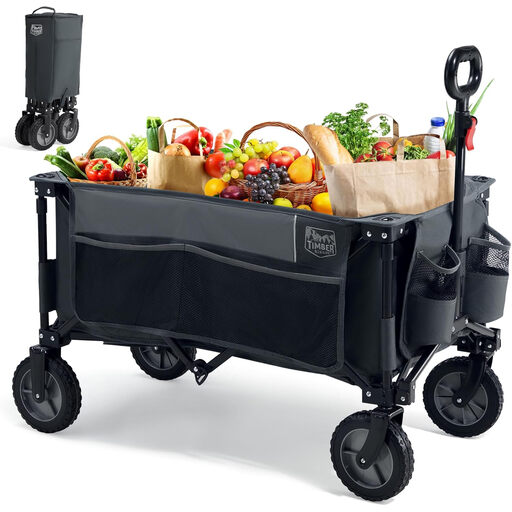
Why This Fits Their Persona: A practical option for picnics, shopping, gardening and occasional camping, with no assembly required and an adjustable handle for different users.
Its specifications state a 200L volume and 100kg maximum load, making the capacity-to-weight distinction clear. The one-pull fold mechanism also avoids complicated setup.
200L capacity; Oxford fabric, metal frame, zipped side pockets and cup holders.
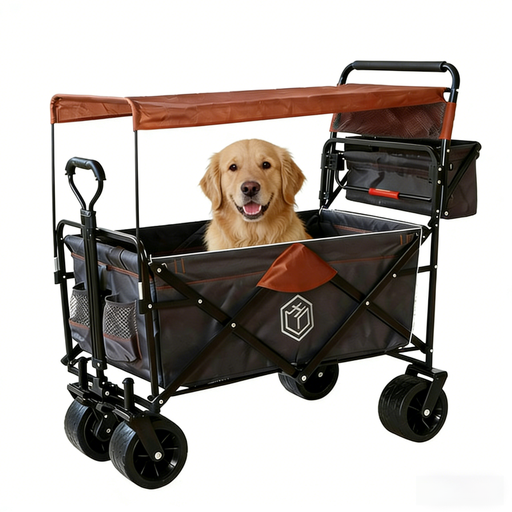
Why This Fits Their Persona: Suited to users moving heavier equipment for camping, picnics, vending or outdoor events where wheel performance and stopping control matter.
The listing specifies off-road wheels, dual brakes and a reinforced carbon steel frame rather than relying only on a general “outdoor” description.
150L interior; stated 260kg load capacity; detachable canopy and safety belt.
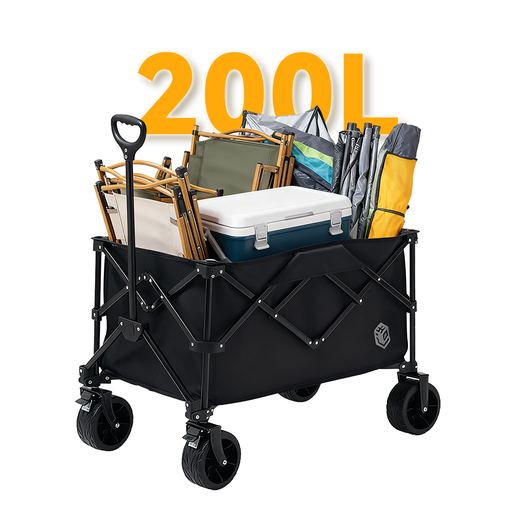
Why This Fits Their Persona: Designed for large loads such as camping equipment, garden materials, groceries, beach supplies or market-stall stock.
The product information identifies 200L capacity, off-road PVC wheels and a double-brake design, helping buyers assess space, terrain and parking control separately.
200L capacity; high-strength steel frame; 600D Oxford cloth; dual brakes and off-road wheels.
A folding trolley is likely to last longer when it is not stored wet. After a muddy campsite or beach trip, wipe the frame and fabric with a damp cloth, remove grit from the wheels and allow everything to dry before folding. Avoid harsh chemicals unless the product instructions permit them.
Always follow the supplied safety information. A 200L camping wagon should not be used as a seat or step stool unless specifically designed for that purpose. Keep hands away from folding joints, engage the brakes when stationary and avoid steep slopes or terrain where the wagon could tip.
For products sold in Great Britain, check that the listing provides appropriate manufacturer or responsible-person information and clear usage warnings. Product compliance information is not a substitute for following the stated load and terrain limits.
We have compiled a complete, real-time list of products that fully satisfy these strict selection criteria and UK safety regulations.
It depends on the wheel design. Wider, off-road wheels are more appropriate for sand and loose ground than small standard wheels. Pull the wagon slowly, keep the load balanced and check the manufacturer’s terrain guidance. Rinse or wipe away sand after use to reduce wear around the wheels and frame.
There is no single standard rating. The permitted load varies by model, so check the product specification rather than estimating from its size. A wagon may have 127L or 200L of storage but a different maximum load rating. Never exceed the stated limit and distribute weight evenly.
Some are suitable for groceries, parcels and market shopping, particularly models with an adjustable handle, stable base and easy-turning wheels. Consider the folded dimensions, your route from the shop and whether the wagon can be stored dry. For frequent use, a model with a durable frame and accessible cleaning routine may be more practical than one chosen solely for maximum capacity.