
24/7 Customer Support

Free returns

Same-day & Next-day Delivery

Quality Guaranteed

Unlock Your Welcome Offers: FREE Delivery | Up to 80% OFF | Free 30-day JoyPlus trial
Download the APP
A foldable camping wagon can save repeated trips between the car and campsite, beach, allotment or picnic area. However, product listings often focus on impressive capacity figures without explaining how the trolley behaves when fully loaded, folded or used on uneven ground.
Before buying a collapsible camping trolley, watch for three common pitfalls:
Look for two separate measurements: cargo volume in litres and maximum supported load in kilograms. A 200-litre camping wagon may suit bulky sleeping bags and picnic equipment, while a smaller model can be easier to manoeuvre when carrying groceries or garden tools.
The frame also affects stability. Steel or alloy steel frames generally provide a firm structure, while reinforced fabric such as Oxford or polyester material forms the cargo body. Check that the wagon has a locking mechanism and that the safety instructions require it to be fully unfolded before loading.
Do not exceed the stated load limit. Heavy items should sit low and centrally, rather than being piled high at one end. This is particularly important for a heavy-duty camping cart, garden trolley or outdoor folding trolley used on grass and gravel.
Wheel construction is one of the clearest differences between a basic portable folding cart and an off-road camping wagon. Consider:
For a beach wagon, check whether the wheels are designed for sand rather than assuming that “all-terrain” covers every surface. Loose, deep sand can remain difficult even for a model with large wheels.
Measure your boot opening, cupboard or shed shelf before choosing a folding wagon. A compact folded frame is valuable for festival travel and public transport, while a larger model may be worthwhile for families carrying bulky equipment.
An adjustable handle can improve comfort for users of different heights. Side pockets and cup holders are practical additions, but they should not distract from the core checks: frame stability, wheel security and the condition of the fabric body.
After a muddy trip, wipe the frame and fabric with a damp cloth and rinse removable wheels where permitted. Allow the wagon to dry fully before folding it away. Storing a damp trolley can encourage odours, mildew or corrosion.
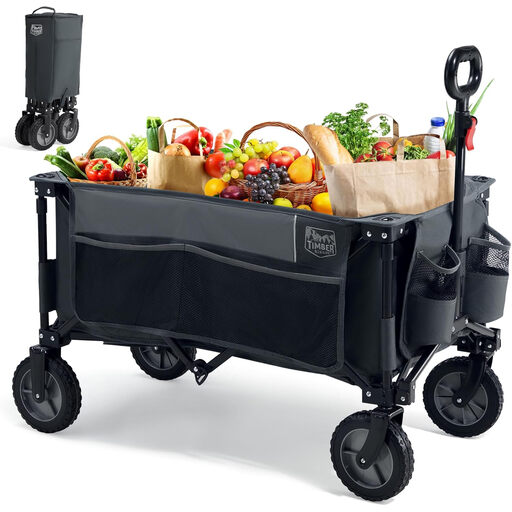
Why This Fits Their Persona: A practical choice for first-time buyers who want a 200-litre wagon for picnics, shopping, gardening or occasional beach trips without choosing a larger off-road model.
The listing separates its 200-litre capacity from its 100 kg maximum load and gives folded-use guidance, helping shoppers compare capacity with actual weight limits.
One-pull opening and folding, adjustable handle, cup holders and zipped side storage pockets.
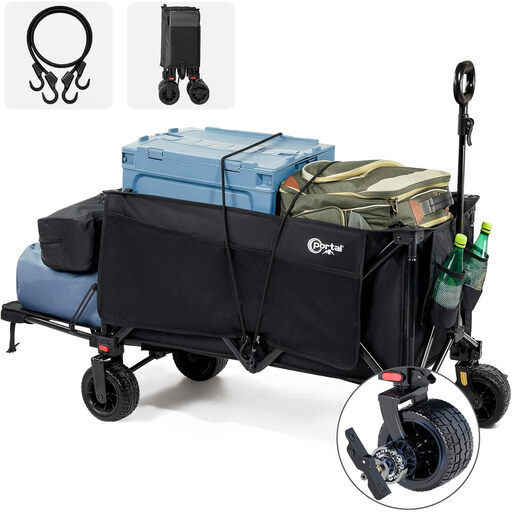
Why This Fits Their Persona: Suitable for families, festival-goers and market traders who need substantial carrying space and organised storage for repeated outdoor use.
The specifications state both the 300-litre capacity with open tailgate and the 132 kg load limit, while dual brakes address stationary use on slopes.
PU wheels with internal bearings, quick-release wheels, side pockets, cup holders and a stated folded size of 35 x 26 x 80 cm.
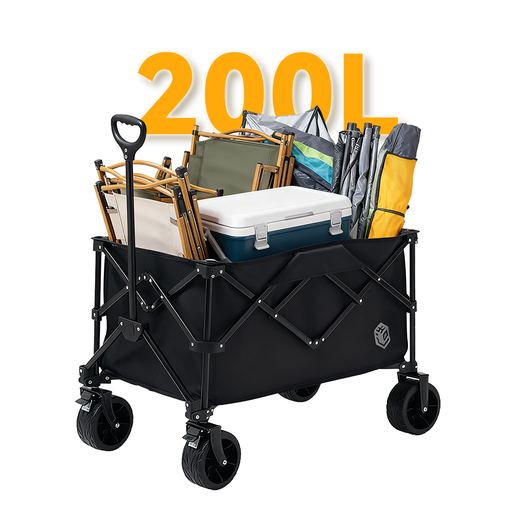
Why This Fits Their Persona: Designed for shoppers who regularly move heavier camping equipment, garden supplies, picnic loads or stock across outdoor settings.
Its listed off-road wheels and double-brake design directly address terrain and parking concerns, but users should still distribute weight evenly and avoid steep ground.
200-litre capacity, steel frame, 600D Oxford cloth, PVC off-road wheels and a foldable storage design.
Place the wagon on stable, level ground, release its folded position and pull the frame open until it locks. Attach or secure the wheels according to the product instructions, then check that the handle and base are stable before loading. Keep fingers clear of hinges and folding joints.
Lifespan depends on load frequency, terrain, storage and cleaning. Avoid exceeding the stated load limit, do not drag the wagon over unsuitable surfaces and dry the fabric and frame before storage. Regularly inspect wheel fittings, brakes, stitching and locking points for wear.
No. These are manually pushed or pulled products, so there are no batteries, fuel or charging costs. Possible maintenance expenses include replacement wheels or hardware if the model supports removable components. A quick-release wheel system can make cleaning and replacement more convenient.