
24/7 Customer Support

Free returns

Same-day & Next-day Delivery

Quality Guaranteed

Unlock Your Welcome Offers: FREE Delivery | Up to 80% OFF | Free 30-day JoyPlus trial
Download the APP
A foldable camping wagon can save repeated journeys between the car and your pitch, beach spot, garden or market stall. However, not every collapsible camping wagon is suitable for heavy outdoor use. Product listings often highlight capacity and oversized wheels while leaving out the details that affect stability, storage and daily handling.
Before buying, look beyond the headline number. The right wagon should match your typical load, terrain and available storage space.
A large capacity does not automatically mean a high weight limit. A wagon may hold 200 litres of equipment but be unsuitable for very dense loads such as bottled drinks, paving materials or gardening supplies.
Check both:
Also consider whether the stated capacity includes an open tailgate or an extended section. For example, a 300-litre specification may depend on the wagon being used with its tailgate open, rather than the enclosed compartment alone.
“Off-road” and “all-terrain” descriptions can cover very different wheel designs. Small hard wheels may roll well on pavements but become difficult to pull across wet grass, gravel or sand. For a beach trip or festival field, look for large wheels with a pronounced tread, suitable clearance and a frame that does not sit too close to the ground.
Wheel material also matters. PU, PVC, rubber and polyurethane wheels can provide different levels of grip and cushioning. Product specifications should identify the material rather than relying only on promotional wording.
A wagon can be spacious in use but awkward to store in a car boot, shed or hallway. Always compare the folded dimensions, not just the open size.
Brakes are another commonly overlooked feature. A camping wagon with brakes is useful when loading or parking on a slope, but the brakes should be engaged whenever the wagon is stationary. They are not a substitute for careful use on steep or unstable ground.
For occasional picnics or light shopping, a 100–170-litre cart may be sufficient. Regular campers, market traders and gardeners may prefer a large capacity folding wagon of around 200 litres or more.
The frame should be made from steel or another clearly identified load-bearing material. Fabric bodies such as polyester or 600D Oxford cloth should have secure stitching and a firm base. Weight should be distributed evenly to reduce the risk of tipping.
For grass, gravel, mud and uneven paths, select an off-road utility wagon with wide, durable wheels. Swivel wheels can improve manoeuvrability around campsites and event areas, while fixed or larger tank-style wheels may offer more direct movement across sand.
Check the handle design too. An adjustable handle can make pulling more comfortable for different users, and bearings may help wheels roll more smoothly. These features are particularly relevant when using a wagon as a garden trolley, folding beach wagon or all-terrain folding trolley.
A practical wagon should unfold securely and collapse without excessive effort. Look for:
Do not immerse fabric-bodied wagons in water unless the instructions specifically allow it. Sand, mud and salt should be removed before storage to help preserve the wheels and frame.
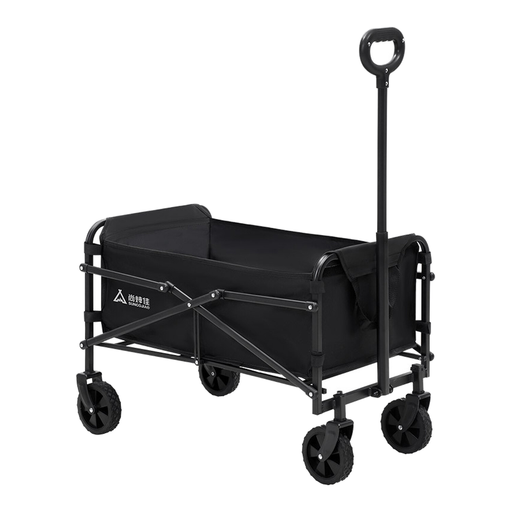
Why This Fits Their Persona: Its approximately 4.8kg product weight makes it practical for occasional camping, shopping, sports events and beach trips where compact transport is a priority.
The listing states both a 170-litre cargo capacity and a 100kg load capacity, helping buyers compare volume with actual weight handling.
Foldable frame, 600D Oxford fabric cargo bag, multi-directional wheels and a stated 100kg load capacity.
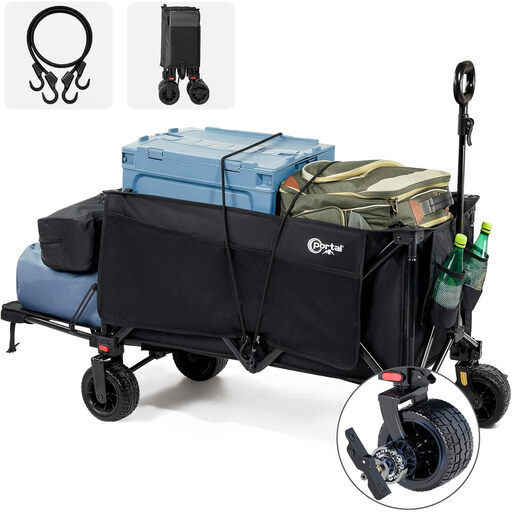
Why This Fits Their Persona: Suitable for campers, festival-goers and homeowners who want extensive space, organised storage and a more detailed wheel and folding specification.
The product information separates its 300-litre capacity, 132kg load limit and folded size of 35 x 26 x 80cm.
PU wheels with bearings, dual brakes, side pockets, cup holders, adjustable handle and quick-release wheels.
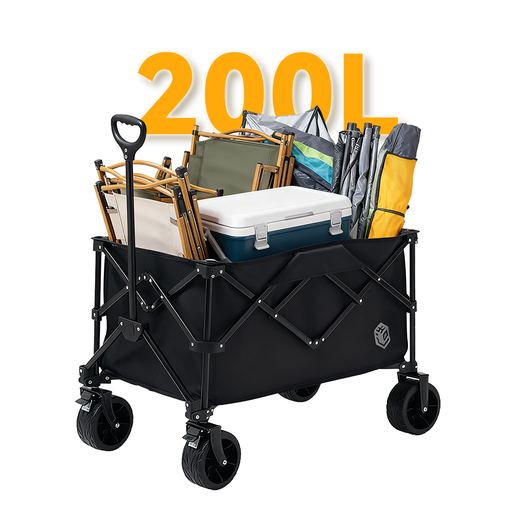
Why This Fits Their Persona: A practical match for regular campers, gardeners, vendors and shoppers moving bulky equipment across outdoor areas.
Its specification identifies a 200-litre body, steel frame, 600D Oxford cloth, off-road PVC wheels and a double-brake design.
Large 200-litre capacity, foldable storage, reinforced fabric construction and off-road wheels with double brakes.
We have compiled a complete, real-time list of products that fully satisfy these strict selection criteria and UK safety regulations.
Before loading any outdoor utility cart, follow the instructions supplied with the specific model:
A folding wagon is not usually powered, so running costs are limited to occasional cleaning and replacement parts where available. Wheels, bolts, brakes and fabric seams are the components most worth checking during regular use.
Some models are designed for outdoor terrain and use oversized wheels, but performance varies. Wide, deeply treaded wheels are generally more appropriate for sand than small narrow wheels. Even a heavy-duty camping cart may become difficult to pull on soft, wet sand when heavily loaded, so reduce the load and distribute it evenly.
The limit depends on the model. The products listed above specify capacities ranging from 100kg to 132kg, while other models in the range state higher limits. Always follow the manufacturer’s stated maximum and do not confuse litres with kilograms.
Remove sand, mud and grass, then wipe the fabric, frame and wheels with a damp cloth. Let every part dry fully before folding. Store the wagon in a dry garage, shed or indoor cupboard, and periodically inspect the wheel fixings, frame locks and brakes before use.