
24/7 Customer Support

Free returns

Same-day & Next-day Delivery

Quality Guaranteed

Unlock Your Welcome Offers: FREE Delivery | Up to 80% OFF | Free 30-day JoyPlus trial
Download the APP
Hauling gear from the car park to the perfect camping spot or festival pitch can often feel like the most challenging part of the adventure. Multiple trips loaded with tents, coolers, chairs and supplies can leave you exhausted before you’ve even started. A reliable foldable camping wagon transforms this task from a chore into a simple, single trip.
This guide is designed to help you navigate the options. We will look at the key features to consider before you buy and present a few recommendations that stand out for their practicality and design, helping you find the right collapsible cart with wheels for your needs.
Choosing the right wagon involves more than just picking the one with the biggest capacity. Here are a few practical points to consider to ensure you get a model that suits your typical activities.
The wheels are arguably the most critical feature. Standard, narrow wheels are often sufficient for smooth paths, pavements or firm, dry grass. However, if your plans include trips to the coast or muddy festival fields, you will need something more robust. Look for an off-road utility wagon with wide, chunky wheels. These distribute the weight over a larger surface area, preventing the cart from sinking into soft ground like sand or mud, making it a far more practical beach wagon uk option. Some models also feature 360-degree swivel front wheels for easier steering around obstacles.
Consider what you will be carrying. Load capacity, measured in kilograms (kg), tells you the maximum weight the frame can safely support. For general family camping, a capacity of around 80-100 kg is usually adequate. However, for transporting very heavy equipment, such as for a market stall or extensive garden work, a heavy duty festival trolley with a capacity of 150 kg or more is a better choice.
Equally important is the volume, measured in litres (L), which indicates how much space is inside the fabric liner. A large garden cart might have a high volume for bulky items like bags of compost, while a compact camping cart might prioritise a smaller folded size over maximum volume.
The frame provides the wagon's strength. Most are made from steel tubes, which offer a good balance of durability and weight. Check for features like a powder-coated or spray-painted finish, which helps protect the metal from rust. The main benefit of a foldable camping wagon is its portability. Consider how small the cart collapses and its overall weight. A lightweight model is easier to lift in and out of a car boot, but this can sometimes come at the expense of a lower load capacity.
Here are a few foldable wagons that offer practical solutions for different needs, from family picnics to heavy-duty hauling.

Why It Stands Out: This wagon impresses with its exceptionally high load capacity relative to its manageable size. It’s a versatile workhorse that balances heavy-duty capability with everyday convenience.
Pros:
Who is it for?
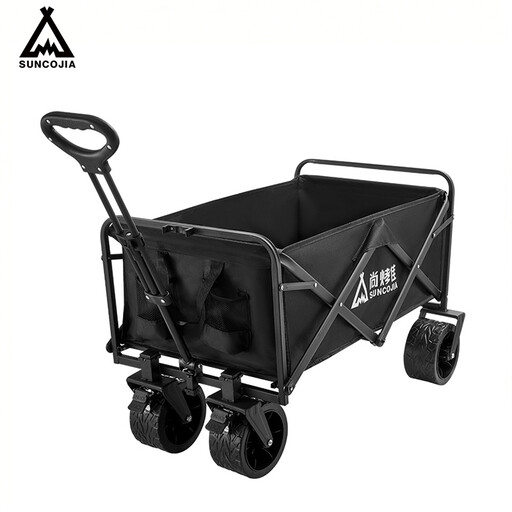
Why It Stands Out: This model is all about space and terrain versatility. Its enormous volume and wide, shock-absorbing wheels make it ideal for hauling bulky gear over uneven ground.
Pros:
Who is it for?
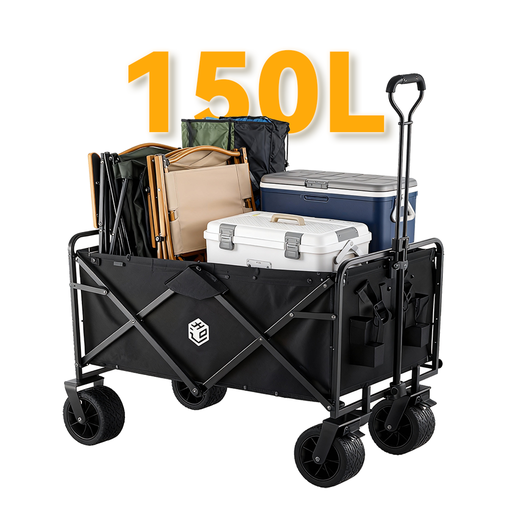
Why It Stands Out: This is a true heavy-lifter. With a reinforced frame and robust "tank" style wheels, it is built to handle the most demanding tasks and heaviest loads with confidence.
Pros:
Who is it for?
If the models above aren't quite what you need, or if you're interested in exploring a wider variety of transport solutions, you can browse our full collection.
? Explore more metal wheeled trolley options here
1. Can you pull a foldable wagon on sand? Yes, but the type of wheels is crucial. For effective use on a beach, you should choose a wagon with wide, balloon-style or "off-road" wheels. These distribute the weight more evenly and are less likely to dig into the sand compared to standard, narrow wheels.
2. How much weight can a typical folding trolley for camping hold? Capacities vary significantly between models. Lighter, more compact carts may hold around 50-70 kg. Standard family camping wagons typically support 80-120 kg, while heavy-duty models can handle 150 kg, 200 kg or even more. Always check the manufacturer's specified maximum load capacity before purchasing.