
24/7 Customer Support

Free returns

Same-day & Next-day Delivery

Quality Guaranteed

Unlock Your Welcome Offers: FREE Delivery | Up to 80% OFF | Free 30-day JoyPlus trial
Download the APP
Open shelving can quickly become cluttered with jumpers, toys, towels and miscellaneous household items. Foldable fabric storage cubes offer a simple way to hide everyday mess while keeping frequently used belongings accessible. They work particularly well in bedrooms, rented homes, student accommodation, children’s rooms and living rooms with cube shelving units.
However, not every fabric box provides the same level of stability or fit. A low price can be attractive, but the wrong dimensions, weak base or unsuitable fabric may leave you with storage that sags, smells strongly or cannot hold what you intended. The following guide explains what to check before buying fabric storage boxes, along with practical recommendations for different household needs.
A product listed as 30 x 30 x 30 cm may fit many standard cube units, but the internal shelf opening can vary between manufacturers. Measure the width, depth and height of the compartment rather than relying on the external dimensions alone.
Allow a small amount of clearance so the box can slide in and out without catching on the shelf edges. The JOYFURNOS grey cubes, for example, are designed for compartments measuring 30.5 cm or more, which is a useful reference when checking your own unit.
Fabric storage baskets often use cardboard or another stiffening panel to maintain their shape. This can provide useful support, but it does not make them equivalent to plastic crates or solid furniture.
Check the stated static weight capacity before storing books, heavy shoes or tightly packed linens. A box rated at 5 kg per cube is more suitable for folded clothing and ordinary household items than for dense collections of hardback books.
A thin or poorly supported base can bow when a box is lifted. Handles also need careful attention because they experience extra strain when the cube is full.
Look for a reinforced handle or grommet-style opening, together with a base insert that can be removed when the box is folded flat. Also check the care instructions: many non-woven fabric storage bins should be spot cleaned rather than machine washed.
For cube shelving organisers, 30 x 30 x 30 cm storage boxes are a common format. Before ordering, measure:
If you are storing clothes in a wardrobe, a cube does not always provide the most efficient use of vertical space. A hanging organiser may use the full height of the rail instead.
Common materials include non-woven fabric, cardboard panels, bamboo inserts and metal frames. Non-woven fabric is lightweight and flexible, while the inner board gives the box its cube shape.
For everyday clothes storage boxes, look for clear material information and a stated capacity. A box made with 80 g/m² non-woven fabric and a cardboard structure can be suitable for light-to-medium household storage, provided it is not overloaded or exposed to moisture.
The main benefit of foldable storage baskets is that they can be flattened when not required. Confirm how assembly works: many models simply require the base panel to be inserted.
Storage cubes with handles are easier to retrieve from lower shelves or wardrobe compartments. For maintenance, use a damp cloth and mild detergent where permitted, then allow the box to air-dry fully. Avoid placing fabric boxes near radiators, open flames or damp walls.
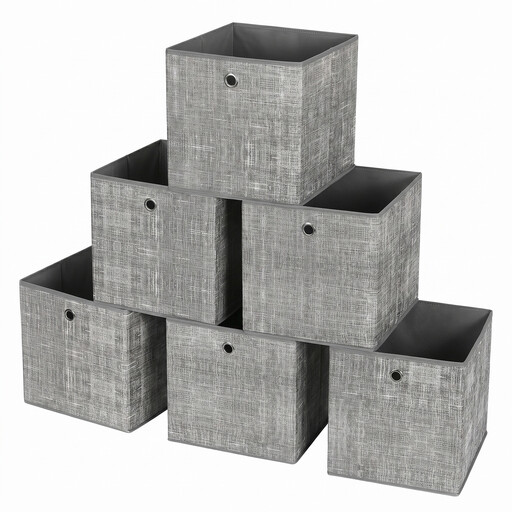
Why This Fits Their Persona: A six-piece set gives renters, students and families a straightforward way to organise several shelf compartments at once.
The 30 x 30 x 30 cm size is clearly stated, as is the 5 kg static capacity per box. The base panel inserts for set-up and the cubes fold flat when not in use.
Six matching boxes; 80 g/m² non-woven fabric; suitable for clothes, small household items and study storage.
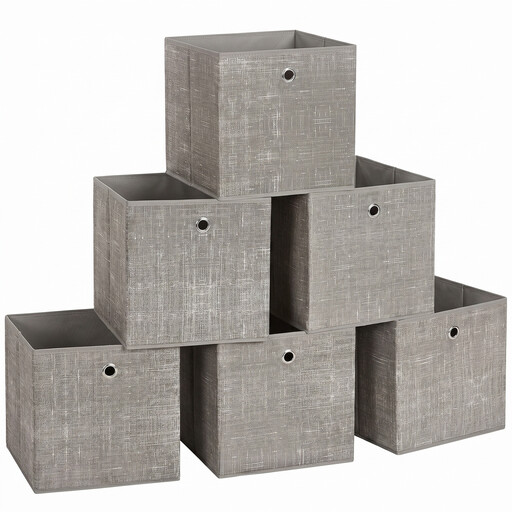
Why This Fits Their Persona: The textured taupe-grey appearance suits buyers who want practical storage that blends with a bedroom, lounge or study interior.
The listing identifies 1.9 mm cardboard, 80 g/m² non-woven fabric and a 5 kg capacity per cube rather than relying only on appearance.
Six coordinated cubes; integrated handles; fold-flat construction; suitable for clothes, books and general shelf organisation.
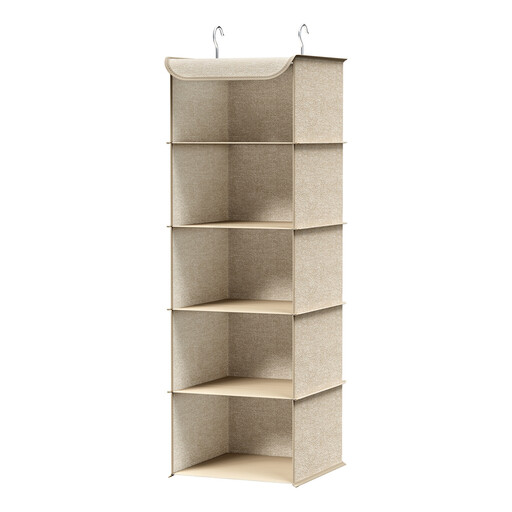
Why This Fits Their Persona: This vertical organiser is suited to wardrobes, dormitories and compact bedrooms where floor space is limited but rail height is available.
The published limits are specific: up to 2 kg per shelf and 10 kg for the complete unit. This helps prevent overloading based on appearance alone.
Five hanging tiers; dual metal hooks; foldable design; useful for shoes, bags, hats and folded garments.
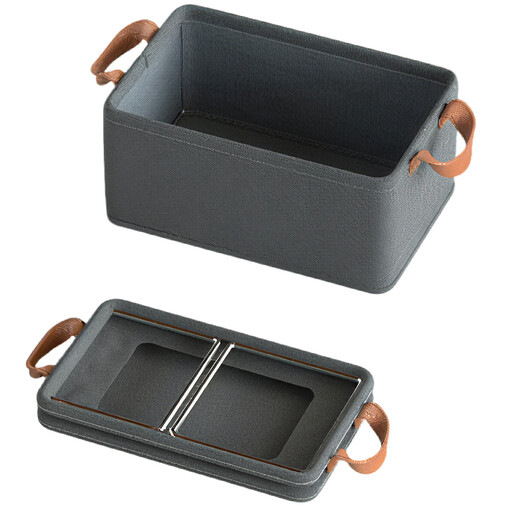
Why This Fits Their Persona: The open, non-grid interior is useful for wardrobes and cabinets where you need to store jumpers, trousers, underwear, towels or linens in different quantities.
Its foldable layered design and no-divider interior avoid forcing clothing into small compartments. The care guidance specifies spot cleaning rather than machine washing.
Cotton/polyester-blend fabric; flexible open storage; folds flat for seasonal clothing and infrequently used items.
We have compiled a complete, real-time list of products that fully satisfy these strict selection criteria and UK safety regulations.
They are suitable for many standard cube units, but measurements differ between shelves. Check the internal compartment dimensions and look for at least a small clearance around the box. A tight fit can make handles difficult to use and may damage the fabric during removal.
Lifespan depends on loading, handling and storage conditions. Keeping within the stated capacity, supporting the base correctly and avoiding damp environments can help preserve the shape. Fabric cubes are generally more appropriate for clothing and lighter household items than extremely heavy contents.
No. These organisers are passive storage products and do not require batteries, power or ongoing energy use. The main maintenance cost is occasional cleaning or replacement if a box becomes damaged through overloading or moisture exposure.