
24/7 全天候客户支持

免费退货

当日/次日达

品质保障

开启新人专享福利: 全场免邮 | 低至 2 折 | 免费试用 30 天 JoyPlus 会员
下载 Joybuy
A foldable heavy-duty utility trolley can simplify supermarket trips, camping weekends, garden projects and market-day transport. However, a trolley that looks spacious online may be awkward to steer, difficult to store or unsuitable for the weight you need to carry.
Before buying, look beyond capacity claims and promotional photographs. The frame, wheel design, folding mechanism and braking system determine whether a trolley remains useful on pavements, grass, gravel and sloped driveways.
A trolley may advertise a large internal volume, such as 200L, but that does not automatically mean it can safely carry 200kg. Capacity describes space; load capacity describes weight. A wagon filled with bulky cushions is very different from one carrying compost, bottled drinks or tools.
Always check both figures and follow the manufacturer’s maximum load guidance. If the listing provides only one measurement, contact the seller before purchase.
Large wheels can help with grass, gravel and uneven paths, but wheel material, swivel design and axle construction also matter. Small rigid wheels may be manageable in a supermarket but struggle on a beach or campsite. Conversely, large off-road wheels can make a trolley heavier to lift into a car.
For mixed UK use, check whether the wheels are described as off-road, whether the front wheels swivel and whether the handle allows controlled turning.
A folding wagon without a secure parking system can roll on a sloped drive, campsite or station platform. A trolley may also appear compact when folded but still require considerable space in a boot or shed.
Check for wheel brakes, folded dimensions and the space required to open the frame. Keep hands clear of joints during folding and unfolding, and do not allow children to operate the mechanism unsupervised.
For frequent outdoor use, a steel frame generally provides a substantial structure, while reinforced fabric helps contain irregular loads. Products using 600D Oxford cloth are designed for tougher everyday handling than lightweight fabric, although stitching, base support and wheel mounts should also be considered.
For a folding garden cart or outdoor utility wagon, inspect whether the base appears supported and whether the fabric can be wiped clean. Damp grass, muddy paths and coastal air can accelerate wear, so dry storage is sensible.
Choose capacity according to your typical load rather than the largest number in an advert:
A 127L folding wagon can be easier to control on narrow paths, while a 200L camping wagon offers more room for large or awkward items. Avoid overloading the top of the trolley, as a high centre of gravity can increase the risk of tipping.
An off-road trolley with brakes can be useful on slopes and uneven ground. Dual brakes may help keep the trolley stationary when parked, while 360-degree swivel wheels can improve turning in confined areas.
The handle should extend comfortably without forcing you to stoop. An ergonomic handle may be particularly useful for an elderly-friendly shopping cart, but users should still check the trolley’s overall weight and whether it is easy to pull when loaded.
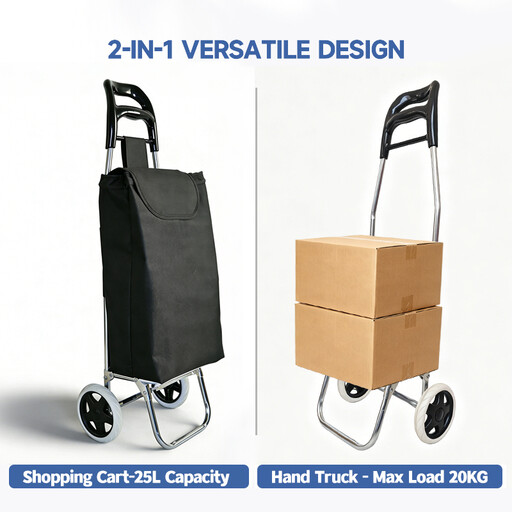
Why This Fits Their Persona: A practical starting point for supermarket trips, grocery runs and everyday household transport, particularly for shoppers seeking a large-size folding design with an ergonomic handle.
Its product title specifies a folding format and ergonomic handle, helping shoppers focus on storage and handling rather than capacity alone. Check the listing for exact load limits before placing heavy items inside.
Large-size shopping format; ergonomic handle; folding design for more convenient storage.
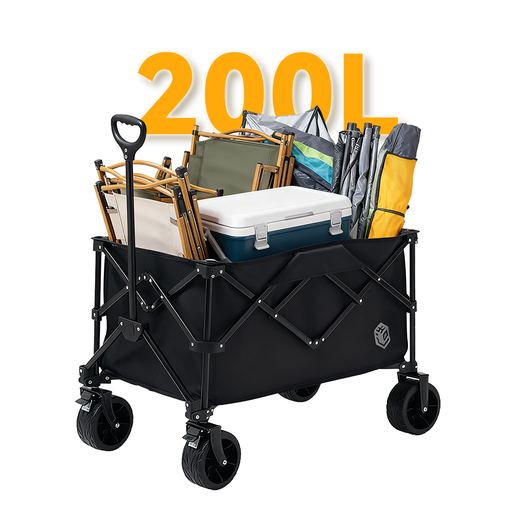
Why This Fits Their Persona: Suited to families, campers, gardeners and market traders who need a spacious wagon for bulky loads and varied outdoor surfaces.
The specification lists a steel frame, 600D Oxford cloth, PVC off-road wheels and a double brake design. These details address frame durability, outdoor handling and parking control, but the stated load limit should still be observed.
200L internal capacity; off-road wheels; double brakes; no assembly required.
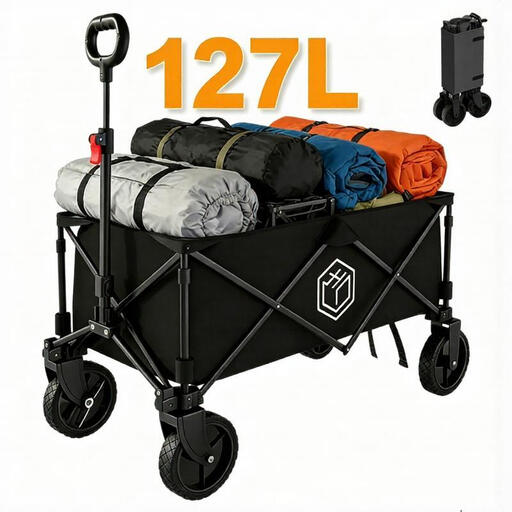
Why This Fits Their Persona: A focused option for users transporting heavier equipment, groceries, vending supplies or moving items while preferring a slightly more compact footprint than a 200L wagon.
The listing separates its 127L space from its stated 200kg load capacity, making it easier to distinguish volume from weight. The frame uses spray-painted steel tubes and the wheels include dual brakes.
127L capacity; stated 200kg load capacity; 360° swivel wheels; collapsible storage.
Use this short checklist when comparing a heavy-duty folding cart or portable camping trolley:
We have compiled a complete, real-time list of products that fully satisfy these strict selection criteria and UK safety regulations.
Yes, provided its folded size, handle height and wheel design suit your route. A large-capacity shopping trolley can reduce repeated carrying, but check whether it fits between aisles and can be lifted into your car when empty or loaded.
The main difference is internal volume. A 127L folding wagon may be easier to manoeuvre in tighter spaces, while a 200L camping wagon provides more room for bulky tents, picnic equipment or beach items. Neither capacity figure alone confirms the safe weight limit.