
24/7 Customer Support

Free returns

Same-day & Next-day Delivery

Quality Guaranteed

Unlock Your Welcome Offers: FREE Delivery | Up to 80% OFF | Free 30-day JoyPlus trial
Download the APP
A tidy home often feels like a tidy mind. Foldable storage boxes promise a quick and easy path to decluttering our living spaces, from chaotic wardrobes to overflowing living room shelves. However, the path to an organised home is paved with potential pitfalls. Many of us have been let down by boxes that buckle, handles that rip or organisers that simply don't fit the space they were bought for.
As a Joybuy Product Recommendation Officer, my role is to help you see past the marketing gloss and focus on what truly matters. Before you add another set of collapsible organisers to your basket, let's look at the common issues that lead to buyer's remorse and how to sidestep them.
To ensure your new storage solution is a lasting investment, focus on these core parameters. They are the difference between a box that lasts for years and one that's destined for the bin in a few months.
The durability of a foldable storage box is determined by its internal structure, not just its outward appearance.
Never rely on generic descriptions like "fits most cube shelves."
storage cubes for shelves, leave at least 1 cm of clearance for easy removal. For underbed storage, pay close attention to the height.stackable storage boxes with lids are a more practical choice. For clothes storage boxes, breathability and a lid to protect from dust are key.Based on these practical criteria, here are a few options matched to different household needs.
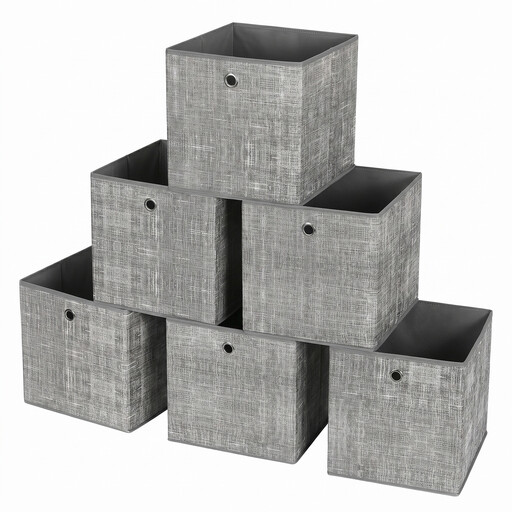
Why This Fits Their Persona: Perfect for UK residents with popular cube shelving units. This multi-pack allows for a uniform, organised look in a living room or home office at an accessible price point.
It directly counters the "one-size-fits-most" myth by stating its exact 30 x 30 x 30 cm dimensions. The construction from 80g/m? non-woven fabric and cardboard provides a reliable structure that resists sagging.
Comes as a set of six, providing excellent value and consistency. Grommet handles offer a more secure grip than fabric-only versions.

Why This Fits Their Persona: Ideal for those needing to store away seasonal clothes, bedding or children's toys. The lid offers protection from dust, and the sturdy build allows for stacking in a wardrobe or loft.
The "thickened" construction and "robust frame" directly address the flimsy base problem. The separate lift-off lid ensures contents are protected and the box can support another one on top without collapsing.
The combination of a lid and stackable design makes it a highly efficient use of vertical space in cupboards or on top of wardrobes.
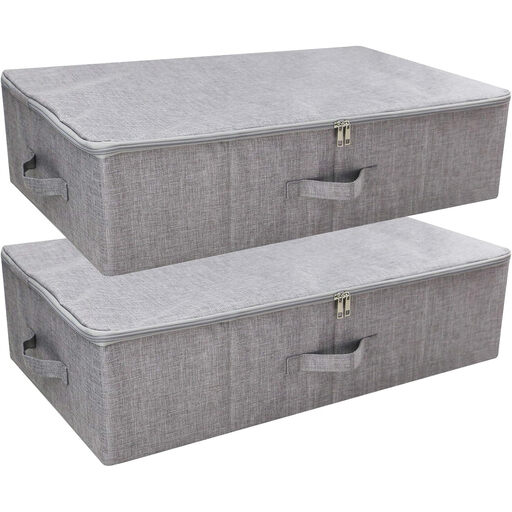
Why This Fits Their Persona: For anyone living in a UK flat or house where space is at a premium. This organiser is purpose-built to reclaim the often-neglected storage area under a bed for out-of-season duvets, shoes or guest bedding.
This product is the antidote to the sizing trap. Its low-profile rectangular shape and specific 18 cm height are designed precisely for underbed use, ensuring it will slide in and out without catching on the bed frame.
The zippered cover provides 360-degree protection from dust and pests, which is essential for long-term storage. Handles on the side make it easy to pull out from under the bed.
We have compiled a complete, real-time list of products that fully satisfy these strict selection criteria and UK safety regulations.
1. How should I clean fabric storage boxes? For most non-woven fabric and cardboard boxes, washing is not recommended as it can damage the structure. The advised method is to spot-clean stains with a damp cloth and a mild detergent. Always allow the box to air dry completely before folding or using it again to prevent mould or mildew.
2. Can you stack all foldable storage boxes? Not all foldable boxes are designed for stacking. Open-top fabric storage bins without lids will likely collapse. To stack effectively, you need stackable storage boxes with lids. Look for models with a rigid frame and a sturdy, flat-topped lid that can support the weight of another box on top.
3. What is non-woven fabric and is it durable? Non-woven fabric is a material made from fibres that are bonded together chemically, mechanically or with heat, rather than being woven or knitted. It is lightweight and breathable. Its durability depends on its thickness, often measured in grams per square metre (g/m?). A higher number, like 80 g/m?, indicates a thicker and more robust fabric that is less likely to tear.