
24/7 Customer Support

Free returns

Same-day & Next-day Delivery

Quality Guaranteed

Unlock Your Welcome Offers: FREE Delivery | Up to 80% OFF | Free 30-day JoyPlus trial
Download the APP
A foldable treadmill with incline can make home workouts more varied without taking over a spare room. However, product listings often highlight peak motor figures, maximum speeds and “space-saving” designs while leaving out details that affect everyday use.
Before buying an electric treadmill, check how the incline works, whether the running deck suits your stride, how much storage space it needs and whether the stated noise level applies to actual operation. These details matter particularly for UK flat residents, home-office workers, taller users and anyone planning regular jogging or running.
A large horsepower figure does not tell you everything about a treadmill’s usability. Check the speed range, motor type, user-weight limit and intended workout. A machine suitable for walking may not feel appropriate for repeated running at higher speeds.
Also confirm whether the motor rating is presented as continuous or peak output. Product descriptions do not always use these terms consistently, so comparing the full specification is more useful than focusing on one prominent number.
“ Treadmill with incline” can refer to two very different systems:
Manual incline can reduce complexity and cost, but it cannot normally be changed while walking. Automatic incline is more convenient for interval sessions, although it may add weight, noise and mechanical components.
A folding running machine still needs enough room to unfold safely. Measure the treadmill’s length, width and folded height, then allow clearance around the belt and handrails. Check the ceiling height too if the deck lifts significantly at an incline.
A compact frame may be useful in a flat or home office, but a narrow running belt can feel restrictive during jogging. Transport wheels are also worth checking if you intend to move the treadmill after each session.
Walking and jogging place different demands on a treadmill. Look for a running belt that gives you enough room to move naturally, especially if you are taller or have a longer stride. A treadmill with cushioning may feel more comfortable than a rigid deck, but cushioning descriptions vary widely.
The YOSUDA model listed below specifies a 15 mm cushioning plate, four cushioning pads and a floating suspension system. These are objective design details, although comfort remains personal and depends on footwear, pace and body weight.
Always compare your body weight with the stated maximum capacity. Do not treat the limit as a target; leaving a sensible margin may provide a more suitable experience and reduce strain on the machine.
For light walking, a lower speed range may be sufficient. Joggers should check that the upper speed is appropriate for their routine, while runners should consider belt length, frame stability and motor specification together.
An automatic 18% incline offers a wider range of adjustment than a fixed manual setting. By contrast, a manual incline of 6% or 8% can be practical for straightforward hill-style walking without requiring electronic incline controls.
A walking pad with incline is not automatically a substitute for a full treadmill. Under-desk treadmill designs are generally aimed at walking, while raised-handlebar models may offer better support for jogging.
Noise levels are commonly quoted in decibels, but the result can vary with user weight, speed, flooring and belt maintenance. A stated level below 45 dB may appeal to people working from home, but it does not mean the treadmill will be inaudible in an upstairs flat.
Place the machine on a stable, level surface and consider a suitable floor mat to reduce vibration. Keep the power cable clear of walkways, use the safety key and follow the supplied instructions. Bluetooth connectivity can add workout tracking or app control, but check whether the required app is compatible with your phone before purchase.
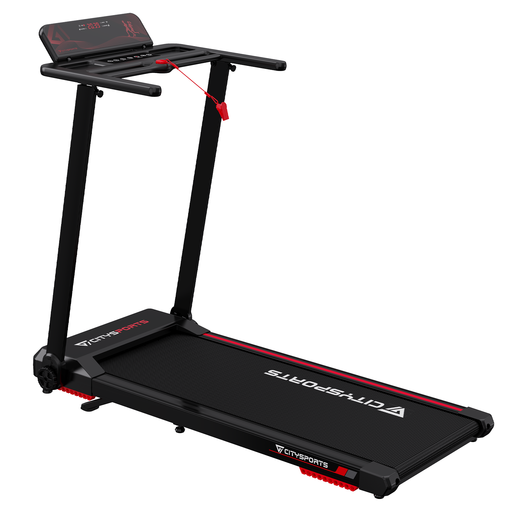
Why This Fits Their Persona: Its 1–12 km/h speed range and compact 26.5 kg folding design suit beginners who want walking or light jogging equipment for a flat or smaller home.
The listing clearly identifies its incline as manual, with 0% and 8% positions, so buyers are less likely to expect automatic adjustment.
1400W motor, stated operating noise below 45 dB, six-layer running belt and a maximum user weight of 120 kg.
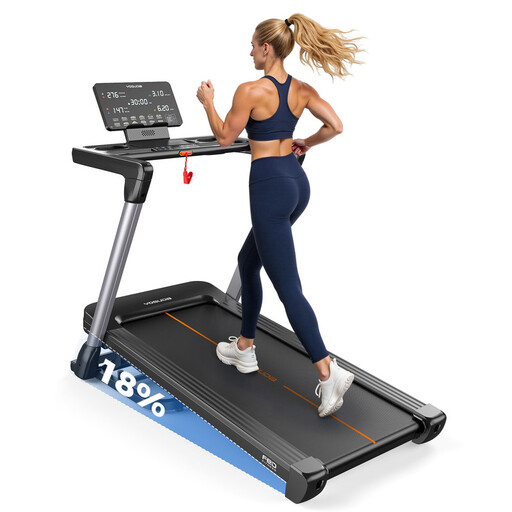
Why This Fits Their Persona: This model is suited to shoppers prioritising a broader incline range, a steel frame and a higher stated load capacity for regular home walking, jogging or running.
The specification states that the incline is automatic and reaches 18%, avoiding confusion with a treadmill that only has fixed manual positions.
One-piece steel frame, stated maximum load of 172 kg, 3.0 HP brushless motor, Bluetooth app compatibility and a four-way cushioning system.
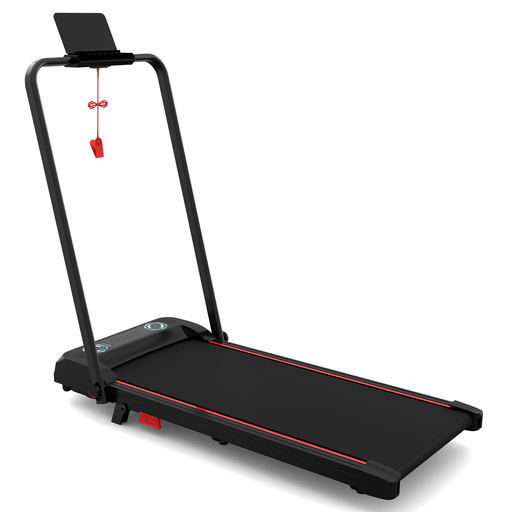
Why This Fits Their Persona: The three-mode design can work as an under-desk treadmill for walking, a flat treadmill for jogging or an incline trainer when the handlebar is raised.
The listing specifies a 0–6% manual incline, a 1–10 km/h speed range and no assembly requirement, making its compact-use limitations clear.
Approximate 23 kg weight, transport wheels, phone holder, remote control, auto-stop feature and stated noise below 45 dB.
A motorised treadmill uses mains electricity, so running cost depends on the motor’s power draw, workout duration and your electricity tariff. The wattage shown on a listing is not necessarily the exact electricity consumed throughout a session. Shorter, lower-speed walks generally use less power than sustained incline running.
For longer service life:
Before ordering, check delivery access, assembly requirements, folded dimensions, returns information and whether replacement parts or support are available. These practical details can matter as much as Bluetooth, LED displays or preset programmes.
We have compiled a complete, real-time list of products that fully satisfy these strict selection criteria and UK safety regulations.
It can be useful if you want to change gradient during a workout or use preset routines. A manual incline may be sufficient for simple hill walking and usually requires fewer electronic adjustments. Compare the price, folded weight and control method with your actual routine.
Often, yes, but noise and vibration depend on the floor, speed, user weight and belt condition. Check the stated noise figure, use a suitable mat and avoid placing the machine directly against a shared wall. A below-45 dB specification may be relevant for quieter use, but it should not be interpreted as silent operation.
Measure both its operating and folded dimensions. Leave room for safe access, belt movement and the safety key. A treadmill with a small footprint should also have transport wheels or a manageable weight if it must be stored after every workout.