
24/7 Customer Support

Free returns

Same-day & Next-day Delivery

Quality Guaranteed

Unlock Your Welcome Offers: FREE Delivery | Up to 80% OFF | Free 30-day JoyPlus trial
Download the APP
A foldable trolley can simplify supermarket trips, garden jobs, market trading and weekend camping. However, the wrong model may be awkward to steer, difficult to store or unsuitable for the weight you need to carry.
Marketing descriptions often focus on large capacities and heavy-duty frames without explaining how those figures apply in everyday use. Before buying, watch for these common pitfalls:
The suitable design depends on whether you need a compact shopping trolley, a folding camping wagon, a collapsible utility trolley or a rolling storage trolley for indoor organisation.
Check both the maximum load capacity and the internal volume. Litres describe how much space is available, while kilograms indicate the stated carrying limit. These are not interchangeable measurements.
For example, a 127-litre camping wagon may hold bulky blankets and picnic equipment, while a large-capacity trolley with a 200-litre interior may be more suitable for gardening supplies or several days of camping gear. Always distribute weight evenly across the base rather than placing the heaviest item at one end.
Do not exceed the stated capacity. Overloading can affect steering, braking and structural stability. A trolley should also be fully unfolded and locked before loading.
Wheel construction has a direct effect on usability:
For UK pavements, market areas and gardens, check the wheel size and the supplier’s surface guidance rather than assuming that “all-terrain” means suitable for every route.
A heavy-duty folding trolley should use a frame and base suitable for its intended load. Steel or carbon steel frames can provide a firm structure, while Oxford or polyester fabric bodies are commonly used for collapsible wagons because they fold away efficiently.
Measure the folded trolley against your available cupboard, boot or shed space. Also check:
For indoor use, a 3-tier storage trolley may be more practical than a deep wagon, particularly where items need to remain visible and accessible.
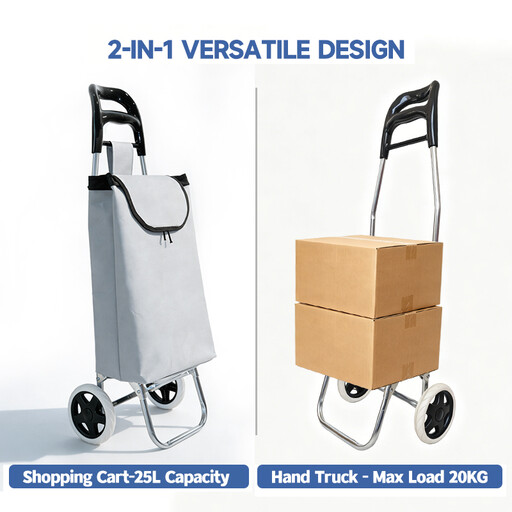
Why This Fits Their Persona: A practical grocery trolley for supermarket trips, market visits and daily errands where compact storage and a pull handle are more important than outdoor wagon features.
Its folding design supports compact storage, while the ergonomic handle is intended to make pulling more manageable. Check the product capacity before loading heavy groceries.
Large-size folding format; ergonomic handle; suitable for supermarket and household errands.
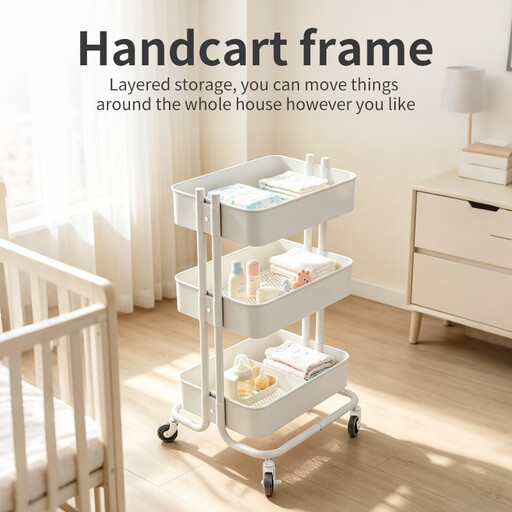
Why This Fits Their Persona: A suitable mobile storage organiser for kitchens, bathrooms, salons, offices and craft areas where separate visible shelves are useful.
The three-tier layout avoids the problem of placing frequently used items in a deep, inaccessible basket. Lockable castors help secure it when stationary.
Three open mesh tiers; four castor wheels; two lockable wheels; powder-coated metal finish.
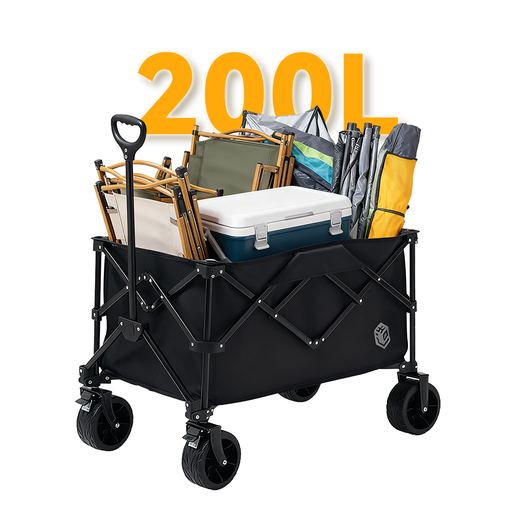
Why This Fits Their Persona: Designed for campers, gardeners, traders and households moving bulky equipment across outdoor areas where a large-capacity trolley is useful.
Its stated 200-litre capacity, off-road wheels and double-brake design address the limitations of small wheels and undersized baskets. Use the brakes when parked and avoid unsuitable slopes.
200-litre interior; steel frame; 600D Oxford cloth; PVC off-road wheels; foldable construction.
We have compiled a complete, real-time list of products that fully satisfy these strict selection criteria and UK safety regulations.
Before each use, confirm that the frame is fully open and locked. Keep fingers away from folding joints, distribute the load evenly and avoid using a trolley as a seat or step. Do not transport children in a shopping trolley or camping wagon.
Wipe fabric, metal and plastic parts with a damp cloth, then allow the trolley to dry before folding. Store it in a dry place and periodically check wheels, screws, brakes and handle connections. These simple checks can help identify wear before it affects manoeuvrability.
Most are not designed to be pulled up or down stairs. Even a stair-climbing shopping trolley should be checked against its specific instructions, and heavy loads can increase the risk of tipping. For regular stair use, keep the load light and maintain firm control.
Use the manufacturer’s stated maximum capacity and never exceed it. A trolley rated for 200 kg still requires even weight distribution and stable, relatively flat ground. The practical limit may be lower if the load is tall, loose or difficult to control.
No electricity is normally required. Running costs are therefore minimal, but maintenance still matters. Clean the wheels and frame, inspect the folding locks and keep fabric dry before storage. Replacement wheels or fasteners may eventually be needed depending on frequency of use and terrain.