
24/7 Customer Support

Free returns

Same-day & Next-day Delivery

Quality Guaranteed

Unlock Your Welcome Offers: FREE Delivery | Up to 80% OFF | Free 30-day JoyPlus trial
Download the APP
A foldable utility cart can make grocery runs, camping trips and household organisation easier, but the wrong design may become awkward to use after only a few outings. UK buyers should look beyond a large capacity figure or polished product photos and check how the cart will perform in real conditions, such as pavements, narrow hallways, car boot storage and uneven grass.
The main traps to avoid are:
Capacity is one of the first specifications to compare, particularly for a heavy-duty folding cart, camping wagon or grocery shopping cart. Look for a clearly stated maximum load rather than vague wording such as “extra strong”.
The frame material also matters. Steel can provide a firm structure for bulky items, while reinforced fabric affects how the load is contained. A reinforced base is useful when carrying drinks, equipment or boxed goods, as it can help prevent the bag from sagging into the wheels.
Do not fill a cart to its stated limit without considering the weight distribution. Keep dense items low and centred, and avoid placing sharp objects directly against fabric panels.
Capacity is usually listed in litres. A large-capacity folding cart may be suitable for family picnics, shopping or event supplies, but litres alone do not show the shape of the storage area. Compare the internal length, width and depth where those measurements are available.
For car owners, check the folded dimensions against the boot opening, not only the available boot volume. For flats and smaller homes, a collapsible camping cart or portable utility wagon should be easy to lift, store and unfold without blocking a passageway.
Consider access too. An open-top wagon allows quick loading, while a tiered design may offer better visibility and separation for smaller items.
A camping wagon, beach cart or folding shopping trolley should roll in a predictable direction when loaded. Look for wheel details such as swivel movement, wheel material and brake provision.
Four multi-directional wheels can help with turning around market stalls, kitchen units or indoor shelving. A brake is particularly useful when the cart is parked on a slight incline, although it should not be treated as a substitute for careful positioning.
For outdoor use, check whether the product description identifies the intended surfaces. Sand, loose gravel and kerbs place different demands on wheels. If you regularly transport supplies across outdoor venues, prioritise a stable frame and a handle that can be controlled with both hands.
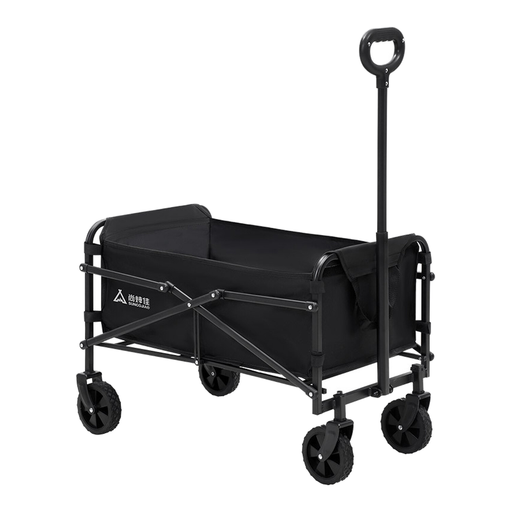
Why This Fits Their Persona: A practical starting point for shoppers, picnic users and occasional campers who want a portable cart with a stated 170-litre cargo capacity and compact folding design.
Its listed specifications identify the cargo capacity, 100 kg load rating, materials and wheel type, giving buyers more useful information than an unspecified “heavy-duty” label.
Cold-rolled iron frame, 600D Oxford fabric cargo bag, PVC wheels and multi-directional movement; minor wheel assembly is required.
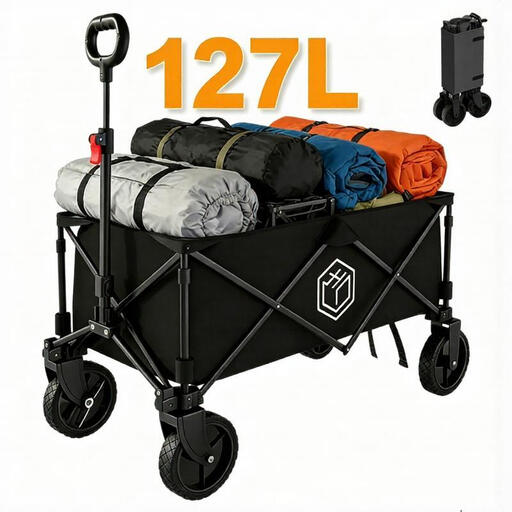
Why This Fits Their Persona: Suitable for buyers who prioritise a reinforced structure, substantial stated load rating and convenient storage for camping, vending, moving or regular grocery runs.
The description specifies a 127-litre interior, a 200 kg maximum load, heavy-duty spray-painted steel tubes and dual brakes, making the principal selection criteria easier to compare.
Collapsible format, dual brake system and 360° swivel wheels; the graphite black finish is designed for a straightforward, low-maintenance appearance.
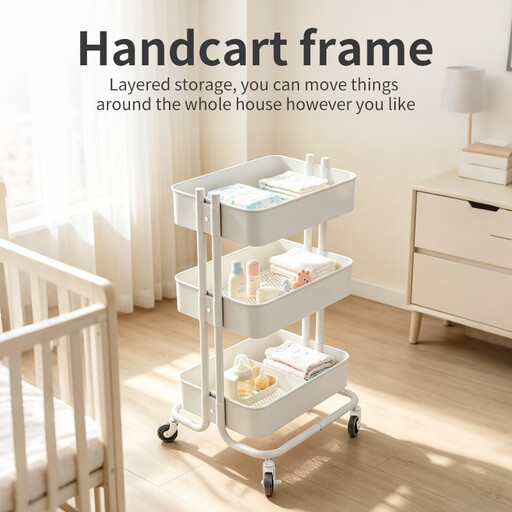
Why This Fits Their Persona: A useful option for salon professionals, home workers, kitchens, bathrooms and small businesses that need mobile, visible organisation rather than a deep outdoor wagon.
Its three-tier layout separates supplies and avoids the hidden-access problem found in deep bags. Two of the four caster wheels are lockable for stationary use.
Open wire-mesh shelves provide visibility, while the powder-coated metal finish is described as resistant to rust and scratches and easy to clean.
We have compiled a complete, real-time list of products that fully satisfy these strict selection criteria and UK safety regulations.
Before ordering, measure the route from storage space to the front door and consider whether the loaded cart will pass through lifts, gates and narrow aisles. Also check:
A folding cart should be chosen around its main job. A deep portable utility wagon suits bulky outdoor loads, while a 3-tier rolling trolley is more appropriate for organised indoor storage. Matching the design to the route, load and storage space is more useful than choosing the largest number on the product page.
Yes, provided its open dimensions, wheel design and load rating suit your shopping routine. A folding shopping trolley is useful for transporting packaged groceries, but chilled goods should be secured upright and the cart should not be overloaded.
Remove dirt from the wheels and frame with a damp cloth, then allow all parts to dry before folding. Check that locking points and wheels move correctly, and store the cart in a dry place. Follow the product instructions for fabric care and do not exceed the stated load rating.
They are primarily designed for organised indoor or sheltered use. Open shelves may not protect contents from rain, dust or sand, so a covered camping wagon or beach cart is generally more suitable for exposed outdoor transport.