
24/7 Customer Support

Free returns

Same-day & Next-day Delivery

Quality Guaranteed

Unlock Your Welcome Offers: FREE Delivery | Up to 80% OFF | Free 30-day JoyPlus trial
Download the APP
A reliable folding camping trolley can be a game-changer, transforming the chore of hauling gear into a simple, single trip. Whether you're navigating a muddy festival field, trekking across a sandy beach or simply moving supplies for a family picnic, the right collapsible cart saves your back and your patience.
However, the market is flooded with options that look sturdy online but fail in the real world. Many buyers find themselves with a wagon that buckles under pressure or has wheels that grind to a halt on anything but perfect tarmac. Before you invest, it's crucial to understand the common design flaws that separate a dependable workhorse from a disappointing purchase.
The 3 Pitfalls to Avoid When Buying a Folding Trolley:
To ensure your trolley is up to the task, focus on these core parameters instead of marketing buzzwords.
The backbone of any good utility wagon is its frame. Look for models specifying a reinforced carbon steel frame, which offers a better strength-to-weight ratio than standard steel. Most importantly, always check the maximum load capacity, measured in kilograms.
The wheels determine where your trolley can and cannot go. For genuine versatility in the UK, you need a utility wagon with off-road wheels.
A trolley's usefulness is also defined by its size—both when open and when folded.
We've identified several models that address the common pitfalls by focusing on robust construction and practical design. Here are a few options matched to different user needs.
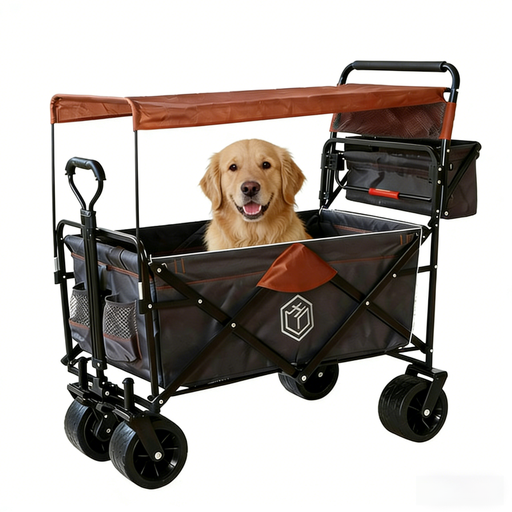
Why This Fits Their Persona: This user needs to haul a week's worth of gear across potentially treacherous festival grounds. The huge load capacity, rugged wheels and protective canopy make it ideal for surviving a British festival weekend, rain or shine.
It directly counters the "wrong wheels" pitfall with its large "Tank" style off-road wheels. The reinforced carbon steel frame and massive 260 kg load capacity mean it won't buckle under the weight of tents and coolers.
Exceptional load capacity and true all-terrain wheels. The dual brake system adds crucial safety on crowded, uneven sites and the detachable canopy protects gear from sun or showers.
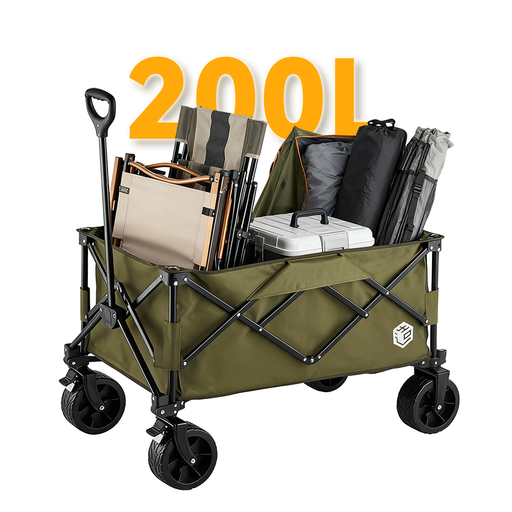
Why This Fits Their Persona: This user needs a versatile, reliable cart for beach days, park picnics and camping trips. It needs to be large enough for family gear but still easy to store and handle.
It avoids the misleading capacity trap by offering a genuinely large 200L volume paired with a sturdy frame and practical off-road wheels, making it a true all-rounder rather than just looking the part.
A great balance of high capacity, all-terrain capability and compact folding. The high-sided design helps keep bulky items like chairs and bodyboards secure during transport.
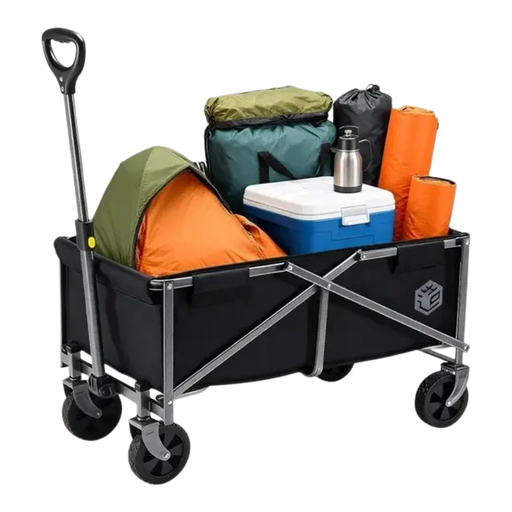
Why This Fits Their Persona: This user needs a simple, lightweight garden cart for moving compost bags, tools or groceries from the car. Portability and ease of storage are more important than extreme off-road performance.
It avoids the "heavy-duty deception" by being honest about its purpose. With a 100 kg load capacity and 75L volume, it's not trying to be a festival monster. It's a practical, easy-to-store utility cart.
Its key strengths are its quick-fold mechanism and lightweight, compact design. The durable 600D Oxford fabric is wear-resistant, making it a reliable choice for frequent, lighter-duty tasks.
We have compiled a complete, real-time list of products that fully satisfy these strict selection criteria and UK safety regulations.
For most models, maintenance is straightforward. Wipe the frame and fabric body with a damp cloth after use, especially if it has been exposed to mud or saltwater. Allow the fabric to dry completely before folding it for storage to prevent mildew. The wheels can be rinsed with water. Periodically check that all bolts are tight and that the brake mechanism functions correctly.
This depends entirely on the wheels. A trolley with standard, narrow plastic wheels will sink into soft sand and become almost impossible to pull. To use a trolley on a beach, you must choose a model with wide, balloon-style off-road wheels. These distribute the weight over a larger surface area, allowing the cart to "float" on top of the sand rather than digging in.
Think of it like a moving box. Volume (litres) is the amount of space inside the box—how much you can fit in it. Load capacity (kg) is the maximum weight the box can hold before it breaks. A trolley might have a huge 200L volume, but if its load capacity is only 75 kg, you can't fill it with heavy items like rocks or full water containers. Always check both specifications to ensure the trolley meets your needs.