
24/7 Customer Support

Free returns

Same-day & Next-day Delivery

Quality Guaranteed

Unlock Your Welcome Offers: FREE Delivery | Up to 80% OFF | Free 30-day JoyPlus trial
Download the APP
As a Joybuy Product Recommendation Officer, my role is to help you navigate the crowded market of outdoor gear. A folding camping trolley seems like a simple purchase, but many end up with a wobbly, frustrating piece of kit that fails after one trip to a festival or a family day at the beach.
Before you add one to your basket, let’s look at the common pitfalls that lead to buyer's remorse. Understanding these helps you sidestep the marketing hype and choose a trolley that genuinely meets your needs.
To avoid these issues, focus on three core parameters. These are the non-negotiable features that separate a reliable workhorse from a disposable gadget.
The single most important feature for UK conditions is the wheels. Forget standard castors; you need wheels designed for varied and often soft ground.
A trolley is only as strong as its frame and the material holding your gear.
Consider both how much you need to carry and how you will transport the trolley itself.
Based on these practical criteria, here are a few options matched to different user needs.
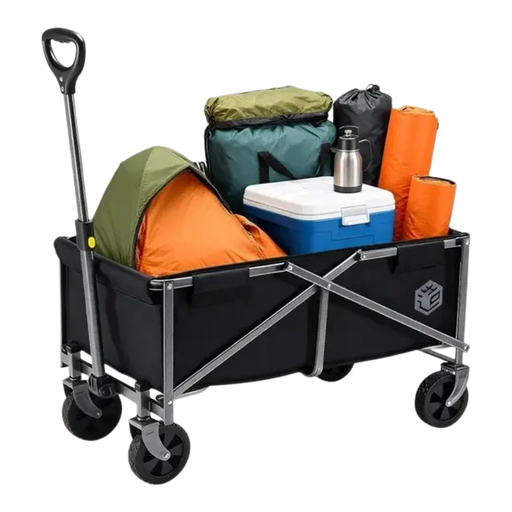
Why This Fits Their Persona: Ideal for those who need a simple, reliable solution for park picnics, light grocery runs or carrying essentials at a small, local festival. It's not over-engineered for extreme conditions, making it lightweight and easy to handle.
This model avoids the trap of exaggerated claims. Its 100kg load capacity and 75L volume are realistic for its lightweight frame and it is marketed for convenience rather than extreme heavy-duty use.
Its main advantage is its quick-fold mechanism and lightweight portability. The double-layer 600D Oxford fabric provides good durability for its class.
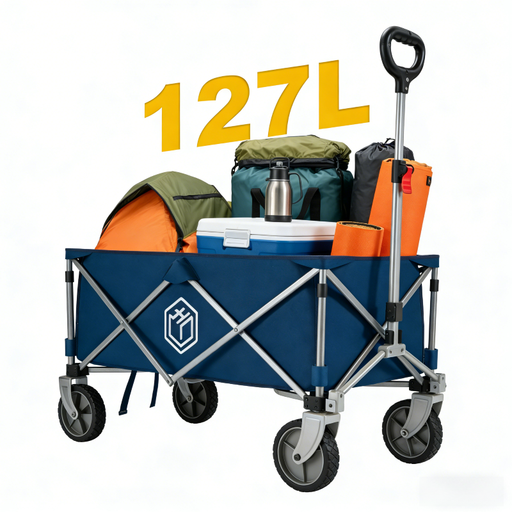
Why This Fits Their Persona: A great all-rounder for family camping trips or multi-day festivals. The 127L capacity is a significant step up, providing enough space for tents, chairs and a cooler, while still folding down to a manageable size for the car.
It features a heavy-duty spray-painted steel tube frame and 360° swivel wheels with dual brakes, directly addressing the common failure points of flimsy frames and poor manoeuvrability on uneven ground.
The combination of a generous 127L capacity, a robust 200kg static load limit and dual brakes offers a strong balance of performance and safety for typical UK camping and festival use.
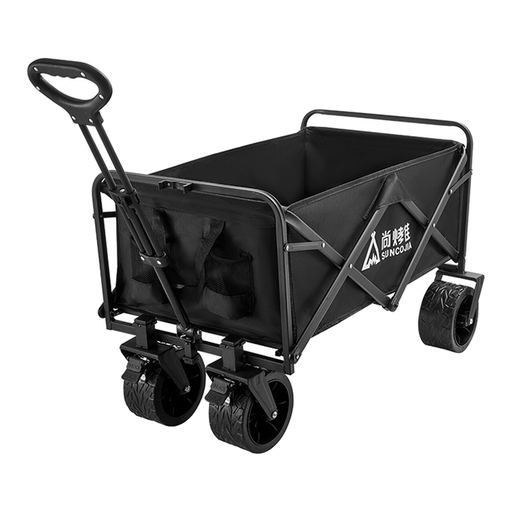
Why This Fits Their Persona: For those who need to move serious gear across challenging terrain. This is an excellent choice for beach trips with the family, extensive gardening work or for market stall holders transporting heavy stock.
This model directly counters the "all-terrain illusion" with its specified "widening cross-country damping wheels" and a robust carbon steel frame, designed for high load-bearing on varied surfaces.
Its standout features are the enormous 350L volume and the specialised, shock-absorbing wheels, making it a true heavy-duty beach cart and all-terrain garden cart.
We have compiled a complete, real-time list of products that fully satisfy these strict selection criteria and UK safety regulations.
For most models, the fabric liner can be wiped clean with a damp cloth and mild soap. Avoid harsh chemicals. If the liner is removable, you may be able to hand wash it. Always ensure the fabric and the metal frame are completely dry before folding the trolley away for storage to prevent mould or rust. Periodically check that all bolts on the wheels and frame are tight.
No. To be effective on sand, a trolley needs very wide wheels. Standard or narrow wheels will sink and become almost impossible to pull. If you are a frequent beach-goer, you must prioritise a model specifically designed as a heavy-duty beach cart with wide, sand-friendly wheels.
Focus on the task at hand. For light duties like carrying picnic supplies, a trolley with a 70-100kg static load capacity is usually sufficient. For serious camping, festivals or gardening, look for models with a sturdier frame and a static load capacity of 150kg or more, as this indicates a more robust build that can better handle the stresses of being moved while loaded.