
24/7 Customer Support

Free returns

Same-day & Next-day Delivery

Quality Guaranteed

Unlock Your Welcome Offers: FREE Delivery | Up to 80% OFF | Free 30-day JoyPlus trial
Download the APP
A folding camping wagon seems like a straightforward purchase. You load it up, pull it along and fold it away. Yet, many UK buyers find their new trolley is more trouble than it's worth, failing after just a few uses. The market is filled with models that look the part but hide critical design flaws. Before you spend your money, it's important to know what separates a reliable workhorse from a disposable gadget.
This guide cuts through the marketing jargon to focus on what truly matters. We will highlight the common pitfalls that lead to disappointment and break down the essential features you need for a durable and practical collapsible camping trolley.
Many wagons fail not because of extreme use, but because of fundamental flaws that are easy to overlook online. Here are the most common issues:
To ensure you get a product that lasts, focus on these three non-negotiable specifications.
The backbone of any good wagon is its frame. Look for models constructed from heavy-duty steel tubes, which offer a far better strength-to-weight ratio than cheaper aluminium or low-grade steel. A powder-coated or spray-painted finish is also crucial for preventing rust, especially given the UK's damp climate. When assessing capacity, consider both the internal volume (measured in litres) and the maximum load capacity (in kg). For a family camping trip or a heavy duty festival trolley, a capacity of 100kg or more is advisable to provide a safe margin. The fabric is just as important; a minimum of 600D Oxford fabric provides good resistance to tearing and abrasion.
Forget "all-terrain" and inspect the wheels themselves. For general use in parks and on firm campsites, standard-width wheels are adequate. However, if you plan to use it as a beach cart or across muddy ground, you need wide wheels to distribute the weight and prevent sinking. Key features to look for include:
A good collapsible camping trolley should be intuitive to operate. The best designs use a simple central pull-strap in the base of the wagon, allowing it to collapse inwards in a single motion. Check the folded dimensions to ensure it will fit comfortably in your car boot or storage space. A compact, upright fold is generally more practical than a long, flat one.
We have identified several models that align with these quality benchmarks, matching them to different user needs.
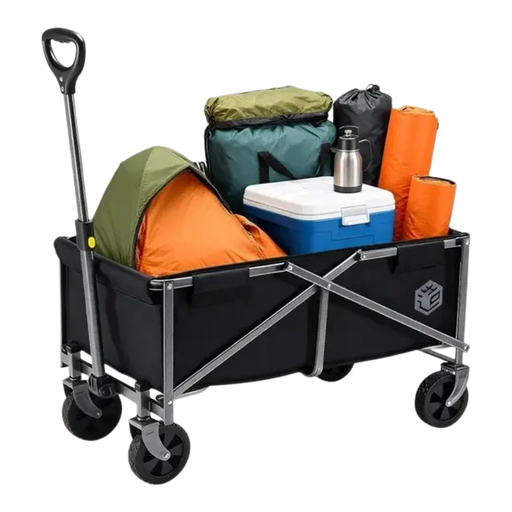
Why This Fits Their Persona: Ideal for those who need a reliable wagon for occasional camping trips, picnics or as a large garden trolley for moving compost and tools. Its moderate size makes it easy to store in a shed or car boot.
It offers a realistic 100kg load capacity supported by a steel frame and wear-resistant 600D Oxford fabric, avoiding the trap of exaggerated claims. The folding mechanism is designed for quick, simple operation.
Its key advantage is the balance of portability and strength. The one-second fold design and lightweight construction make it exceptionally convenient for quick jobs and easy storage.
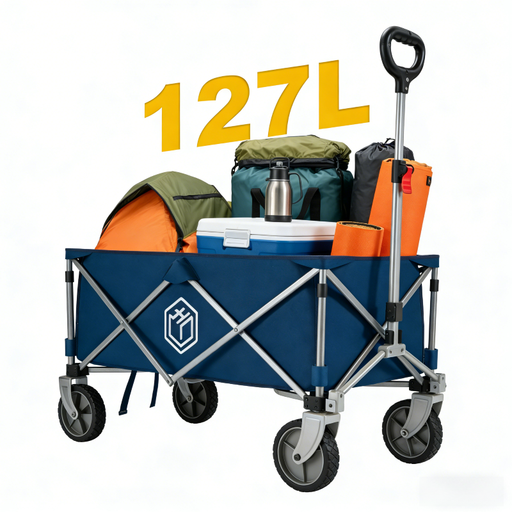
Why This Fits Their Persona: Perfect for those who need to transport a significant amount of gear. The large 127L interior and high load limit are ideal for family beach trips with coolers and chairs or for hauling a full setup across a festival site.
This model directly counters the "unsuitable wheels" pitfall. Its robust, 360° swivel wheels are wide enough to handle softer ground, while the heavy-duty steel frame genuinely supports the 200kg load capacity.
The combination of a huge 127-litre capacity and a high 200kg weight limit is its main strength. The addition of dual brakes provides essential safety and control when fully loaded.
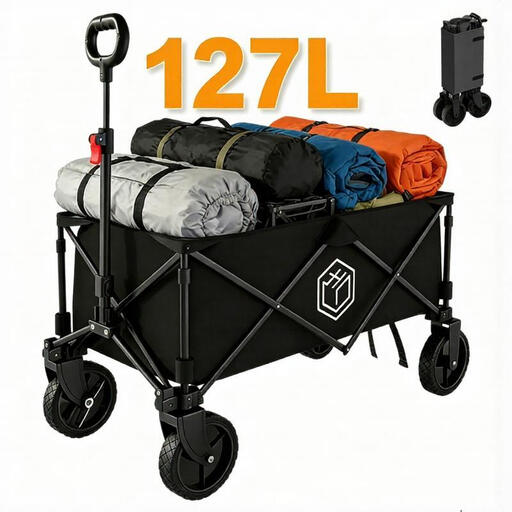
Why This Fits Their Persona: This is a true workhorse for those who need maximum strength and durability for frequent, demanding tasks like market vending, moving equipment or large grocery runs. The discreet black finish is suitable for more professional settings.
It avoids the pitfall of structural failure under repeated stress. The heavy-duty spray-painted steel tubes and robust construction are engineered to handle its 200kg load capacity regularly, not just once.
Its primary advantage is its uncompromising strength and durability, combined with the convenience of a space-saving collapsible design. It offers maximum utility without sacrificing portability.
We have compiled a complete, real-time list of products that fully satisfy these strict selection criteria and UK safety regulations.
This depends entirely on the wheels. To effectively use a wagon as a beach cart, it must have wide, solid wheels that can float on top of the sand rather than digging in. Standard-width or thin plastic wheels will sink, making it almost impossible to pull when loaded. Always check the wheel specifications if beach use is a priority.
With proper care, a well-constructed wagon with a steel frame and durable Oxford fabric should provide many years of reliable service. To maximise its lifespan, always clean off mud and debris after use, ensure it is completely dry before folding it for storage and keep it in a dry place like a garage or shed to prevent rust and fabric degradation.
For light use, such as carrying a picnic and a few chairs, a 100kg capacity is more than sufficient. However, the higher 200kg capacity provides a crucial safety and durability margin for more demanding tasks. If you plan on using it as a large garden trolley for heavy bags of soil, moving bulky camping equipment or for any semi-professional use, opting for the higher capacity is a wise investment in the product's longevity.