
24/7 Customer Support

Free returns

Same-day & Next-day Delivery

Quality Guaranteed

Unlock Your Welcome Offers: FREE Delivery | Up to 80% OFF | Free 30-day JoyPlus trial
Download the APP
A folding camping wagon can make a significant difference when transporting tents, cool boxes, garden tools, shopping or festival supplies. However, product listings often focus on large litre figures and impressive load limits without explaining how those figures work in everyday conditions.
Before buying a collapsible camping wagon, look beyond the headline capacity. A useful wagon must fit your car, roll across the surfaces you actually use and remain manageable when fully loaded. The following guide highlights common buying traps, essential specifications and suitable options for different UK lifestyles.
A stated capacity may refer to the main compartment, an extended tailgate or a stackable configuration. These are not always equivalent in daily use. A large capacity utility wagon may offer plenty of volume but still be awkward if the sides are too low or the opening is narrow.
Check whether the listed litre figure applies to the wagon in its standard configuration. Also consider the internal length, width and height. Tall camping equipment, folding chairs and gardening tools may need a high-sided design, while groceries and picnic items may be easier to organise in a lower compartment.
A 200kg load capacity does not mean every user should regularly pull 200kg across sand, slopes or loose gravel. The surface, wheel size, weight distribution and handle design all affect handling.
A heavy-duty folding wagon should be loaded evenly, with heavier items positioned low and centrally. Always follow the manufacturer’s stated limit and avoid steep or unstable ground, particularly when carrying dense items such as bottled drinks, tools or stock for a market stall.
An all-terrain wagon may roll over grass, gravel or compact sand more effectively than a small-wheel trolley, but no folding cart eliminates the effort required on soft beach sand or deep mud. Wheel diameter, tread and bearing construction are more useful details than the all-terrain label alone.
For regular beach use, check the wheel width and material. For gardens and gravel paths, look for robust wheels, a stable frame and brakes that can hold the wagon when stationary.
Match capacity to your routine rather than choosing the largest figure available.
The load limit should be treated separately from volume. A wagon may hold a large amount of lightweight equipment but become difficult to manoeuvre with a concentrated heavy load. Weight should be distributed evenly to reduce tipping risk.
PU, PVC or rubber wheels with bearings can offer smoother rolling than basic plastic wheels, depending on the construction. Off-road wheels with deeper tread may be more suitable for grass, gravel and uneven paths.
A wagon with brakes is particularly useful at campsites, gardens with slopes or festival fields. Dual brakes provide a way to secure the wagon when stationary, but they are not a substitute for careful positioning. Engage both brakes on an incline and check that the wagon is fully unfolded before loading.
Measure your boot, shed or cupboard before choosing a camping cart. A wagon that folds to 35 x 26 x 80cm, for example, may be easier to store than a larger model, but its unfolded footprint still needs to suit your intended route.
Look for a steel or alloy steel frame, reinforced fabric and secure locking points. Polyester and Oxford fabric bodies are practical for outdoor equipment, but they should be wiped clean and dried fully before storage. Damp storage can contribute to mould, odours or corrosion on metal components.
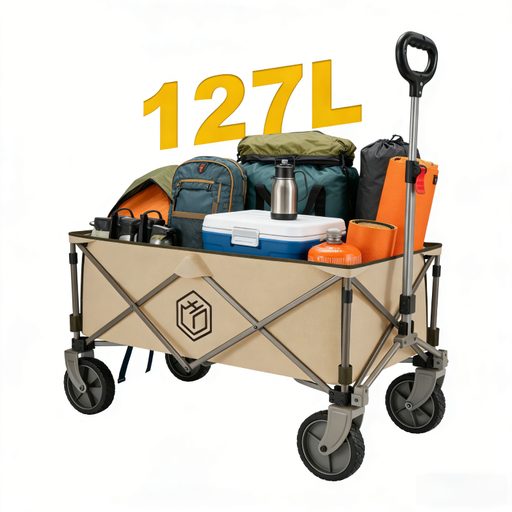
Why This Fits Their Persona: Its 127-litre interior is suitable for occasional camping, picnics, shopping trips and everyday outdoor carrying without the footprint of a 200-litre wagon.
The specified 127-litre capacity and 200kg maximum load are clearly separated, helping shoppers compare volume with weight rather than relying on one headline figure.
Foldable design, 127-litre interior, 200kg stated load capacity and dual-brake 360° swivel wheels.
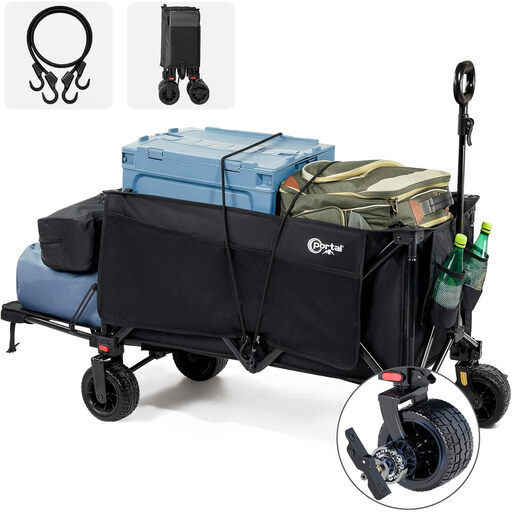
Why This Fits Their Persona: This option suits shoppers prioritising organisation, extended loading space and practical maintenance features for repeated camping, garden or festival use.
The listing identifies both the 300-litre capacity with open tailgate and the separate 132kg load limit. Its folded dimensions are also stated for storage planning.
All-terrain PU wheels with bearings, dual brakes, side pockets, cup holders and quick-release wheels.
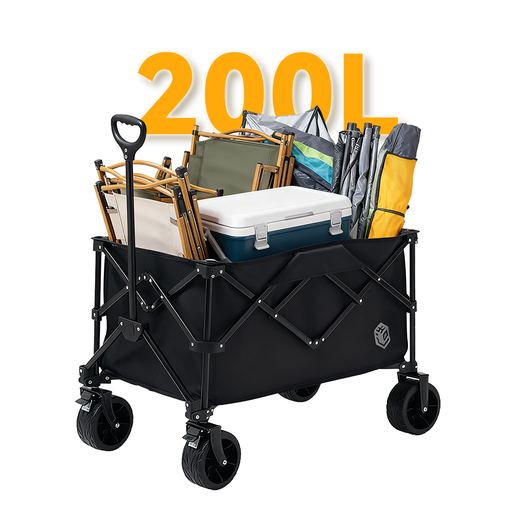
Why This Fits Their Persona: The 200-litre format is designed for bulky camping loads, gardening, beach trips, moving supplies and market or vending equipment.
Its high-sided 200-litre design is paired with off-road wheels and dual brakes, giving shoppers specific details to assess instead of relying only on the heavy-duty label.
200-litre capacity, steel frame, 600D Oxford cloth, off-road PVC wheels and double brakes.
We have compiled a complete, real-time list of products that fully satisfy these strict selection criteria and UK safety regulations.
It can be suitable for compact sand and beach paths when fitted with larger, wider off-road wheels. Deep, loose sand remains difficult for most wheeled carts. Reduce the load if pulling becomes difficult and avoid overloading the wagon near the shoreline.
Service life depends on load frequency, terrain, storage and maintenance. Staying within the stated load limit, cleaning grit from the wheels and storing the wagon dry can help reduce wear. Inspect the fabric, frame, wheel fixings and brakes before regular use.
Brakes are useful when loading, unloading or parking on an incline. A wagon with brakes should still be placed on stable ground whenever possible. Engage all available brakes and do not use the wagon as a seat, step or child carrier unless the product specifically states that it is designed for that purpose.