
24/7 Customer Support

Free returns

Same-day & Next-day Delivery

Quality Guaranteed

Unlock Your Welcome Offers: FREE Delivery | Up to 80% OFF | Free 30-day JoyPlus trial
Download the APP
A folding camping wagon can make a family trip, market setup or garden job considerably easier—but only if its capacity, wheels and frame match the load and terrain. Many buyers focus on a large litre figure or an attractive price, then discover that the trolley is awkward to steer, difficult to store or unsuitable for uneven ground.
Before choosing a collapsible camping wagon, watch for these common pitfalls:
The stated load limit is the maximum weight the manufacturer specifies, not a recommended target to exceed. Distribute heavy items across the base rather than placing everything at one end. This helps reduce tipping and uneven strain on the frame.
For occasional shopping and picnic use, a 127-litre wagon with a 200kg load capacity may provide a practical balance between space and portability. Larger households, traders and festival vendors may prefer a 150-litre or 200-litre body, provided they have room to store it.
Also check how capacity is measured. Some products list a “stackable capacity” that may include extra height above the main compartment. A high-sided body can carry bulky equipment, but items should still be secured so they do not fall out while moving.
For pavements, supermarket car parks and compact storage, 360-degree swivel wheels can make turning easier. For grass, gravel, mud and sand, larger off-road wheels with a deeper tread are generally more suitable.
A proper off-road utility cart should also have brakes that can hold the wagon when stationary. Engage both brakes on slopes and never rely on the handle alone. “Explosion-proof” or puncture-resistant descriptions should not be treated as a guarantee against all damage; inspect wheels regularly for wear, trapped stones and loose fixings.
Steel or carbon steel frames can provide a firm structure for heavier loads, while polyester or Oxford fabric sides offer flexibility and can be wiped clean. A reinforced or thickened base is useful when carrying crates, garden tools or boxed supplies.
Look for a clear folding mechanism and ensure the wagon locks into its open position before loading. Keep fingers away from hinges and do not use a camping gear cart as a seat or step. Before purchasing, compare the folded size with your car boot, garage or cupboard.
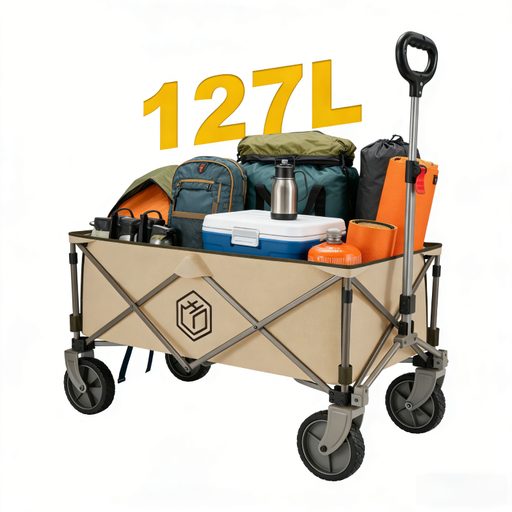
Why This Fits Their Persona: Its 127-litre interior and foldable design suit occasional campers, families attending picnics and shoppers who need a capable trolley without choosing an extra-large body.
The stated 200kg limit is clearly identified, while dual brakes and 360-degree swivel wheels address parking and manoeuvrability concerns.
127L capacity, 200kg stated load limit, collapsible format and heavy-duty spray-painted steel tubes.
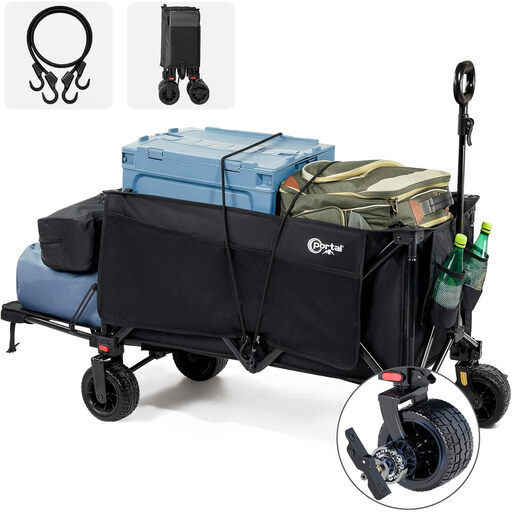
Why This Fits Their Persona: This option suits buyers who value organisation and maintenance access for repeated beach trips, garden work, grocery runs or festival use.
The 132kg load limit is specified separately from its 300L capacity, helping prevent the common mistake of equating volume with weight tolerance.
PU wheels with bearings, dual brakes, side pockets, cup holders, quick-release wheels and a stated folded size of 35 x 26 x 80cm.
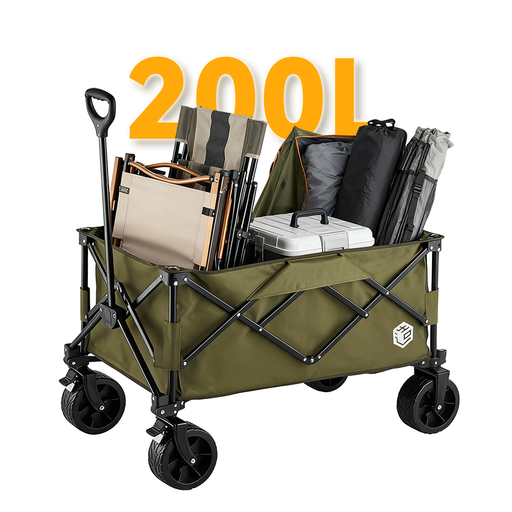
Why This Fits Their Persona: Its high-sided 200-litre body is suited to market traders, festival vendors, gardeners and families transporting bulky outdoor equipment.
Large off-road wheels, dual brakes and a stated 200L capacity address terrain and bulk, while the instructions still require level loading and a fully locked frame.
200L high-sided interior, off-road wheels, dual brakes, foldable metal frame and use across camping, beach, gardening and market tasks.
We have compiled a complete, real-time list of products that fully satisfy these strict selection criteria and UK safety regulations.
Before loading, unfold the trolley completely and check that the frame has locked. Place heavier items low and centrally, then engage both brakes whenever it is stationary on an incline. Avoid steep or unstable ground, public roads and fast towing.
After a wet beach trip or muddy garden job, wipe the frame and fabric with a damp cloth and allow everything to dry before folding. Check wheel bolts, brake function and stitching periodically. Store the wagon somewhere dry, particularly if it has a steel frame, to reduce the risk of corrosion.
A beach wagon with larger, wider off-road wheels is more suitable for sand than a compact trolley with small wheels. Even then, avoid overloading it and pull steadily rather than making sharp turns. Check the product instructions for terrain limitations.
Its service life depends on load frequency, terrain, weather exposure and maintenance. Staying within the stated load limit, drying the fabric and checking wheels and brakes can help preserve its condition. Folding mechanisms should never be forced if the frame is not aligned.
There is normally no fuel or electrical running cost. Ongoing costs may include cleaning supplies and, on some models, replacement wheels or hardware. A trolley with quick-release wheels can make cleaning and replacement more straightforward, but confirm compatibility before ordering.