
24/7 Customer Support

Free returns

Same-day & Next-day Delivery

Quality Guaranteed

Unlock Your Welcome Offers: FREE Delivery | Up to 80% OFF | Free 30-day JoyPlus trial
Download the APP
A folding camping wagon can save repeated trips between the car, campsite, beach, garden or market stall. However, product listings often focus on large capacity and impressive-looking wheels while leaving out details that affect everyday usability.
Before buying a collapsible camping wagon, watch for three common pitfalls:
Choose capacity according to what you normally carry, rather than selecting the largest number available. A 200L camping wagon may suit tents, cool boxes and picnic equipment, while a smaller 127L model may be easier to manoeuvre for shopping or gardening.
The load rating should also match the type of goods being transported. Camping equipment is usually bulky but relatively light; paving materials, bottled drinks or market stock can create a much heavier load. Distribute weight evenly and never exceed the manufacturer’s stated limit.
Some wagons offer stackable capacity or an open rear section. This can be useful for long or irregularly shaped items, but it should not be confused with fully enclosed storage. A 300L trolley with its tailgate open, for example, may offer more flexibility but less protection from movement or rain.
For grass, gravel and woodland paths, an off-road camping trolley needs more than small household-style castors. Large polyurethane, PVC or rubber wheels with tread can provide greater clearance over uneven surfaces. Wheels with bearings may also roll more smoothly and can be easier to clean or replace when they have a quick-release design.
A camping wagon with brakes is worth considering if you regularly stop on slopes, at campsites or beside a beach access path. Dual brakes can help keep the cart stationary, but they do not remove the need to hold the handle on steep or unstable ground. Check that the brakes engage properly before loading.
A 360-degree swivel wheel configuration may improve turning in a garden centre or car park. For loose sand and rough ground, larger fixed or off-road wheels may offer more predictable movement.
A heavy-duty folding wagon commonly combines a steel or alloy frame with polyester or Oxford fabric. Look for reinforced stitching, a stable base and a frame-locking mechanism that is easy to confirm visually. Fabric should be kept dry before folding to reduce the chance of mould or corrosion during storage.
A portable folding cart should be manageable when collapsed. Compare the folded size with your vehicle’s boot opening, garage shelving or storage cupboard. Some models require wheel attachment, while others unfold without tools. Quick-release wheels can be helpful when removing sand and mud after a beach trip.
Remember that a foldable garden trolley is still a wheeled load carrier, not a seat, step or child carrier unless the product specifically states otherwise. Keep fingers away from hinges and ensure the frame is fully locked before use.
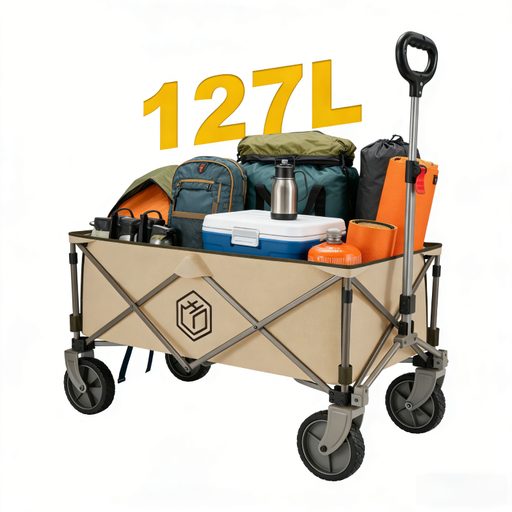
Why This Fits Their Persona: A practical choice for occasional campers, grocery runs, picnics and garden jobs where compact storage and a substantial load rating are priorities.
Its stated 127-litre capacity and 200kg maximum load provide clearer reference points than an unspecified “extra large” claim. The foldable format helps limit storage demands.
127-litre interior; 200kg stated load capacity; collapsible design; dual-brake 360° swivel wheels.
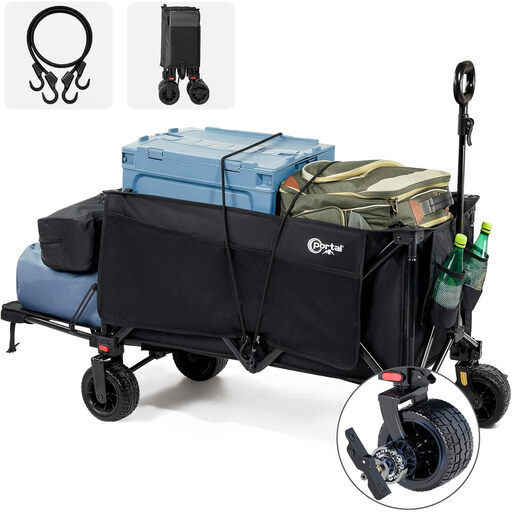
Why This Fits Their Persona: Suitable for users who want detailed capacity information, organised storage and a folding mechanism suited to repeated beach, festival, camping or garden use.
The listing distinguishes its 300-litre capacity with the tailgate open and specifies a 132kg load limit. Folded dimensions and quick-release wheels make storage and cleaning easier to assess.
300-litre open-tailgate capacity; 132kg load rating; PU wheels with bearings; side pockets, cup holders and dual brakes.
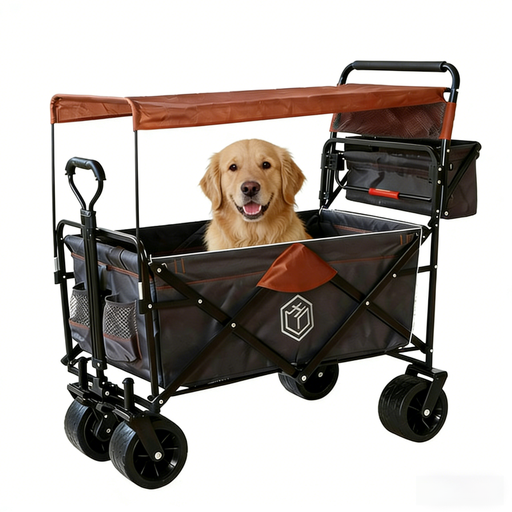
Why This Fits Their Persona: Designed for heavier outdoor loads, vending supplies, event equipment and moving tasks where a reinforced frame and large wheels are useful.
The product information states a 260kg load capacity, dual brakes and a reinforced carbon steel frame, giving heavy users specific features to compare rather than relying on general durability wording.
150-litre capacity; 260kg stated load capacity; reinforced carbon steel frame; detachable canopy; dual-brake off-road wheels.
We have compiled a complete, real-time list of products that fully satisfy these strict selection criteria and UK safety regulations.
It can be, provided it has large off-road wheels and a suitable load rating. Loose sand increases rolling resistance, so avoid overloading and pull steadily. Clean sand from the wheels and frame after use, then dry the wagon before storage.
Lifespan depends on load frequency, terrain, weather exposure and maintenance. Avoid exceeding the stated capacity, protect the fabric from prolonged damp and periodically check wheel bolts, frame joints, brakes and locking points. Store it in a dry place when not in use.
A manual outdoor utility cart does not require fuel, charging or a subscription. Ongoing costs may include replacement wheels, cleaning supplies or repairs if components become worn. A model with quick-release wheels can make cleaning and replacement more convenient.