
24/7 Customer Support

Free returns

Same-day & Next-day Delivery

Quality Guaranteed

Unlock Your Welcome Offers: FREE Delivery | Up to 80% OFF | Free 30-day JoyPlus trial
Download the APP
A folding camping wagon can save repeated trips between the car and campsite, help move gardening supplies or make a beach day easier to organise. However, product listings often emphasise impressive capacity figures without explaining how the trolley behaves when fully loaded.
For UK buyers, the right choice depends on more than colour or price. You need to consider the usable load, wheel design, folded dimensions, brakes and the type of ground you expect to cross.
A large internal volume does not automatically mean that a wagon can safely carry heavy equipment. A 200-litre compartment may be useful for bulky sleeping bags and picnic supplies, but the stated maximum load capacity is a separate specification.
Also check whether the capacity refers to the inside space or a “stackable capacity” figure. Do not exceed the manufacturer’s stated weight limit, and distribute heavy items evenly to reduce the risk of tipping.
Small swivel wheels may work well on pavements and supermarket floors but can struggle on sand, gravel or wet grass. Conversely, large off-road wheels may be less convenient in tight indoor spaces.
For campsites, beaches and gardens, look for wide, rugged wheels with sufficient clearance beneath the frame. A beach wagon or off-road camping cart should be pushed slowly across soft or uneven surfaces rather than treated like a road vehicle.
“Collapsible” does not always mean compact enough for your boot, shed or hallway. Before buying, check the folded dimensions and the weight of the wagon itself. A heavy-duty utility wagon may carry more, but it can also be harder to lift into a car.
A reliable folding mechanism should lock securely when open and keep fingers clear during folding. Allow fabric and the frame to dry before storage, particularly after use on damp grass or near the coast.
Start by separating three measurements:
A 127L wagon may suit everyday shopping, picnics and moderate camping equipment. A large capacity camping cart of 150L or 200L is more appropriate for family camping, market stock, gardening materials or bulky beach equipment. In every case, place dense items low in the base and avoid loading above the sides if this affects stability.
The frame should be described clearly, for example as steel or reinforced carbon steel. Steel can provide a firm structure for heavier loads, while fabric walls make the trolley foldable. Look for practical details such as reinforced stitching, a strengthened base and a fabric type such as 600D Oxford cloth.
A spray-painted or powder-coated finish can help protect metal surfaces, but it is not a reason to leave the wagon permanently outdoors. Wipe away mud and salt residue, then store it dry. Avoid sharp objects that could damage the cart body.
A wagon with brakes is useful when loading or parking on a gentle incline, but brakes are not a substitute for supervision or careful positioning. Check whether the product has dual brakes and whether they act on the wheels securely.
For pavements, shopping and grocery runs, 360-degree swivel wheels can improve manoeuvrability. For grass, gravel, mud and sand, large all-terrain wheels are generally more suitable. Do not use an outdoor transport wagon on public roads, and follow the supplied instructions for terrain and load limits.
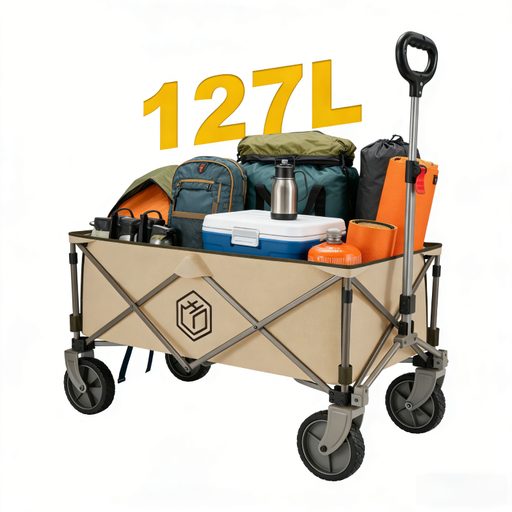
Why This Fits Their Persona: A practical starting point for UK households wanting one foldable trolley for picnics, grocery runs, moving boxes or occasional camping.
The listing states both a 127-litre interior and a 200kg maximum load, helping shoppers distinguish space from weight capacity.
Foldable design, 127L capacity, 200kg stated load limit and dual brake 360-degree swivel wheels.
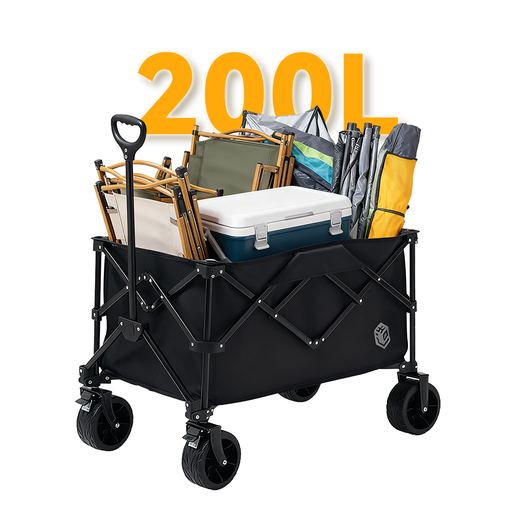
Why This Fits Their Persona: Suitable for buyers prioritising a larger compartment and materials suited to repeated outdoor use, including camping, beach trips and gardening.
The product information specifies a steel frame, 600D Oxford cloth and off-road PVC wheels rather than relying only on general durability wording.
200L capacity, foldable construction, large off-road wheels and a double-brake design.
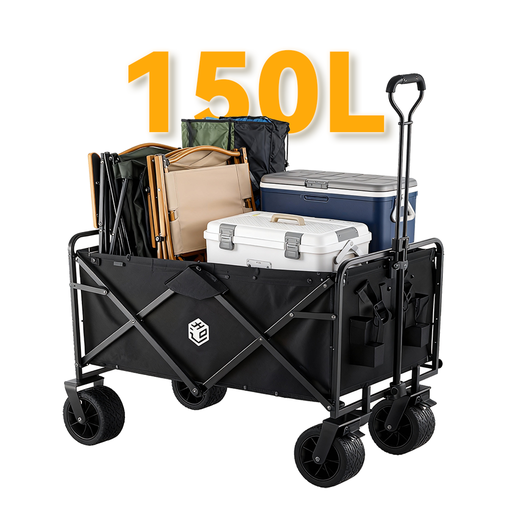
Why This Fits Their Persona: A consideration for market traders, event vendors, gardeners and campers moving heavier equipment across outdoor areas.
The listing gives a 150L capacity and 260kg load capacity, alongside a reinforced carbon steel frame and dual-brake wheels.
150L storage, 260kg stated load capacity, tank-style off-road wheels and reinforced carbon steel frame.
Before loading any collapsible camping wagon, fully unfold the frame and confirm that its locking mechanism is engaged. Keep hands away from hinges and folding joints. Place heavier items centrally, secure loose equipment and test the brakes before using the trolley on an incline.
After a muddy campsite or beach trip, remove grit from the wheels and wipe the fabric and frame with a damp cloth. Salt and moisture can affect metal components over time, so allow the wagon to dry fully before folding it away. Periodically check wheel fasteners and brake operation.
We have compiled a complete, real-time list of products that fully satisfy these strict selection criteria and UK safety regulations.
Choose a model with larger, wider off-road wheels and move it slowly. Very soft sand can still be difficult, particularly when the wagon is heavily loaded. Distribute weight evenly and avoid pulling at an angle.
Service life depends on load frequency, terrain, storage and maintenance. Staying within the stated capacity, cleaning mud and salt, checking wheel fittings and storing the wagon dry can help reduce avoidable wear. Folding components should be handled carefully rather than forced.