
24/7 Customer Support

Free returns

Same-day & Next-day Delivery

Quality Guaranteed

Unlock Your Welcome Offers: FREE Delivery | Up to 80% OFF | Free 30-day JoyPlus trial
Download the APP
A folding camping wagon can make a family camping trip, beach day or garden project considerably easier. It can carry cool boxes, tents, chairs, shopping bags and tools in one journey, then fold away in the boot or garage.
However, impressive capacity figures and “off-road” wording do not always tell the full story. A suitable collapsible camping wagon needs to match your load, terrain and storage space. The wrong choice may be awkward to steer, difficult to lift or unstable when fully loaded.
This guide explains the practical details to check before buying, followed by our top recommendations for different UK users.
A wagon may advertise a large internal volume but have a lower maximum weight rating. Capacity in litres describes space, not how much weight the frame, base and wheels can safely carry.
For example, camping equipment is often bulky but relatively light, while paving materials, bottled drinks or market stock can quickly create a heavy load. Check both the litre capacity and the maximum load capacity, and never exceed the manufacturer’s stated limit.
A camping cart with wheels may roll well on grass and gravel but struggle on soft sand if its wheels are narrow. Conversely, larger off-road wheels can take up more storage space and may feel less nimble on pavements or indoors.
Look for wheel dimensions, tread design, swivel function and brakes. For beaches, fields and uneven tracks, a wider wheel profile and greater ground clearance are useful. For shopping centres, markets and smooth paths, 360-degree swivel wheels may be more convenient.
A large capacity camping wagon is only practical if you can store and transport it. Check its folded dimensions against your car boot, shed or cupboard. Also confirm that the frame locks securely when opened.
Keep fingers clear of hinges during setup, unfold the frame fully and inspect the base before loading. A wagon should not be used as a seat or step unless the product specifically states that it is designed for that purpose.
A reinforced steel or carbon steel frame can provide a stable structure for heavier loads, while Oxford or polyester fabric helps form the cargo compartment. A thickened base plate can help support awkward items, but the whole assembly—including wheels, axle and handle—must be considered.
For regular outdoor use, look for:
Materials alone do not guarantee durability. After wet trips, dry the wagon before folding it and store it in a dry place to reduce the risk of rust, mildew and unpleasant odours.
A heavy-duty camping trolley may list a load capacity of 100kg, 200kg or more. Treat this as a maximum specification rather than a target. Distribute heavy items low and centrally, keep the load balanced and avoid placing dense objects only at one end.
On slopes, apply the brakes before leaving the handle. Even a strong frame can become difficult to control if the centre of gravity is high or the surface is loose.
An outdoor utility cart intended for grass, mud, gravel or sand benefits from larger off-road wheels with a pronounced tread. Dual brakes are useful when loading or parking on an incline, although they do not replace careful handling.
For everyday errands, a compact trolley with swivel wheels may be easier to turn around market stalls, pavements and supermarket aisles. Those seeking a foldable beach wagon should pay particular attention to wheel width, as narrow wheels can sink into soft sand.
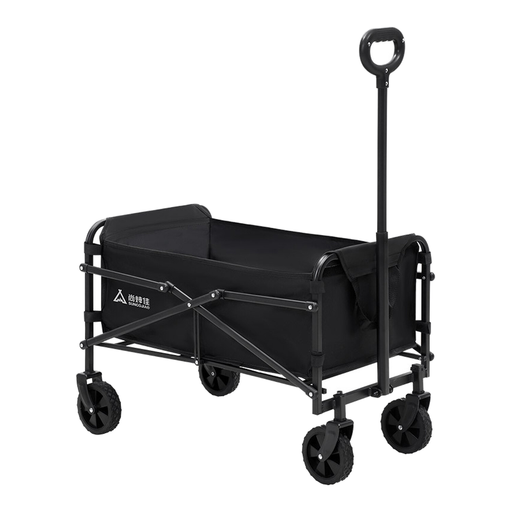
Why This Fits Their Persona: At approximately 4.8kg, this portable folding cart is a practical starting point for picnics, sports days, grocery runs and occasional beach trips where easy lifting matters.
Its stated 100kg load rating and 170-litre cargo capacity make the space-to-weight specification clear, helping buyers avoid judging suitability by appearance alone.
600D Oxford fabric, a cold-rolled iron frame, PVC wheels and multi-directional movement.
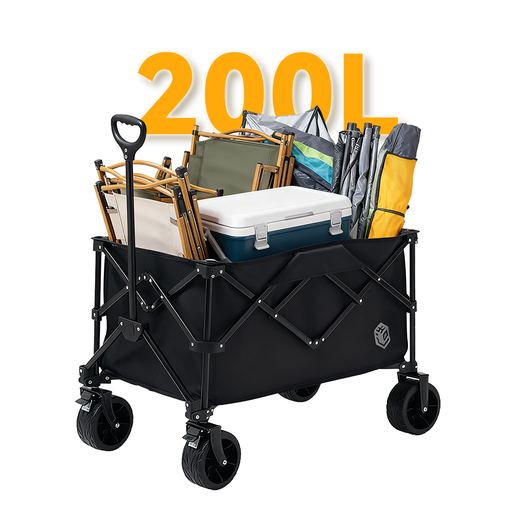
Why This Fits Their Persona: The 200-litre high-capacity format suits families, regular campers and users who want one wagon for camping, gardening, shopping and moving bulky supplies.
It combines a stated 200L capacity with off-road wheels and dual brakes, rather than relying on capacity alone to describe outdoor performance.
Steel frame, 600D Oxford cloth, PVC off-road wheels and a foldable design.
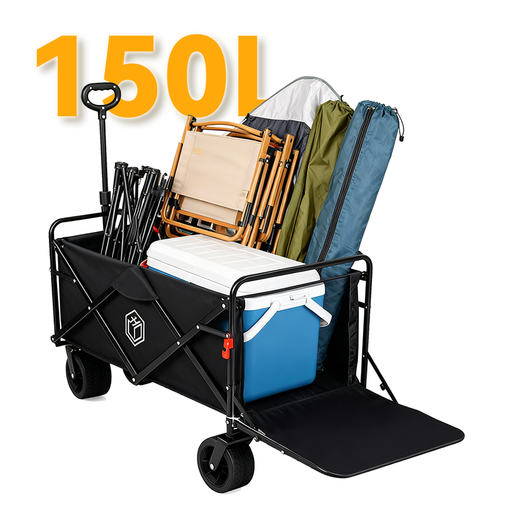
Why This Fits Their Persona: With a stated 260kg load capacity, this heavy-duty camping trolley is aimed at event vendors, market traders, movers and campers transporting dense equipment.
The listed carbon steel frame, thickened PP base plate and dual braking wheels address the common gap between a large cargo area and actual heavy-load support.
150L interior, rear opening, reinforced carbon steel frame and dual brake explosion-proof wheels.
Before using any camping and picnic cart, check that the frame is fully unfolded and locked. Place heavier items at the bottom, keep the load within the stated limit and avoid sharp objects that could damage the fabric.
After use:
Do not use a folding wagon on public roads or at high speed. On steep or uneven ground, move slowly and keep control of the handle.
We have compiled a complete, real-time list of products that fully satisfy these strict selection criteria and UK safety regulations.
It can be, provided it has wheels designed for the surface. Wider off-road wheels generally handle sand, grass and gravel more effectively than small narrow wheels. Reduce the load on soft sand and avoid dragging the wagon through water.
Lifespan depends on load frequency, terrain, weather exposure and maintenance. Staying within the rated capacity, drying the fabric after wet use and checking the wheels and frame can help preserve its condition. Folding storage also reduces exposure to dirt and moisture.
No. A standard camping wagon is manually pushed or pulled, so there is no battery charging or fuel cost. Ongoing costs are normally limited to cleaning and, where necessary, replacement wheels or hardware. Always check the product’s care and spare-part information before purchase.