
24/7 全天候客户支持

免费退货

当日/次日达

品质保障

开启新人专享福利: 全场免邮 | 低至 2 折 | 免费试用 30 天 JoyPlus 会员
下载 Joybuy
A folding shopping trolley can make supermarket trips, market visits and everyday errands easier to manage, particularly when carrying groceries over longer distances. However, a trolley that looks spacious online may be awkward to pull, difficult to store or unsuitable for uneven pavements.
Before buying, look beyond appearance and promotional wording. The following guide explains the practical features that matter when choosing a folding shopping trolley, including capacity, frame construction, wheel design and storage.
A wide fabric compartment does not automatically mean the frame or wheels can safely carry heavy groceries. Bottles, tins and large household products can place considerable strain on the base, stitching, handle and wheel mounts.
Check whether the product listing provides a maximum weight capacity. If no figure is provided, avoid assuming that a large-capacity shopping trolley is suitable for exceptionally heavy loads. Distribute weight evenly and keep heavier items low inside the bag.
“Foldable” describes the storage function, not necessarily the quality of the locking mechanism. A trolley that is not fully opened and secured can flex while being pulled, especially over kerbs or uneven paths.
Look for clear instructions to unfold and engage the locking mechanisms before loading. A metal frame, reinforced base and firmly attached handle can provide a more dependable structure than a very lightweight design with limited support.
A stair-climbing shopping trolley may help when negotiating steps, but it does not make stairs risk-free. Multi-wheel arrangements can be useful for moving the trolley over certain steps, yet the load still needs to be controlled by the user.
Use caution on stairs, ramps and uneven surfaces. If the trolley is heavily loaded, consider using lifts, ramps or level routes where available. A stair-climbing design should be treated as a handling aid rather than a replacement for safe lifting practice.
The frame is central to the trolley’s durability. Common options include carbon steel, blended metal construction and aluminium alloy. Steel may offer a rigid feel, while aluminium alloy can reduce overall weight. The material name alone does not confirm the maximum load, so always check the product specification and safety instructions.
For a heavy-duty grocery trolley, also inspect:
A product described as a lightweight collapsible shopping trolley may be easier to lift into a car, but it may not be the right choice for frequent large shops unless its load guidance suits your needs.
An ergonomic handle trolley should allow the user to pull without excessively bending the wrist or shoulder. Older adults and carers should consider the handle height, grip shape and whether the trolley can be manoeuvred with one hand.
An adjustable handle can be useful for households where more than one person uses the trolley. A fixed ergonomic handle may be simpler, with fewer moving parts to maintain. In either case, check whether the handle feels secure when the trolley is loaded.
A shopping trolley with wheels should roll smoothly on the surfaces where it will normally be used, such as supermarket floors, pavements and market streets. Larger wheels may handle small kerbs more effectively, while compact wheels can make storage easier.
Consider the route from the shop to home. For level pavements, a standard two-wheel grocery trolley may be sufficient. For buildings with steps, a stair-climbing shopping trolley may be more suitable, but the user should still keep the load manageable.
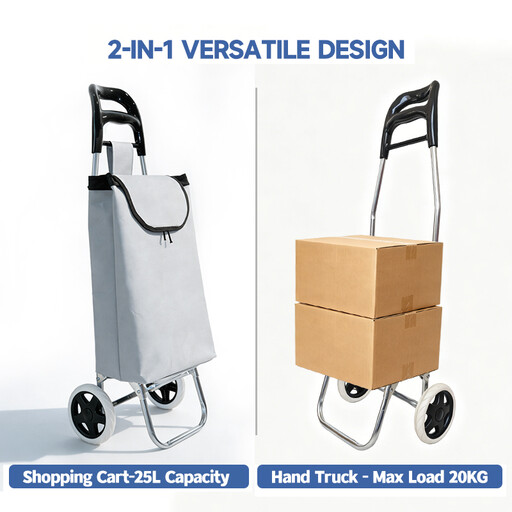
Why This Fits Their Persona: A practical option for regular supermarket shoppers wanting one spacious trolley for groceries, market trips and routine household errands.
Its listed design combines a large compartment with a metal frame, while the instructions state that the trolley should be fully opened and locked before loading.
Large-size format, ergonomic handle, foldable frame and blended fabric/metal construction.
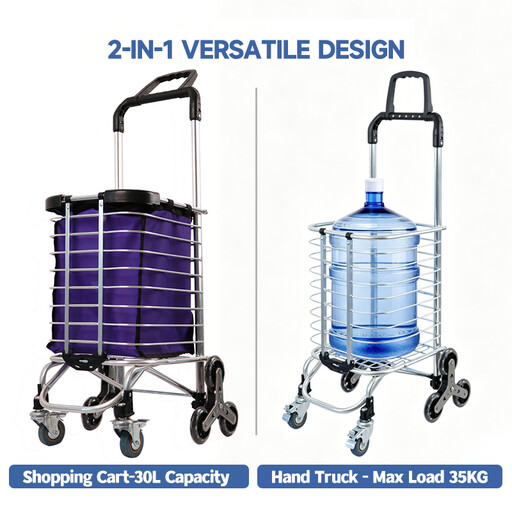
Why This Fits Their Persona: Suitable for shoppers who prioritise an adjustable handle and a foldable frame for storage in a hallway, cupboard or car boot.
The listing identifies an aluminium alloy frame and adjustable handle, giving buyers specific construction details to compare instead of relying only on appearance.
Aluminium alloy frame, adjustable handle, foldable design and high-load-capacity positioning in the product listing.
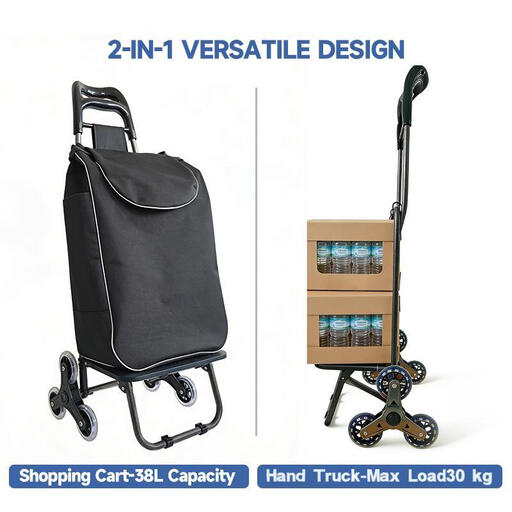
Why This Fits Their Persona: Designed for shoppers and carers who regularly carry groceries between shops, pavements and homes where steps may be present.
The stair-climbing format addresses step-related handling needs, while its foldable construction helps prevent storage becoming a separate problem.
Stair-climbing wheel design, large-capacity format, lightweight positioning and foldable storage.
Most folding grocery trolley designs require little or no tool-based assembly. Before the first trip:
For routine care, wipe the fabric basket and metal frame with a damp cloth. Store the trolley somewhere dry when folded, particularly if it has been used in wet weather. Check wheel mounts, screws and handle connections periodically. A loose fitting can affect stability and should be tightened where the design permits.
Do not use a shopping trolley to transport children. Keep it away from young children when not in use, and take extra care on stairs and uneven ground.
We have compiled a complete, real-time list of products that fully satisfy these strict selection criteria and UK safety regulations.
An elderly-friendly shopping trolley may be suitable when it has a comfortable handle, manageable weight and wheels suited to the user’s usual route. Check the handle height and pulling action before loading it heavily. A carer may also need to consider whether the trolley can be lifted into a vehicle.
Lifespan depends on load frequency, outdoor surfaces, storage conditions and maintenance. Avoid dragging an overloaded trolley, check the wheels and frame regularly, and follow the manufacturer’s capacity guidance. Damp storage and repeated impacts against kerbs can accelerate wear.
A manual folding shopping trolley has no fuel or charging cost. Ongoing expenses are generally limited to replacement wheels or fittings if these become worn or damaged. Keeping the trolley clean, dry and within its load limit can help reduce avoidable maintenance.