
24/7 全天候客户支持

免费退货

当日/次日达

品质保障

开启新人专享福利: 全场免邮 | 低至 2 折 | 免费试用 30 天 JoyPlus 会员
下载 Joybuy
A folding shopping trolley can make supermarket trips, market visits and household transport much easier. However, not every foldable shopping trolley is suited to heavy groceries, uneven pavements or limited storage space. A lightweight frame may feel convenient in a product photograph but become difficult to steer when fully loaded.
Before buying, look beyond phrases such as “large capacity” or “heavy-duty”. The useful details are the actual load rating, wheel design, folded dimensions, handle construction and locking system.
A large bag does not automatically mean that the frame, base or wheels can safely carry a substantial load. Some products provide plenty of litres but give limited information about supported weight.
Check both:
Avoid filling a trolley with heavy tins, bottled drinks and cleaning products unless the listed load rating is suitable. Always follow the manufacturer’s instructions and do not exceed the stated limit.
Small fixed wheels may work well in a supermarket aisle but can catch on kerbs, paving gaps and rough paths. A grocery trolley with wheels should be selected according to where it will be used.
For everyday shopping, look for wheels that rotate smoothly and remain stable under load. For camping, beaches or outdoor events, a wider wheel arrangement and a reinforced base may be more useful. A stair-climbing shopping trolley can appear attractive, but buyers should check how the stair mechanism works, whether it requires lifting and whether the manufacturer provides clear usage guidance. No wheeled trolley should be treated as risk-free on stairs.
An adjustable handle shopping trolley can improve comfort for users of different heights. However, a handle that flexes, slips or locks inconsistently can make a loaded trolley awkward to control.
Check whether the handle has a clear locking position and whether the grip is comfortable for longer journeys. An ergonomic handle may help with handling comfort, but it does not remove the need to distribute weight evenly or avoid overloading.
For routine supermarket use, a blend-fabric bag with a metal frame can offer a practical balance between portability and support. A heavy-duty shopping trolley should also have a stable base so that groceries do not bunch at the bottom and affect balance.
For more demanding outdoor use, reinforced steel or cold-rolled iron frames may provide a higher stated load rating. Oxford fabric, such as 600D material, is commonly selected for resistance to tearing, but buyers should still check seams, stitching and the way the bag attaches to the frame.
A large capacity shopping trolley may reduce the number of trips, but it must still fit through your front door, lift, car boot or storage cupboard. Before ordering, measure:
A collapsible camping wagon usually offers more space than a conventional shopping trolley, while a portable grocery cart may be easier to store and pull for smaller shops.
Multi-directional swivel wheels can improve manoeuvrability, particularly when pushing a bulky cart around a car park or outdoor space. Brakes are useful when loading or parking on a slight incline, but they should be engaged whenever the trolley is stationary.
For indoor organisation, a rolling storage trolley with lockable castors may be more suitable than a fabric grocery cart. It can move between rooms but remain stable when the wheels are locked.
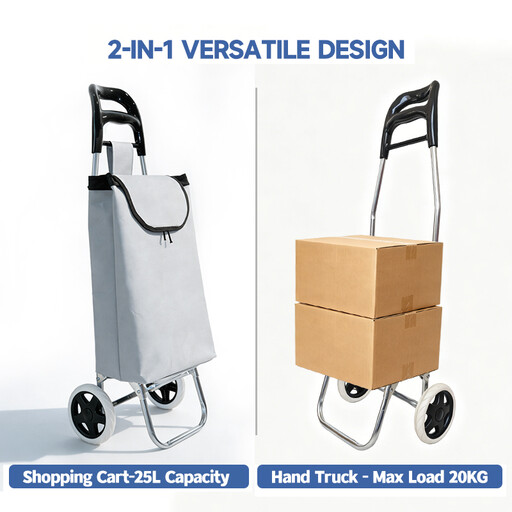
Why This Fits Their Persona: A practical option for regular supermarket trips, market shopping and daily errands where compact storage and a spacious fabric compartment are priorities.
The listing specifies a metal frame, plastic wheels, an ergonomic handle and a foldable design. Buyers should still confirm the maximum load before adding particularly heavy items.
Large-size folding format; ergonomic handle; suitable for groceries and everyday transport.
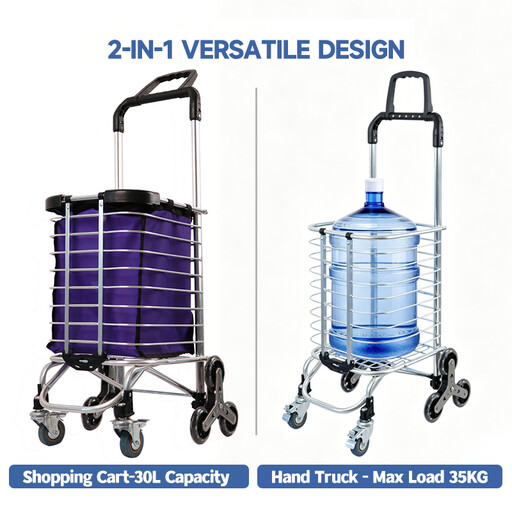
Why This Fits Their Persona: Suitable for shoppers who prioritise a lighter frame, adjustable handling and a trolley that can be stored neatly between trips.
An aluminium alloy frame is specified in the product title, while the adjustable handle addresses the risk of a fixed, uncomfortable grip. Confirm the complete specifications before purchase.
Foldable frame; adjustable handle; designed for home and supermarket shopping.
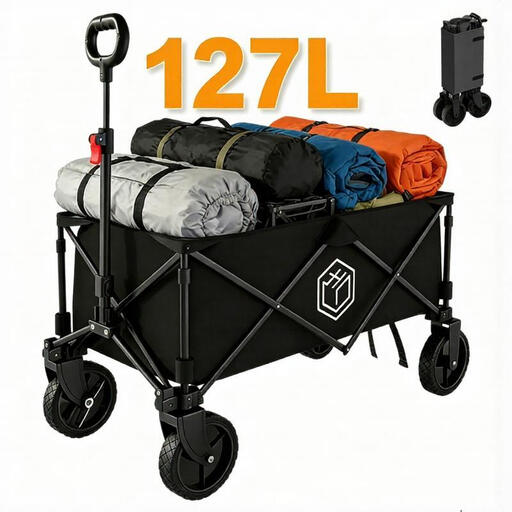
Why This Fits Their Persona: A larger utility cart for camping equipment, picnic supplies, parcels, bulky shopping or moving items around an outdoor space.
The listing states a 127-litre interior and a 200 kg load capacity. Use these figures only within the stated conditions, and check terrain, balance and braking before transporting heavy loads.
127-litre capacity; collapsible construction; dual brake and 360° swivel wheels listed.
A conventional folding shopping trolley is generally easier to pull along pavements and store in a flat. A collapsible camping wagon provides more internal space but may be wider and heavier when folded. For home organisation, a three-tier rolling storage trolley can be more useful than either option, especially where open shelves and lockable castors are preferred.
We have compiled a complete, real-time list of products that fully satisfy these strict selection criteria and UK safety regulations.
Most wheeled trolleys are intended for level surfaces, ramps and pavements rather than regular stair use. A stair-climbing model may reduce some lifting, but users should read its instructions carefully, keep the load within the stated limit and use extra caution.
Service life depends on load, terrain, moisture and storage. Avoid dragging it over kerbs, dry the frame and fabric after wet use, check wheel movement regularly and inspect locks, stitching and screws for wear.
There is usually no fuel or electrical running cost. The ongoing expenses are mainly occasional wheel, fastener or bag replacement, depending on the construction and how heavily the trolley is used.