
24/7 Customer Support

Free returns

Same-day & Next-day Delivery

Quality Guaranteed

Unlock Your Welcome Offers: FREE Delivery | Up to 80% OFF | Free 30-day JoyPlus trial
Download the APP
A folding shopping trolley can make supermarket trips, market visits and daily errands easier, particularly when carrying heavy items is uncomfortable. However, product listings often focus on large capacity or stair-climbing wheels without explaining the practical limitations.
Before buying, look beyond promotional wording and check the frame, wheel design, folded dimensions and stated load limit. The right shopping trolley with wheels should match your route, storage space and typical shopping load rather than simply offering the largest-looking bag.
A spacious bag does not necessarily mean the frame or wheels can carry a heavy load safely. A trolley may hold bulky packets but feel unstable when filled with bottles, tins or cleaning products.
Check both:
These figures measure different things. For example, a 43-litre trolley listed with a 35 kg maximum load offers useful space, but the load should still be distributed evenly and secured before movement.
A stair-climbing shopping trolley can be designed to move over steps using multiple wheels, but it is not a substitute for a lift or level route. Stairs, kerbs and uneven paving can still require additional pulling force and careful handling.
Check whether the product instructions warn against stairs, steep slopes or excessive loads. A compact stair-climbing model may suit occasional steps outside a home, while a larger trolley may be more stable on pavements but less convenient indoors.
“Collapsible” does not always mean compact enough for a narrow cupboard, car boot or under-bed storage. Look for the folded measurements if they are provided, and consider the trolley’s weight. A heavy-duty grocery trolley may carry more, but a lightweight shopping trolley can be easier to lift onto public transport or into a car.
The frame affects stability, weight and long-term handling. Common options include aluminium, carbon steel, stainless steel and blended fabric-and-metal constructions.
A reinforced frame is only useful if the wheels, axle and base can support the same load. Inspect product specifications for a clear maximum weight rather than relying on terms such as “heavy-duty”.
Wheel size and layout influence how easily a trolley moves over pavements, supermarket floors and uneven ground. Swivel wheels can improve turning in tight aisles, while larger fixed wheels may roll more predictably over rougher surfaces.
For an elderly-friendly shopping trolley, also consider:
A trolley should not be overloaded beyond its stated limit. On stairs or kerbs, keep both hands available and follow the manufacturer’s instructions.
A large capacity shopping trolley is useful for a weekly supermarket trip, but a smaller model may be better for short errands. If you shop for chilled or frozen products, a shopping trolley with cooler compartment can help separate temperature-sensitive items during the journey. It should not be treated as a replacement for refrigerated storage, and travel time still matters.
For camping, beach trips or larger outdoor loads, a camping cart with wheels may be more appropriate than a conventional grocery trolley. These carts often have a wider cargo area but can be bulkier in shops and on public transport.
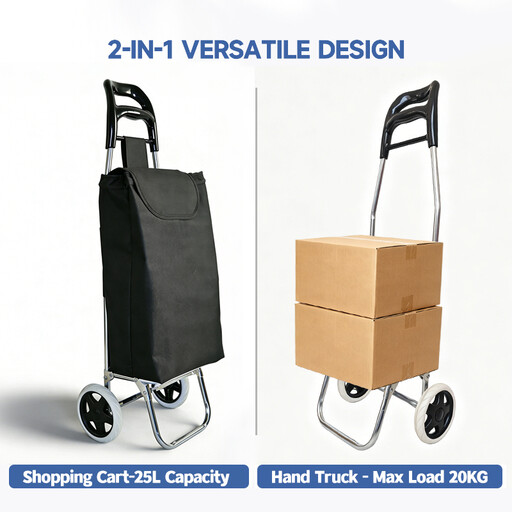
Why This Fits Their Persona: Its large-size format and foldable construction suit routine supermarket shopping when you want more carrying space without a permanent storage fixture.
The listing identifies an ergonomic handle, large capacity and a foldable design, helping you check practical features rather than relying only on “heavy-duty” wording.
Ergonomic handle; large foldable format for groceries and compact storage.
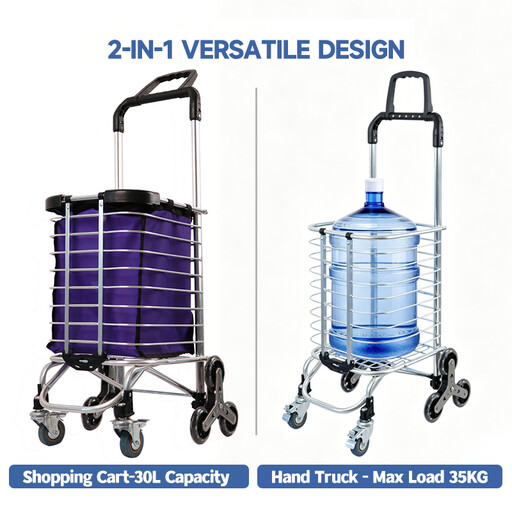
Why This Fits Their Persona: The aluminium alloy frame and adjustable handle make it suitable for shoppers who prioritise a lighter structure and adaptable handling.
The frame material and adjustable handle are specified, giving you concrete details to compare instead of an unsupported durability promise.
Aluminium alloy frame; adjustable handle; foldable format for home or supermarket use.
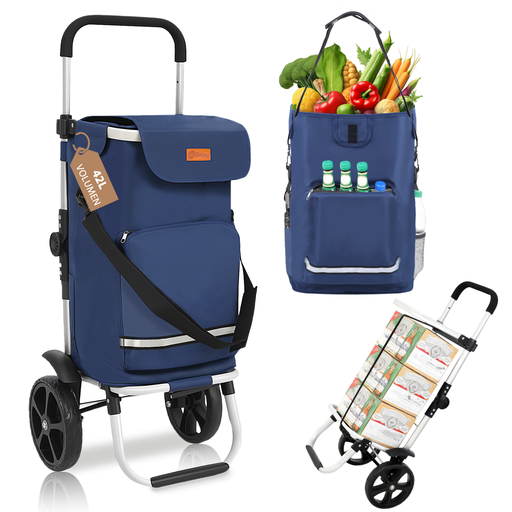
Why This Fits Their Persona: This option is designed for grocery trips, picnics and camping, combining a trolley, sack truck and shoulder bag in one product.
The listing provides measurable figures: 43-litre capacity, 35 kg maximum load and dimensions of 36 cm × 42 cm × 98 cm.
Aluminium frame; PVC wheels; insulated cooler compartment; adjustable handle and tie-down strap.
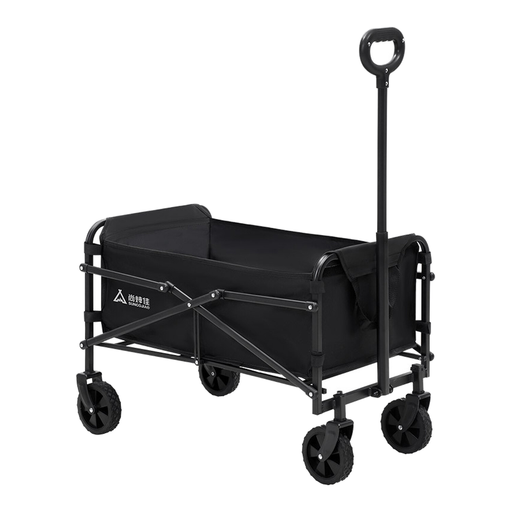
Why This Fits Their Persona: Its 170-litre cargo space and stated 100 kg load capacity are aimed at bulky outdoor loads for camping, fishing, beach trips and larger transport jobs.
The listing specifies the frame, fabric, wheel type, dimensions and load limit, making it easier to assess whether the cart is suitable for your planned terrain.
170-litre cargo capacity; multi-directional swivel wheels; foldable iron frame with 600D Oxford fabric bag.
We have compiled a complete, real-time list of products that fully satisfy these strict selection criteria and UK safety regulations.
Some models include a stair-climbing wheel arrangement, but this does not remove the need for care. Keep the load within the stated limit, hold the handle securely and follow the product instructions. For frequent stair use, compare wheel layout, trolley weight and your own ability to control the load.
Lifespan depends on load frequency, storage conditions, wheel wear and how the frame is handled. Avoid dragging an overloaded trolley, keep fabric dry before folding it away and check wheels, fasteners and locking mechanisms regularly.
There is no fuel or electrical running cost for a standard shopping trolley. Ongoing costs usually relate to replacement wheels, fasteners or fabric components if available. Choosing a model with suitable wheels and staying below its maximum load can help reduce wear.