
24/7 Customer Support

Free returns

Same-day & Next-day Delivery

Quality Guaranteed

Unlock Your Welcome Offers: FREE Delivery | Up to 80% OFF | Free 30-day JoyPlus trial
Download the APP
Finding space for fitness equipment in a modern UK home can be a challenge. Between compact living rooms and the desire to keep your home office uncluttered, a traditional, bulky treadmill is often out of the question. A folding treadmill offers a practical solution, allowing you to get in a quality cardio session without permanently sacrificing a corner of your room.
This guide is designed to help you navigate the options. We will outline the key features to consider when choosing a treadmill for home use and present a few of our top recommendations that balance performance, size and value.
Making the right choice comes down to understanding your space, fitness goals and living situation. Here are a few practical points to consider before you buy.
Before looking at any models, take out a tape measure. You need to measure two key areas: the space where you will use the treadmill and the space where you will store it. For use, ensure you have enough clearance around the machine for safety. For storage, check the dimensions under a bed, sofa or in a tall cupboard. This will help you filter for a treadmill with a truly small footprint or even an under desk treadmill that fits your specific layout.
A machine's motor power and speed range determine its suitability for your workouts.
If you live in a flat or a semi-detached house, noise is a critical factor. A loud treadmill can easily disturb neighbours or family members. Look for models that specify a low operating noise level, often measured in decibels (dB). A quiet treadmill for a flat will typically operate below 50-55 dB, which is comparable to the sound of a quiet conversation. Models with brushless motors are often engineered for quieter performance.
Here are a few standout models that cater to different needs, from intense jogging to under-desk walking.
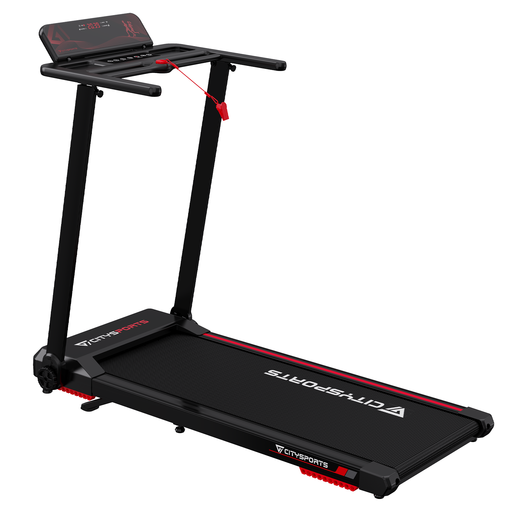
Why It Stands Out: This model cleverly integrates a manual incline feature into a compact, foldable design. The ability to switch between a flat surface and an 8% incline allows you to significantly increase workout intensity and engage different muscle groups without the bulk of a motorised incline system.
Pros:
Who is it for? Individuals living in flats who want more than just a flat walking pad. It's ideal for those looking to add hill-climb simulations to their walking or jogging routines to boost calorie burn.
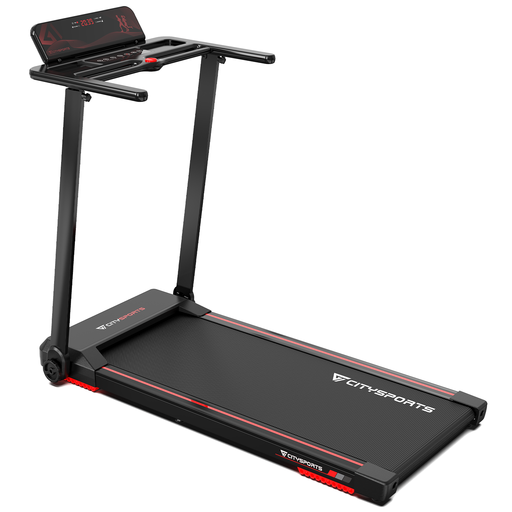
Why It Stands Out: This treadmill is built for the modern multi-tasker. It combines a capable 2.0HP motor with thoughtful entertainment and productivity features, including integrated Bluetooth speakers and a console stand large enough to hold a tablet or laptop.
Pros:
Who is it for? Remote workers who want to stay active during the day or fitness enthusiasts who enjoy being entertained during their workouts. Its balance of power and features makes it a versatile home-gym centrepiece.
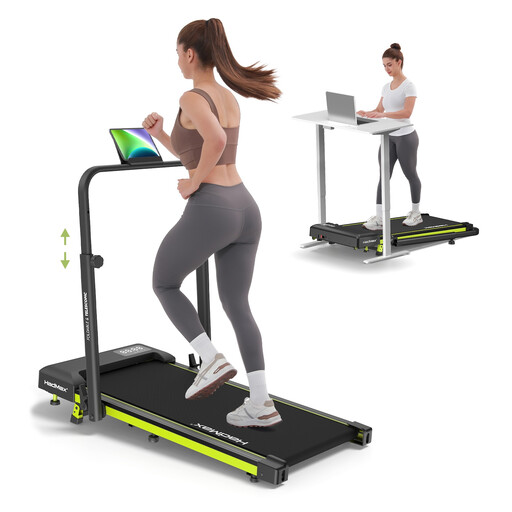
Why It Stands Out: This model prioritises stability and user comfort, particularly for walking. The adjustable two-level handrail provides extra support, while the combination of a quiet brushless motor and a significant manual incline makes it a highly effective walking pad.
Pros:
Who is it for? Users who prioritise safety and stability, including beginners or older individuals. It's also an excellent choice for a dedicated under desk treadmill setup where the handrail can provide support when getting on and off.
These recommendations are a great starting point, but the right treadmill is a personal choice. If you're looking for different features, higher running speeds or alternative designs, there are many other models to consider.
For a wider selection, explore our full range of foldable running treadmill models to find the perfect fit for your home and fitness routine.
Yes, but it depends on the model's specifications. For serious running, look for a machine with a motor of at least 2.5 HP, a top speed over 12 km/h and a sturdy frame. Models described as "walking pads" are typically designed for walking and light jogging at lower speeds.
They can be, but many modern designs are engineered for quiet operation. To ensure you don't disturb your neighbours, look for models that specify a low decibel (dB) rating—ideally under 55 dB. Treadmills with brushless motors and good cushioning systems tend to be the quietest.
You need to account for two measurements. First, the "in-use" footprint, which should have about a metre of clear space behind it and half a metre on each side for safety. Second, the "folded" dimensions. Measure the space under your bed or sofa or in a cupboard, to ensure your chosen model will fit when stored away.