
24/7 Customer Support

Free returns

Same-day & Next-day Delivery

Quality Guaranteed

Unlock Your Welcome Offers: FREE Delivery | Up to 80% OFF | Free 30-day JoyPlus trial
Download the APP
Finding space for fitness in a modern UK home can be a challenge. A folding treadmill with an incline seems like the perfect solution: a solid workout that tucks away neatly. Yet, many buyers find themselves with a bulky, noisy machine that gathers dust. The market is filled with promises that don't always match reality.
As a Joybuy Product Recommendation Officer, my role is to help you see past the marketing jargon. Before you invest, let's look at the common pitfalls that lead to buyer's remorse and how to choose a machine that genuinely fits your home and lifestyle.
The "Whisper-Quiet" Myth: Many treadmills claim to be quiet, but a low hum in a showroom can become a disruptive roar in a small flat, annoying both you and your neighbours. The issue isn't just the decibel (dB) rating, but the type of noise. A high-pitched motor whine is far more irritating than the low thud of your feet. A machine advertised as quiet without specifying a brushless motor or a dB rating below 50 dB should be viewed with caution.
The Illusion of "Compact": A treadmill that folds is not necessarily a treadmill with a small footprint. Many models remain bulky even when folded, with a folded height that prevents them from sliding under a standard sofa or bed. Always check the folded dimensions—particularly the height—and ensure it has robust transport wheels. A machine you can't easily store is one you'll stop using.
The Ineffective Incline: An incline feature is excellent for intensifying a workout, but only if it's meaningful. Some models offer a "manual incline" that is difficult to adjust or provides a gradient of only 1-2%. This minimal slope offers little real-world benefit, meaning you've paid extra for a feature that doesn't deliver a noticeably harder workout.
To ensure you get a machine that works for you, focus on these core parameters. They are the true indicators of a quality portable running machine.
For use in a shared living space or as an under desk treadmill, the motor is critical. Look for a brushless motor, which is mechanically simpler and significantly quieter and more durable than older brushed designs. For walking and jogging, a motor with 1.5 to 2.5 horsepower (HP) is more than adequate. Crucially, check for a specified noise level. A machine that operates at or below 45-50 dB is generally considered a quiet treadmill for home use, equivalent to the ambient sound in a library.
An incline boosts calorie burn and engages different muscle groups. For a noticeable difference in workout intensity, look for a manual incline that offers at least a 4% to 6% gradient. Anything less may not provide a significant challenge. Manual inclines require you to adjust the machine's feet before you start your workout, which is a simple and reliable mechanism for a walking pad with incline. It avoids the cost and complexity of an automated system, which is often a point of failure in affordable models.
This is non-negotiable for flat living. Before adding a treadmill to your basket, measure the space where you plan to store it (e.g., under your bed or sofa). Compare this with the product's folded dimensions. A machine with a folded height of under 15 cm is ideal for under-furniture storage. Also, confirm the product's weight and ensure it is equipped with transport wheels to make moving it from storage to your workout spot a simple task.
Instead of a single "best" model, the right choice depends on your specific needs. Here are a few options matched to different user profiles.
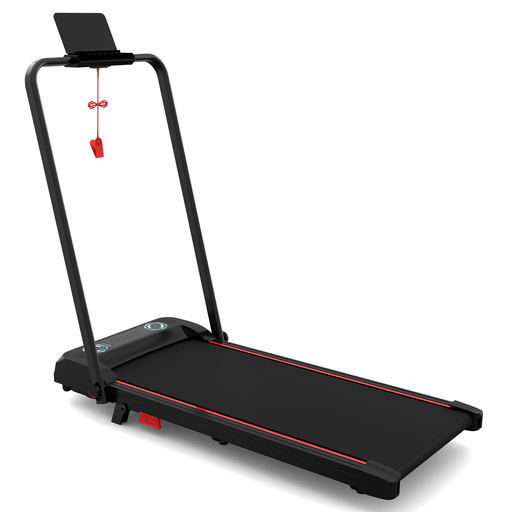
Why This Fits Their Persona: This user needs a true 2-in-1 treadmill that functions as a quiet treadmill for office use during the day and a capable jogging machine after hours. The foldable handlebar makes it a practical under desk treadmill.
It directly counters the "whisper-quiet" myth with a specified motor noise level below 45 dB. The 6% manual incline is effective and avoids the pitfall of a uselessly low gradient.
Versatile 3-in-1 design for walking, jogging and incline training. No assembly required, ready to use straight out of the box.
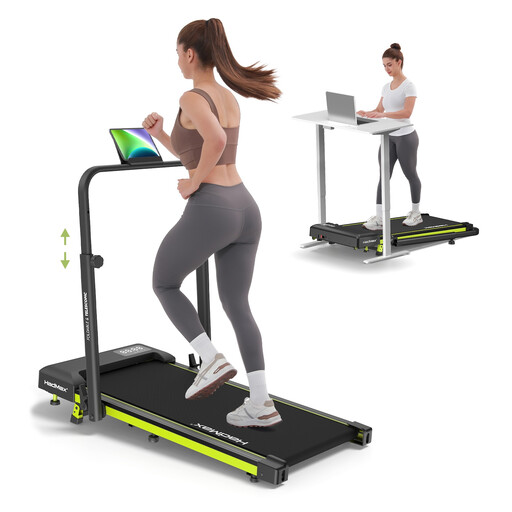
Why This Fits Their Persona: This user prioritises a challenging workout over high speed. The significant incline transforms a simple walk into a high-intensity session, perfect for achieving fitness goals in a very small footprint.
It demolishes the "ineffective incline" trap by offering a substantial 10% manual incline, providing a gym-quality hill climb. The 7-layer belt and shock absorbers also address concerns about comfort on compact machines.
High-intensity incline for maximum calorie burn. Advanced shock absorption system to protect joints during workouts.
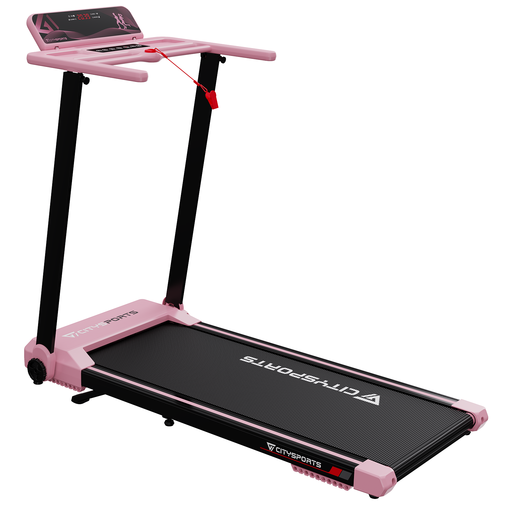
Why This Fits Their Persona: For this user, a fitness machine must be effective without creating an eyesore. This model's slim profile and colour options allow it to blend into a modern home, while its features ensure it's a capable electric walking machine.
It directly solves the "compact illusion" pitfall with an exceptionally slim folded height of just 10.2 cm, making it easy to store under most furniture. The 8% incline is also a significant, useful feature.
Ultra-slim design for superior storage convenience. A meaningful 8% incline setting to intensify workouts.
We have compiled a complete, real-time list of products that fully satisfy these strict selection criteria and UK safety regulations.
The running cost is surprisingly low. A typical compact treadmill with a 1400W (1.4kW) motor, based on an average electricity rate of 25p per kilowatt-hour (kWh), would cost approximately 35 pence per hour to run. This makes it a very cost-effective way to stay active at home compared to a gym membership.
Most folding treadmills are designed for walking and jogging. They typically offer speeds up to 10-12 km/h (around 6-7.5 mph), which is a brisk jog for most people. They are not intended for high-speed sprinting, but they are more than capable of providing an effective cardiovascular workout within their specified speed range.
This depends on the model. Many treadmills arrive pre-lubricated from the factory, but it is essential to check the user manual. It will provide a recommended schedule for checking and applying silicone-based lubricant to the underside of the running belt. Regular lubrication is the most important maintenance task to ensure a smooth, quiet operation and prolong the life of the motor and belt.