
24/7 Customer Support

Free returns

Same-day & Next-day Delivery

Quality Guaranteed

Unlock Your Welcome Offers: FREE Delivery | Up to 80% OFF | Free 30-day JoyPlus trial
Download the APP
A folding wagon trolley can make gardening, camping, beach trips and family outings considerably easier. However, a trolley that looks spacious online may be awkward to pull, difficult to store or unsuitable for uneven UK ground.
Before choosing a heavy-duty folding wagon, look beyond headline capacity and promotional wording. The frame, wheels, folded dimensions and safety features determine whether the trolley works reliably for real household use.
A stated capacity such as 120kg folding wagon or 132kg folding wagon refers to the maximum permitted load, not necessarily what feels comfortable to pull over grass, gravel or sand. A fully loaded trolley can become difficult to control, particularly on slopes or soft ground.
Check the manufacturer’s safety instructions and avoid exceeding the stated limit. Distribute heavier items across the base rather than placing all the weight at one end.
The phrase all-terrain wagon can cover very different wheel designs. Small plastic wheels may suit pavements and smooth paths but struggle on grass or loose gravel. Wider polyurethane wheels with bearings generally offer a more suitable design for outdoor surfaces, although no folding cart should be treated as suitable for every incline or terrain.
Also check whether the wheels are fixed, swivel-mounted, removable or fitted with brakes. These details affect turning, cleaning and stationary stability.
A large capacity wagon trolley may carry plenty of equipment but still fail to fit in your car boot, shed or cupboard. Always compare the folded dimensions with your available storage space.
An adjustable handle is useful for users of different heights, while cup holders and side pockets can prevent smaller items from being buried under gardening tools or camping equipment. A quick-release wheel system may also make cleaning easier after a beach visit.
Capacity is usually listed in litres, kilograms or both. Litres describe available space, while kilograms indicate the maximum permitted load. For example:
Remember that bulky items may fill the trolley before reaching its weight limit. An open tailgate can increase usable length, but it may also require careful loading and securing.
A steel or alloy steel frame provides the supporting structure, while polyester or Oxford fabric forms the carrier body. Look for reinforced seams, a stable base and fabric that can be wiped clean.
A collapsible garden trolley used for compost, tools or plants may encounter moisture and dirt. Wipe the fabric after use and store the trolley in a dry place. Do not assume that outdoor fabric is waterproof unless the product information states this clearly.
For a camping wagon, beach trolley or garden equipment cart, wheel construction is particularly important. Consider:
The trolley should be fully unfolded and locked before loading. Keep fingers away from the folding mechanism and avoid using a heavily loaded wagon on steep slopes.
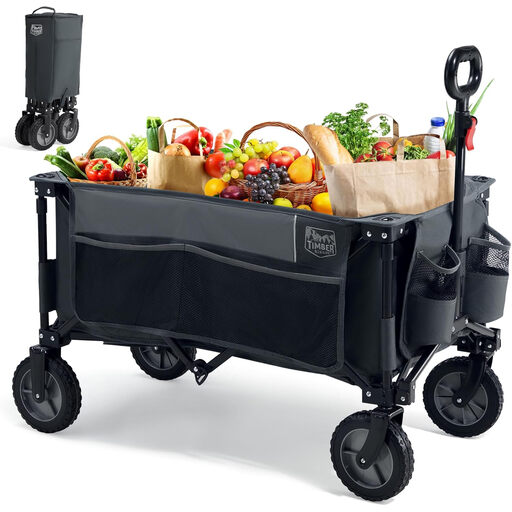
Why This Fits Their Persona: A practical choice for occasional shopping, picnics, gardening and local outdoor trips where straightforward folding and compact car storage matter.
Its one-pull open and fold mechanism avoids complicated setup, while the stated 100kg maximum load gives a clear limit instead of relying on vague “heavy-duty” wording.
200-litre capacity, adjustable handle, cup holders and zipped side storage pockets.
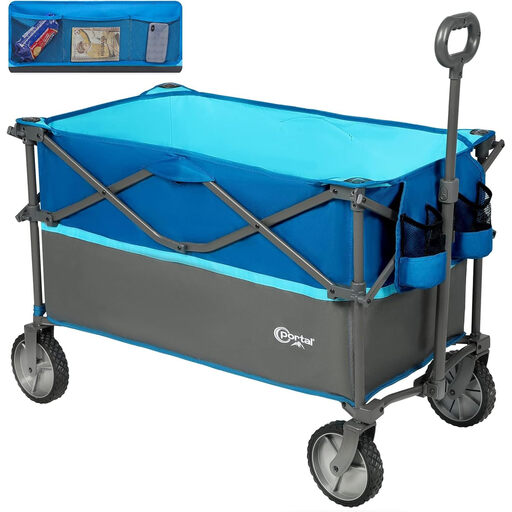
Why This Fits Their Persona: Suitable for households wanting a higher stated load rating and useful organisation for gardening, camping, sports events and beach days.
The specification states both a 228-litre capacity and a 120kg maximum load, helping shoppers compare usable space and weight rather than judging by appearance alone.
Alloy steel frame, polyester fabric, adjustable ergonomic handle, side pockets and two cup holders.
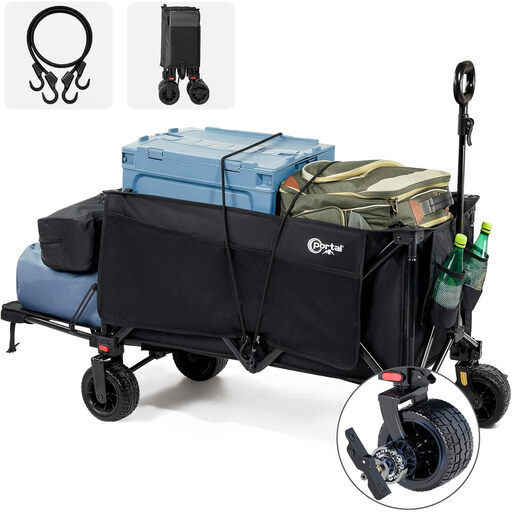
Why This Fits Their Persona: Designed for frequent hauling of bulky camping equipment, garden tools, groceries, beach gear or festival supplies across grass, gravel and other outdoor surfaces.
PU wheels with bearings, dual brakes and a stated 132kg limit address common concerns about rough surfaces, rolling control and load clarity. The brakes should be engaged whenever the trolley is stationary on an incline.
300-litre capacity with open tailgate, quick-release wheels, dual brakes, side pockets and cup holders.
We have compiled a complete, real-time list of products that fully satisfy these strict selection criteria and UK safety regulations.
Some models are more suitable for sand than others. Wider outdoor wheels can spread the load more effectively, while narrow wheels may sink. Even with an all-terrain design, pull slowly and avoid overloading the trolley on soft sand.
Lifespan depends on load frequency, storage and terrain. Regularly exceeding the maximum load, leaving fabric wet or forcing the trolley over kerbs can accelerate wear. Cleaning the wheels, checking fasteners and storing the trolley indoors or in a dry garage can help maintain it.
There is no fuel or electrical running cost. Ongoing expenses are generally limited to cleaning and, where supported by the design, replacement wheels or small hardware. A quick-release wheel system may make maintenance more convenient, but replacement parts should be checked for compatibility before purchase.