What matters when choosing?
Decide whether space for two separated speakers, a simpler streaming setup or connections for several sources will drive the purchase. A large-room label or wattage figure alone cannot settle how a system will work with your seating position and furniture.
| Concern |
What to check |
Who this matters to |
| Room coverage and stereo layout |
Measure space for two speaker positions and the main seat. If choosing passive speakers, check the exact model’s amplifier requirement. |
If I can give two speakers space around my usual seat, I want vocals and acoustic instruments to have a convincing stereo layout rather than choosing by maximum volume alone. Around 40% of consumers put room-scale stereo first. |
| Simple streaming |
Confirm the wireless control and streaming methods you use, and whether a second speaker is needed for a separated stereo pair. |
When I mainly stream music, I would rather start playback without finding room for an amplifier and speaker cable. For around 30% of consumers, that simpler setup is the primary concern. |
| Source connections |
List the devices you will connect, then check for the required turntable input, TV connection and any intended subwoofer output. |
If my turntable or TV needs to share the music system, I do not want to discover after purchase that its output has nowhere suitable to connect. Source compatibility comes first for around 30% of consumers. |
Brands to consider for these setups
These brands illustrate different system arrangements; the named models and their stated features matter more to this decision than a brand name alone.
KEF
Passive hi-fi speakers for a separately amplified stereo system, including the Q11 Meta floorstander and Q Concerto Meta standmount.
- KEF positions the Q11 Meta for larger rooms and specifies a 15–225 W amplifier requirement; its Q Concerto Meta has a stated 15–180 W requirement.
- Both need compatible amplification and space for two speaker positions. KEF’s larger-room positioning does not establish how either model will sound in your particular room.
Sonos
Powered, app-controlled wireless listening, with the Five offering a choice between one unit and a stereo pair.
- Sonos specifies Wi-Fi, AirPlay 2 and a 3.5 mm line-in for Five, and describes a stereo-pair option.
- One cabinet keeps its left and right channels physically close together; wireless control also depends on the supported software setup.
Ruark
An all-in-one system route for combining music playback and several living-room sources in one cabinet.
- Ruark specifies streaming support, HDMI ARC/eARC, an MM phono input and a subwoofer output for the R410.
- Its speakers remain within a single cabinet, so check where that cabinet can sit if you want a defined stereo listening position.
Yamaha
Receiver options for people assembling a passive-speaker system with streaming and other sources.
- Yamaha lists a phono input and subwoofer output on the R-N600A, and phono input and room-acoustic optimisation on the R-N800A.
- These receivers are not speakers: a working system also needs compatible passive speakers, cabling and room for the separate components.
Joybuy wireless speaker options
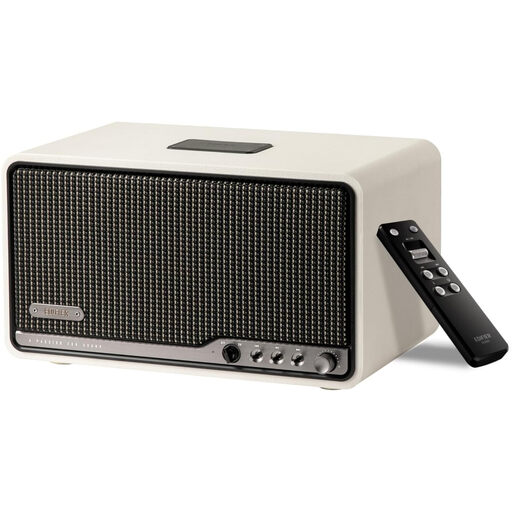
This tabletop wireless speaker fits the lower-clutter route for playing music in a living room. For a large room or a seated stereo setup, check the number of units included and the placement options before deciding whether it fits.
 No image available
EDIFIER S300 Hi-Fi wireless tabletop speaker, Ivory
A tabletop wireless option if you want to play music without assembling a separate passive-speaker system.
Check whether the package contains one unit or a pair, and whether a second unit is needed for the left and right placement you want. Confirm the connections required by your TV or turntable if either will be a source.
View on Joybuy
Common questions
Do I need an amplifier for a speaker pair in a large room?
You need a compatible amplifier or receiver if the pair is passive. KEF specifies a 15–225 W amplifier requirement for Q11 Meta and 15–180 W for Q Concerto Meta; powered speakers and all-in-one systems have amplification built in but still need mains power.
Where should I start when positioning two speakers?
Start with the manufacturer’s guidance, then adjust to suit your room and listening seat. KEF suggests beginning with speakers 1,800–2,400 mm apart and the main seat approximately the same distance from each speaker; that is a starting layout, not a required measurement for every system.
Can one music system take both a turntable and TV?
It can if its inputs match both devices. Ruark specifies an MM phono input and HDMI ARC/eARC on the R410; before connecting any turntable, check whether it supplies a phono-level or line-level signal and follow the system’s connection instructions.
What should I check when ordering a powered speaker online?
Check the seller and, when the speaker arrives, inspect its markings, manufacturer details, instructions and warnings. UK government product-safety guidance recommends checking appropriate marking and manufacturer information; those checks concern safety, not sound quality.


