
24/7 Customer Support

Free returns

Same-day & Next-day Delivery

Quality Guaranteed

Unlock Your Welcome Offers: FREE Delivery | Up to 80% OFF | Free 30-day JoyPlus trial
Download the APP
A food chopper can reduce the time spent preparing onions, herbs, vegetables, nuts and sauces, but choosing the wrong design may create more work than it removes. A compact appliance with a powerful motor may be awkward to clean, while a manual food chopper can struggle with larger batches. Some vegetable chopper sets also include several inserts that are difficult to store or safely handle.
This guide explains the practical details that matter when comparing an electric food chopper, mini food chopper, manual model or multi-function vegetable slicer and dicer. It also highlights suitable options for different UK households and cooking habits.
A higher wattage figure does not automatically mean a more suitable food chopper. Motor power needs to match the bowl size, ingredient type and intended batch size. A 300W mini food chopper may be convenient for garlic, herbs and small quantities of onions, but it is not designed to replace a full-size food processor for large meal preparation.
Check both the motor power and the usable bowl capacity. Remember that the maximum working fill may be lower than the bowl’s total volume.
Dishwasher-safe food chopper parts still require careful checking. Some products specify that only the bowl and blade can go in the dishwasher, while motor bases, lids or plastic inserts may need hand washing. Heat and strong dishwasher detergents can also affect certain plastics over time.
Look for clearly listed dishwasher-safe components, removable blades and a design that does not leave food trapped around the spindle.
A rotating blade is suitable for chopping and mincing, whereas a manual vegetable slicer and dicer may be more useful for producing slices, cubes or julienne strips. A curved mezzaluna blade is particularly suited to rocking through herbs, but it is not a direct substitute for an electric food chopper when you need to purée or process sauces.
Consider the foods you prepare most often before paying extra for attachments you may rarely use.
A glass bowl food chopper can resist odours, flavours and scratches, making it useful when preparing strongly flavoured ingredients such as garlic, chillies or marinades. Glass is heavier than plastic, so check the product’s dimensions and weight if cupboard storage or lifting is a concern.
Plastic bowls are often lighter and easier to handle. Look for food-contact information, measurement markings and a secure lid. A 350ml bowl suits small households and occasional preparation, while a larger bowl is more convenient for family meals.
Stainless steel blades are common in electric and manual models. More blades may distribute cutting action across the bowl, but results still depend on the food quantity, pulse duration and how evenly ingredients are cut before processing.
Two speed settings or a pulse function provide more control. Use shorter pulses for a coarse chop and longer operation for finer textures, while following the manufacturer’s instructions. Never run a motor beyond its stated continuous operating time.
The lid should lock securely before the blades can operate, and non-slip feet help keep the unit stable on a worktop. Blades are sharp and should be removed carefully before cleaning.
For an electric kitchen chopper, check that the voltage and plug configuration are suitable for UK use. Read the supplied safety instructions and confirm that the product includes appropriate UK compliance information, traceable manufacturer details and responsible-person information where applicable. These checks are more useful than relying on vague claims about power or performance.
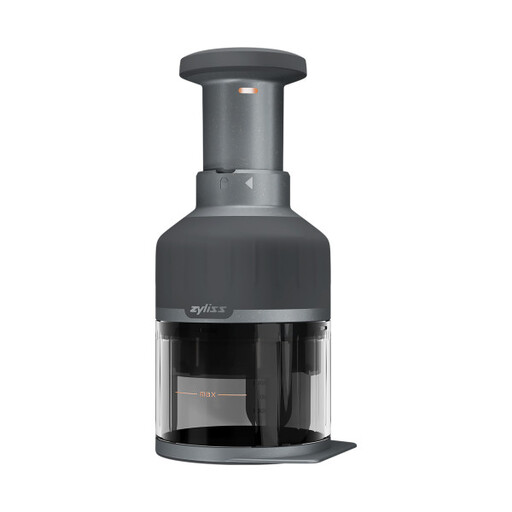
Why This Fits Their Persona: This compact manual food chopper suits renters, students and small households that want quick preparation without adding another powered appliance to the worktop.
It does not rely on motor wattage claims and uses a push-down mechanism, so there is no electrical running cost or cable to store.
Rotating stainless steel blades, a clear container and no electricity requirement.
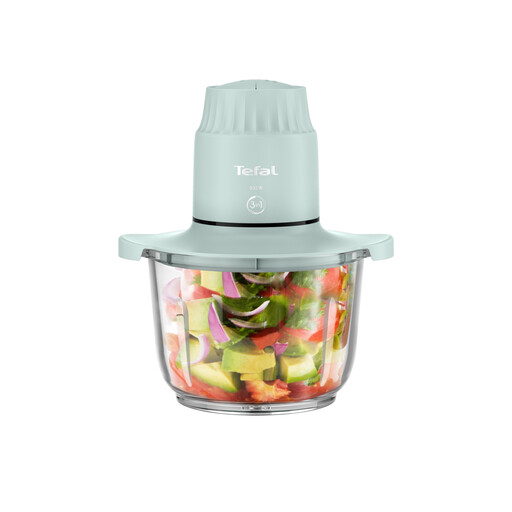
Why This Fits Their Persona: Its borosilicate glass bowl and storage lid suit cooks who value durable materials and want to transfer prepared ingredients directly to the fridge.
The listed 1L useful capacity clarifies the difference between total bowl size and realistic working volume.
500W motor, four stainless steel blades, two speeds and dishwasher-safe removable parts.

Why This Fits Their Persona: Two bowls provide flexibility for small prep and larger batches, making this suitable for families and regular meal-prep sessions.
The separate 0.6L and 2L glass bowls help avoid overfilling a single small container or mixing flavours between tasks.
300W motor, two speeds, two blade sets, glass bowls and a safety lock.

Why This Fits Their Persona: The compact 350ml bowl is practical for one or two people preparing herbs, onions, garlic, breadcrumbs, dips or sauces.
Its stated capacity and 30-second continuous-use warning make the intended small-batch operation clear.
300W motor, two speeds plus pulse, non-slip feet and dishwasher-safe bowl and blade.
We have compiled a complete, real-time list of products that fully satisfy these strict selection criteria and UK safety regulations.
Choose a manual food chopper if you prepare small quantities, want quiet operation or prefer not to use another mains-powered appliance. A push-down or rocking design can be convenient for herbs, onions and garnishes.
An electric food chopper is more suitable for repeated preparation, tougher ingredients or tasks such as mincing, blending and puréeing. However, it needs cupboard or worktop space, access to a socket and careful cleaning around the motor housing.
For slicing, grating and uniform cubes, a multi-function vegetable chopper may be more suitable than a conventional food processor chopper. Always use the supplied pusher or safety guard rather than placing fingers near exposed inserts.
A food chopper generally uses a shorter operating time and a smaller motor than a full-size food processor. Manual models use no electricity. Actual running cost for an electric model depends on its wattage, usage time and household electricity tariff, so compare the specification rather than relying on a general claim.
Lifespan depends on frequency of use, ingredients, cleaning and storage. Avoid overfilling, do not process foods beyond the stated guidance and handle blades carefully. Inspect the bowl, lid, drive connection and blade assembly regularly, replacing or discontinuing use if parts become cracked, loose or damaged.
Only if the product instructions identify them as dishwasher-safe. For models listed here, the Kenwood bowl and blade, Tefal removable parts and Bear glass bowls and blades are described as dishwasher-safe. Keep every motor base, cable and plug away from water, and allow washed parts to dry fully before assembly or storage.