
24/7 Customer Support

Free returns

Same-day & Next-day Delivery

Quality Guaranteed

Unlock Your Welcome Offers: FREE Delivery | Up to 80% OFF | Free 30-day JoyPlus trial
Download the APP
A food chopper can reduce preparation time for onions, herbs, vegetables, nuts and meat, but choosing the wrong type may leave you with a difficult-to-clean appliance, inconsistent pieces or a tool that is too small for your usual recipes.
Before buying, look beyond motor wattage and the number of advertised functions. The most useful comparison points are capacity, blade design, controls, bowl material, cleaning requirements and the type of ingredients you prepare.
A higher wattage can indicate greater motor input, but it does not automatically guarantee better results. Blade shape, bowl design and pulse control also affect how evenly ingredients are processed.
A compact mini food chopper may be suitable for garlic, herbs and small quantities of nuts, while a larger electric food chopper is more appropriate for family meals. Check the manufacturer’s stated capacity and operating instructions rather than assuming that a powerful motor can process unlimited quantities.
A bowl may be advertised as having a certain total volume, but the usable fill level can be lower. Overfilling may lead to uneven chopping, spillage and unnecessary strain on the motor.
For one-person cooking or sauces, a 350ml bowl may be practical. Families and meal-prep users may prefer a food processor with a bowl of around 1.8 litres or more. Always follow the maximum fill mark, particularly when processing liquids or ingredients that expand.
A food chopper with several attachments can be useful, but only if the parts are straightforward to remove and wash. Narrow gaps around blades and discs can trap food residue, while permanently attached components can make cleaning inconvenient.
Look for detachable parts and confirm whether the bowl, blade assembly and discs are dishwasher-safe. Even dishwasher-safe components still require careful handling because stainless steel blades and grating discs remain sharp during washing and removal.
Match the bowl size to your normal batch size:
If you want to process raw meat, check that the product description specifically lists mincing or meat-grinding use. A vegetable chopper may not be designed for this task, even if its blades appear robust.
A single rotating blade can handle basic chopping, while stacked or multi-level blades may distribute ingredients more evenly around a larger bowl. A manual food chopper uses physical pressure or a rocking movement, making it independent of mains electricity but generally less suitable for large batches.
For electric models, two speeds and a pulse setting provide more control. Short pulses can help you achieve a coarse chop without immediately turning soft ingredients into a purée. Follow any stated operating limits; some models specify a maximum continuous running time of 30 seconds per cycle.
Plastic bowls are usually light and easy to store. Glass bowls can resist odours and scratches, although they are heavier and should be handled carefully. Stainless steel bowls are also durable and practical for ingredients such as meat, vegetables and cooked foods.
A dishwasher-safe food chopper can reduce washing-up, but check exactly which parts are suitable for the dishwasher. The motor base, plug and power cord must not be immersed in water.
For broader preparation, consider whether you need a vegetable slicer, dicer and grater attachments, or a multi-functional food processor that can also blend and purée.
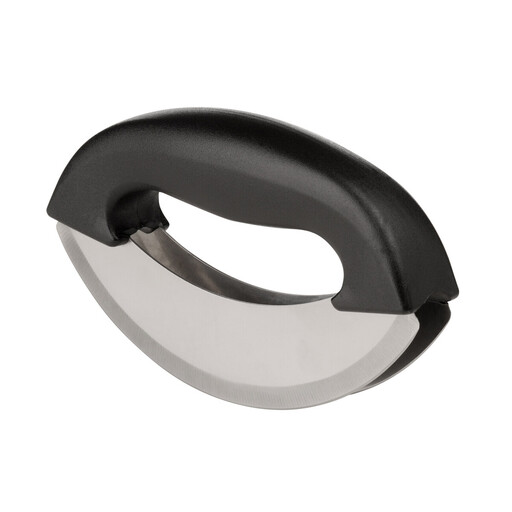
Why This Fits Their Persona: This manual food chopper suits occasional cooks, renters and shoppers who want a compact preparation tool without an electrical motor or mains cable.
It does not rely on exaggerated motor claims. The rocking action is visibly simple, making it easier to judge whether it suits your preparation needs.
Double stainless steel blades, a comfortable handle and dishwasher-safe cleaning make it suitable for herbs and small chopping tasks.
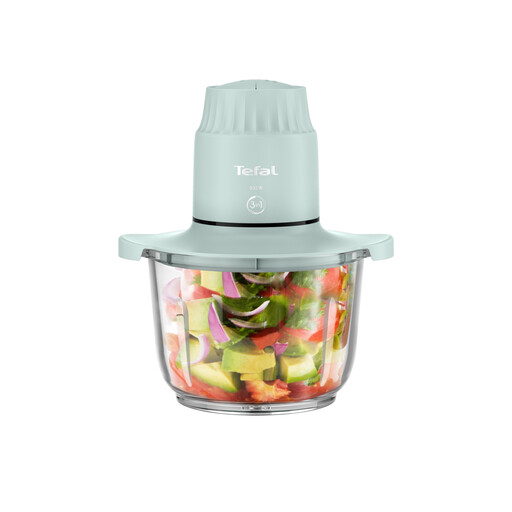
Why This Fits Their Persona: A glass bowl, storage lid and removable components may appeal to households that value durable-feeling materials and convenient food storage.
The listing distinguishes the 2-litre bowl from its 1-litre useful capacity, helping buyers plan portions more realistically.
It has a 500W motor, four-blade stainless steel assembly, two speeds and dishwasher-safe removable parts.
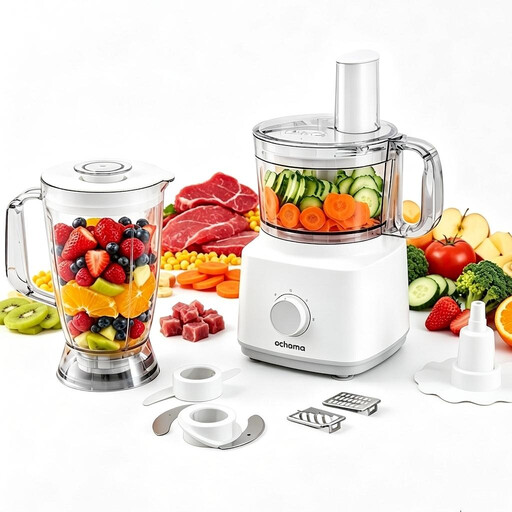
Why This Fits Their Persona: Families and meal-prep households can use its larger bowl and multiple functions for chopping, slicing, shredding, grating and puréeing.
Its stated 1.8-litre capacity and 750W motor are presented alongside specific functions, rather than wattage alone.
It combines food processor and blender functions, with detachable parts designed for easier cleaning.

Why This Fits Their Persona: The compact bowl is suited to one- or two-person kitchens where cupboard space and small portions matter more than batch capacity.
The clearly stated 350ml capacity helps prevent buying a large appliance for tasks that only require small batches.
It offers two speeds plus pulse control, a stainless steel blade and a dishwasher-safe bowl and blade.
We have compiled a complete, real-time list of products that fully satisfy these strict selection criteria and UK safety regulations.
It can be useful if you regularly prepare onions, herbs, sauces, breadcrumbs or chopped vegetables. A mini food chopper is convenient for small portions, while a larger electric food chopper or food processor is more suitable for batch cooking. If you only chop a small amount of herbs occasionally, a manual model may provide sufficient functionality.
Some models are specifically listed as a meat grinder or meat chopper and include suitable bowls or blade systems. Do not assume that every kitchen chopper can process raw meat. Check the product description, capacity guidance and operating instructions before use, and clean all food-contact parts thoroughly afterwards.
Running cost depends on the appliance’s wattage and how long it operates. Most chopping tasks use short bursts rather than extended cycles, so the operating time is usually brief. A 300W mini chopper generally draws less power during operation than a 750W multi-functional food processor, but the practical difference also depends on batch size and frequency of use.