Home cooks making recipe-card prints
If you mainly print small food photographs for recipe cards, displays or proofs, a postcard-format printer may cover your needs without taking up space for A4 output.


A compact postcard printer suits food-photo proofs and recipe cards when you do not need A4 output. For recurring larger prints, consider a refillable A4 photo printer; a multifunction model can also handle scanning and copying, but needs more desk space.
If you mainly print small food photographs for recipe cards, displays or proofs, a postcard-format printer may cover your needs without taking up space for A4 output.
If menus, recipe sheets or portfolio images call for larger prints, look at borderless A4 capability and how the printer handles repeated photo work.
If food photographs share a desk with documents and recipes, check whether the exact photo printer also provides the scanning, copying and paper handling you need.
Choose it when: Small recipe-card prints or quick proofs are your main output.
Accept the limit: Canon lists the SELPHY CP1500’s formats from postcard size down to mini stickers, not A4.
Choose it when: You regularly need larger borderless food photographs, with scan and copy functions if the model includes them.
Accept the trade-off: An A4 multifunction unit takes more workspace than a compact postcard printer; manufacturer photo-yield figures depend on their stated conditions.
| Concern | What to check | Who this matters to |
|---|---|---|
| Finished print size | Check the largest supported photo size and whether your chosen paper permits borderless printing. | If I am making recipe cards or small proofs, I would rather choose for that finished size than make room for A4. Around 33% of consumers put small-format output first. |
| Colour and finish | Check the exact ink system and compatible photo-paper finishes; try a representative image on the intended paper. | When colour transitions and the finish of a food image matter most to me, I want to assess the print itself before a larger run. Around 45% of consumers prioritise colour and finish. |
| Repeated printing and office tasks | Check the basis of stated photo yields and whether the model provides the scanning, copying or document handling you need. | If I regularly print food images alongside paperwork, interruptions and the need for another device matter more to me than a small footprint. Around 22% of consumers place this mixed workflow first. |
Canon lists the SELPHY CP1500’s output from postcard size, 100 × 148 mm, down to mini stickers. It will not cover an A4 menu or portfolio layout.
Decide on your largest finished food photograph before choosing the printer format.
Canon states up to 3,800 4 × 6-inch photos from one bottle set for the PIXMA G650; Epson states up to 2,300 high-quality photos with the EcoTank ET-8500’s included bottles. The figures describe different models and conditions, not an equivalent cost per print.
Use each maker’s figure to plan for that model, then check the correct replacement supplies against your intended print sizes and frequency.
A resolution figure does not tell you which ink system or paper finish suits the food photographs you intend to display. Epson’s photography guide distinguishes the intended uses of dye and pigment inks.
Check compatible photo paper and settings, and make a test print of a representative image before a larger job.
GOV.UK advises checking appropriate product marking and the manufacturer’s name and address when buying consumer products. Marking arrangements can differ between Great Britain and Northern Ireland.
Check the seller, instructions, marking appropriate to your market and route to manufacturer support before purchasing.
Canon offers two relevant but different formats: compact SELPHY postcard printers and PIXMA MegaTank A4 photo multifunction printers.
Epson’s EcoTank ET-8500 is relevant when A4 food photographs share a printer with home-office documents.
HP’s Sprocket range is a reference point for casual, small-format prints rather than A4 home-office photo work.
These choices address different food-photo print sizes: consider the Epson model if you are assessing a larger-format desk printer, or the Polaroid model for 4 × 6-inch prints. Check each model’s supported media and functions against your home-office tasks.
 No image available
Consider this model if you are planning recurring, larger food-photo prints. Confirm its supported photo sizes and paper finishes, and check its scanning and copying functions if you also need to handle paperwork.
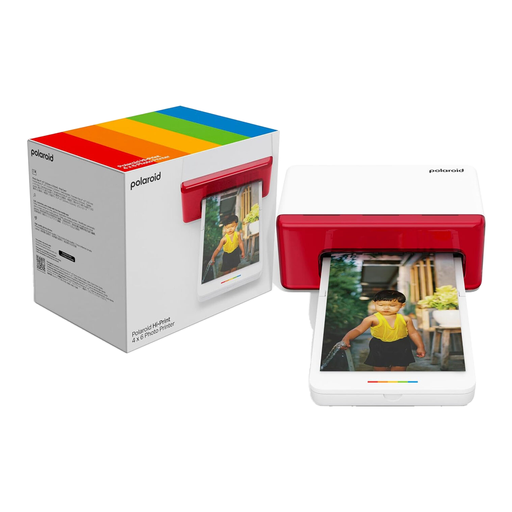 No image available
Consider it for small food photographs such as recipe-card prints rather than A4 layouts. Its stated print format is 4 × 6 inches and the product name specifies Bluetooth; check device compatibility and the dedicated paper cartridge before buying.
Yes, if you mainly need postcard-size proofs, recipe cards or small displays. Canon lists the SELPHY CP1500’s formats from 100 × 148 mm postcards down to mini stickers; choose an A4-capable model if your intended menus or portfolio prints are larger.
Choose by the finish and use you want, not the ink name alone. Epson’s UK photography guide describes dye inks as suited to vibrant, glossy everyday photos and pigment inks as relevant to archival or fine-art work; the exact printer, paper, image and settings still matter.
It is worth considering when food-photo printing is frequent enough for ink replenishment to be an important part of your workflow. Assess the stated yield and replacement supplies for the exact model and print size rather than treating different manufacturers’ photo-yield figures as equivalent.
Yes, if the chosen model has the document functions you need. Canon specifies printing, scanning and copying for the PIXMA G650; Epson also specifies those functions, along with duplex printing and multiple paper feeds, for the ET-8500. Check functions on the exact model before purchase.
Check appropriate product marking, instructions and the manufacturer’s name and address, as GOV.UK advises for consumer products. Great Britain and Northern Ireland can have different marking arrangements, so confirm what applies where you will use the printer rather than relying on a single UK-wide marking assumption.